Legacy field note reviewed · 2025-11-11 · upgraded 2026-06-03
QTT and the Bullet Cluster: Substrate Lensing, Renewal Dust, and the Open Test

The tested cluster-lensing branch failed its H1 holdout
The MACS J0025 and El Gordo H1 record is a retained out-of-sample failure. It blocks the tested lensing branch from being presented as a demonstrated replacement for cluster dark matter. It does not, by itself, erase every renewal or acceleration-knee construction outside that tested branch.
Current decision: Keep the earlier mechanism and in-sample Abell 2744 row as historical construction and qualification records. A successor must be frozen before new data, reproduce the H1 failure cases, and then pass an independent cluster-lensing holdout without source retuning.
Reader map · Renewal and lensing
Maps for this note
Connect dark-matter, galaxy-knee, cluster-lensing, and a0(z) notes to the live renewal map. Book pages and DOI records stay in the separate citation card.
Book and DOI anchor
Current category: Lensing, empirical tests, and audits
Book pages: p. 97, p. 212, p. 515, p. 517, p. 1255
DOI anchors:
10.5281/zenodo.20071244
10.5281/zenodo.20091011
10.5281/zenodo.20095338
Read the 1262-page book · Book DOI · DOI map
The Bullet Cluster separates hot gas, galaxies, and lensing mass. QTT answers that geometry with a structural claim: the lensing source is not just visible surface density, but baryonic density plus substrate corrections, plus a closure-fixed Renewal Dust residual. The honest status is sharper than before: the sign mechanism is clear, while the final map-level closure remains an open substrate-counting test.
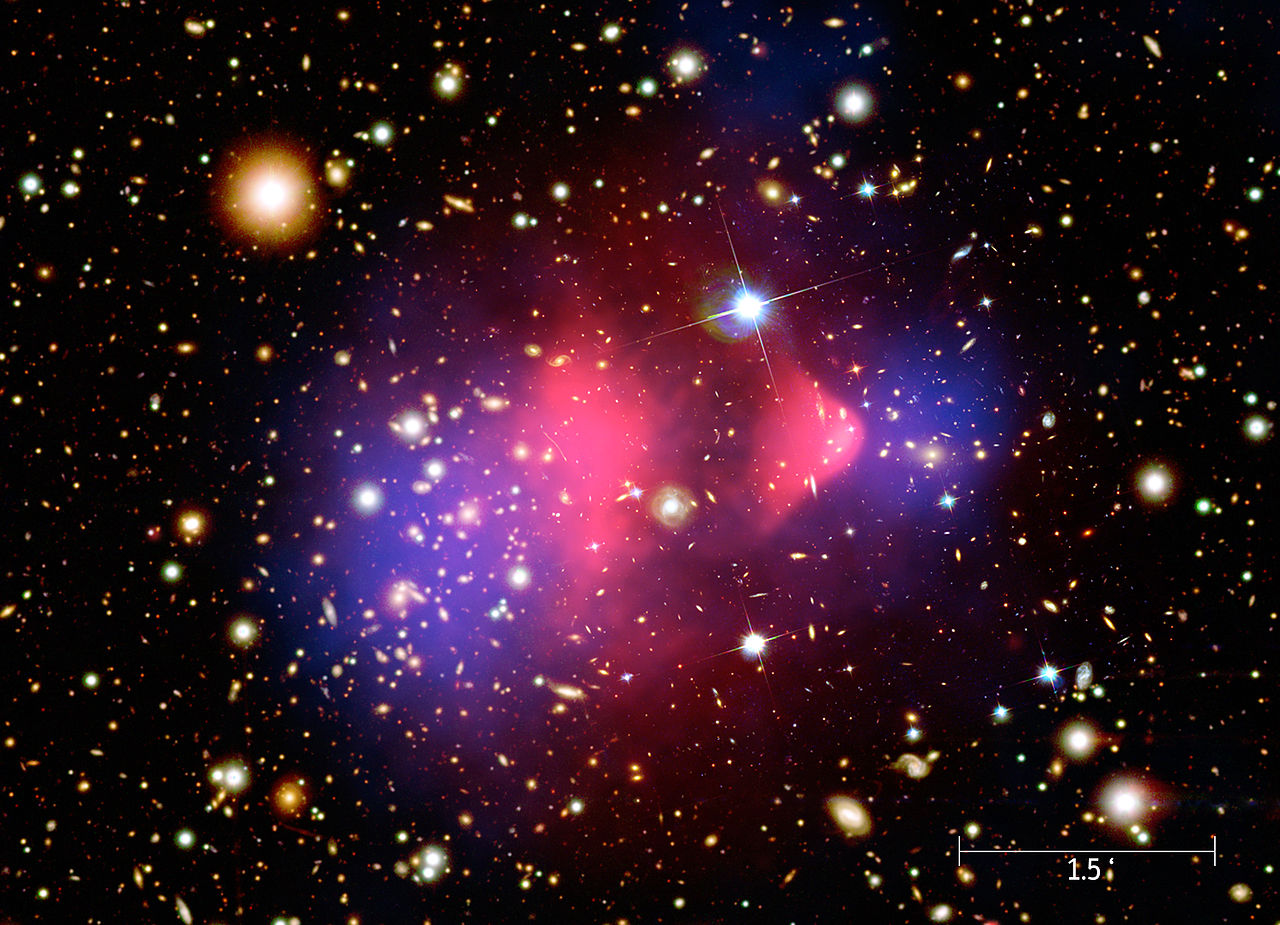
Observed problem
What the Bullet Cluster actually separates.
The plasma is slowed by ram pressure.
Most ordinary baryonic mass in the cluster system is hot X-ray gas. During the collision, this gas shocks and lags behind the galaxy components.
The stars mostly pass through.
Compact galaxy distributions behave effectively collisionlessly on merger timescales. Their projected profiles are much sharper than the shocked gas ridge.
The convergence peaks follow the galaxy side.
The hard sign test is not whether lensing exists. It is whether the dominant convergence can move away from the dominant X-ray gas and toward the collisionless galaxy swarms.
Useful anchors: the system is at z = 0.296; the gas-bullet offset is about 25 arcsec, roughly 110 kpc using the QTT audit plate scale; and Σcrit = 6.47 kg m^-2 in the current Clowe-map comparison convention.
QTT answer
The source term has substrate structure.
The clean QTT claim is not that the Bullet Cluster can be explained by ordinary Newtonian baryons alone. It is that the weak-lensing source contains baryonic substrate corrections that standard baryon-only gravity and no-hidden-mass MOND do not carry.
That distinction matters. QTT still has a dustlike residual, Renewal Dust, but the Bullet sign rule is not supposed to be won by placing an adjustable invisible halo around the galaxies. It is supposed to come first from the baryonic substrate terms: cusp occupancy boosts galaxy-side convergence, while shocked gas can receive a creation/renewal subtraction.
May 2026 audit
The update: stronger math, more careful claim.
The occupancy coefficient is fixed.
The corpus audit forces Z_occ = 1/(16π). No extra 24-lock multiplier survives the log-Laplacian, and no hidden normalization should be inserted by hand.
The shock map is severely suppressed.
The energy-counting check collapses to κ_C = -ℓ_tilde F_RH^los/(c³Σcrit), which is Planck-ruler suppressed. It cannot be treated as a large free gas-side correction.
Fallback profiles overproduce κ_occ.
Using the fixed prefactor, a simplified profile model gives |κ_occ| around 10^4 to 10^5 at 5 to 10 arcsec smoothing, far above observed κ around 0.1 to 0.4. That is not a final closure; it is a serious full-map test.
Best current wording: QTT has a structural mechanism that can put the Bullet sign on the galaxy side, but the absolute normalization and full observed map must be closed against real stellar-light and Chandra gas maps. The post should not claim a completed numerical proof until that is done.
Renewal Dust
RD is the cosmological residual, not a tunable Bullet halo.
Renewal Dust behaves as pressureless dust in the Einstein-shadow description and has no direct Standard-Model interaction term in the QTT ledger. That makes direct-detection null results natural inside the framework, but it does not by itself prove the Bullet geometry.
Its cleanest role here is closure discipline: QTT ties the cosmological residual to the matter budget rather than fitting a separate particle abundance for this cluster.
Framework comparison
Why this is not just CDM renamed.
ΛCDM
Wins the Bullet sign directly: collisionless dark matter follows the galaxies. QTT’s critique is not that this fails observationally, but that the abundance, Λ, and a0 remain independent dark-sector inputs.
No-hidden-mass MOND
Faces the sign problem because the dominant baryonic mass is shocked gas. Without an extra lensing source, the convergence wants to sit where the gas sits.
QTT
Adds substrate terms to the baryonic source and a closure-fixed RD residual. The price is a hard one: the same equations must match the absolute Bullet convergence map, not merely the qualitative peak side.
Claim discipline
What is safe to claim now.
Structural sign route
QTT has a specific equation-level route for pushing lensing toward galaxy cusps and away from shocked gas.
Map-level closure
The actual stellar luminosity map and deconvolved gas map must replace fallback profiles before claiming numerical closure.
Absolute overproduction
The fixed occupancy coefficient can make the correction far too large unless the full map, smoothing, and source decomposition resolve it.
Not rhetoric-proof
A clean Bullet-style merger with the required profile class but robust gas-centered convergence would cut against the peak theorem.
Falsifiers
How the Bullet claim can fail.
Direct RD coupling
A reproducible non-gravitational Standard-Model coupling for the component carrying the RD mass budget breaks L_int,RD = 0.
Bullet sign failure
A high-quality Mach > 2 Bullet-style system with cuspy stellar profiles but gas-centered lensing at high significance would falsify the peak route.
Absolute κ mismatch
If κ_occ/κ_N remains orders of magnitude too large after real-map projection and smoothing, the current coefficient cannot be the final physical lensing map.
Closure failure
A failure of the ABC/WV closure, baryon invariant, or QTT derivation of G would undermine the RD clock anchor used here.
Sources
DOI trail for the technical claims.
Renewal Dust paper
QTT Bullet conditional peak theorem, RD closure residual, and lensing-source decomposition.
Main QTT framework
Axioms, world-cell substrate, weak-field source language, and QTT reconstruction context.
G derivation
Artian-G theorem connecting G to the QTT micro-ruler and angular-capacity normalization.
Bullet observation
Clowe et al. weak-lensing observation of 1E 0657-558, the empirical target for the sign test.
Where this field note sits in the QTT Main Book (v10.01)
Use these page anchors to read the surrounding derivation in the current book version. The stable book DOI is 10.5281/zenodo.17527179.
-
p. 535
Renewal dust as dark sector
the non-particle missing-mass mechanism -
pp. 1209-1211
Renewal dust in the FRW shadow
how the same density enters cosmology -
p. 1253
Thin-lens compact equation
the companion equation used by lensing notes -
pp. 515-535
Substrate-curvature lensing
cluster-lensing morphology and curvature source structure
For DOI/version reconstruction, use the QTT DOI Map.
Find this note in the QTT Blog Map
The Blog Map organizes every field note by reading route and links each post back to the citable papers, book record, and DOI Map.
Citable sources for this field note
Concept DOI is the citation target. The latest version under the concept family speaks. The full live index is the QTT DOI Map.
Artian Geometry & Quantum Traction Theory
Main book record and ontology map; the stable citation anchor for the whole corpus.
Concept DOI: 10.5281/zenodo.17527179
Renewal Dust and Cluster Lensing
Renewal Dust and substrate lensing corrections for Bullet Cluster style empirical tests.
Concept DOI: 10.5281/zenodo.20071244
Abell 2744 Shape-Locked Validation
Shape-locked Abell 2744 validation across independent lensing reconstructions.
Concept DOI: 10.5281/zenodo.20091011
MACS J0025 and El Gordo Negative Lensing Audit
Negative out-of-sample lensing audit for MACS J0025 and El Gordo.
Concept DOI: 10.5281/zenodo.20095338