Legacy field note reviewed · 2025-11-27 · upgraded 2026-06-03
Deriving E = mc² Without Relativity: The QTT Endurance Ledger
Reader map · Gravity and inertia
Maps for this note
Move from the note into endurance current, Newtonian shadows, and finite deviations. Book pages and DOI records stay in the separate citation card.
Book and DOI anchor
Current category: Gravity, endurance, inertia, and energy accounting
Book pages: p. 26, p. 50, p. 89, p. 199, p. 206
DOI anchors:
10.5281/zenodo.20042843
10.5281/zenodo.20057430
10.5281/zenodo.20059779
Reference – Quantum Traction Theory: 10.5281/zenodo.17527179
Einstein’s famous equation 
the same relation drops out of a purely non‑relativistic, Planck‑scale endurance ledger.
No Lorentz group. No postulate about the speed of light being the same for all inertial observers. Just:
- a minimal space quantum,
- a minimal time tick,
- a minimal four‑volume cell, and
- the way those cells feed the endurance current that we perceive as gravity.
This post walks through that ledger and shows where the genuinely new step lives.
1. How E = mc² is usually derived (very briefly)
In standard physics, the mass–energy relation is tied to special relativity. You take:
- the relativistic energy–momentum relation
- look at the case
(particle at rest),
- and you read off the rest energy


All of this leans heavily on Lorentz symmetry and the structure of Minkowski spacetime. In that story, 
QTT, instead, starts somewhere very different.
2. QTT’s micro-geometry: space quanta and four-cells
QTT says: space isn’t smooth, it’s built from tiny “pixelletes”—space quanta (SQs). The key quantities are:
- A minimal 3D space quantum:
with
the Planck length.
- A microscopic length
that sets a four-dimensional cell:
- A microscopic tick
the time it takes light to cross that cell along the hidden reality direction in QTT’s time plane.

Think of 
3. Minimal energy bundle: E★ from the four-cell
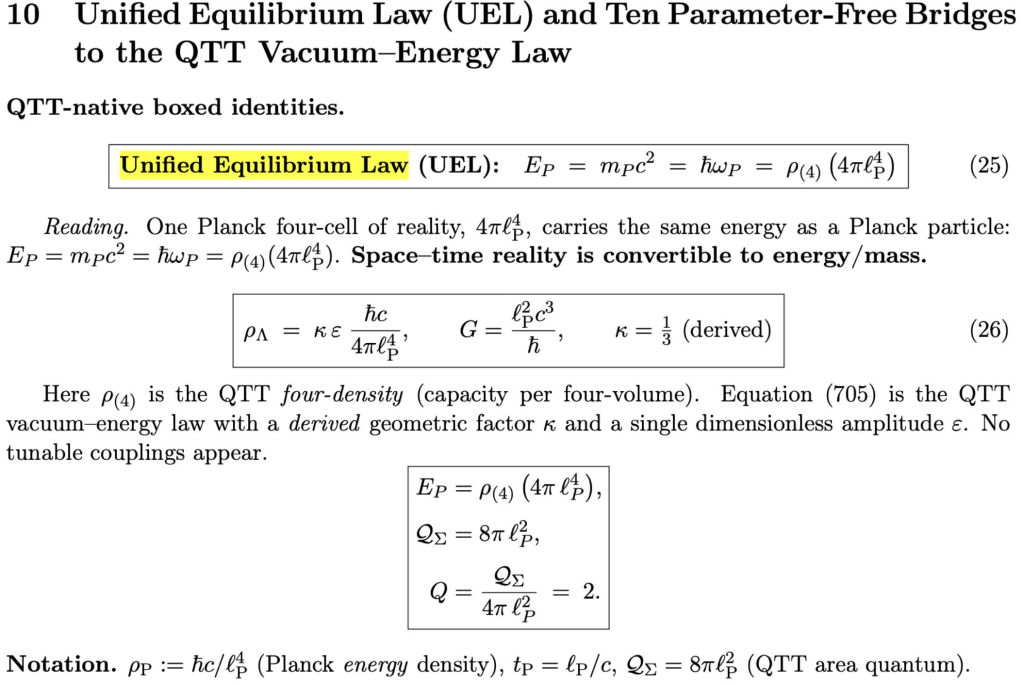
QTT’s Unified Equilibrium Law (UEL) assigns a minimal energy to a four‑volume cell of thickness t̃. By a Planck‑scale uncertainty argument, the smallest energy that can sit coherently on a cell of temporal extent t̃ is of order

Using 

This is the QTT energy quantum: the energy carried by a single endurance four‑cell of size 
is fixed by the cell size
.
- No relativity assumptions are used; we just used the minimal time thickness t̃ and the usual
scaling.
4. Minimal mass bundle: m★ from endurance gravity
On the gravity side, QTT derives Newton’s constant G from the endurance current instead of inserting it by hand. The key relation (from the sink equations plus the definition of the endurance current) is

This is already non‑standard: G is not an independent parameter, but a derived combination of 
Now, QTT introduces a minimal bundle mass 
- one endurance cell of size
- many bundles stack to make up an ordinary mass
.
We choose

Why this choice? Because it synchronises the mass ledger with the same micro‑length
- the energy quantum
, and
- the gravitational coupling
.
With this definition, a single endurance bundle is “the amount of mass that fits into one four‑cell at the QTT equilibrium scale”.
5. The genuinely new step: E★ = m★c² from a single length scale
Now look at the two QTT primitives side by side:
- Minimal energy:
- Minimal mass:


Eliminate


This is the heart of the QTT result:
- The same micro‑length
The new piece is that these are defined independently in QTT, but consistency of the endurance ledger forces
the energy of a single endurance bundle to equal its mass times 
No Lorentz transformations, no relativistic kinematics. The relation
6. From one bundle to any mass: E = mc² as a counting rule
Now take an ordinary mass m. In QTT it is literally a count of bundles:

for some integer or large rational N (depending on how you coarse grain). The total endurance energy stored in those bundles is

E_rest = mc² (QTT, non‑relativistic, bundle counting).
So for QTT:
- inertial mass m = number of endurance bundles,
- gravitational mass = the same count appearing in the endurance sink law for G,
- rest energy = that same count times
All three are locked together by the same micro‑length
7. Where this differs from “just redefining m and E”
You might ask: “Is this just a cute re‑definition? Couldn’t I always define 
The difference in QTT is that:
.
- Those two sides do not know about each other a priori: one is about capacity of a four‑cell, the other about the strength of the endurance sink that reproduces Newton–Poisson.

The new statement is:
In QTT, the same microscopic length
.
That’s what turns
8. Why I even I tried to do this?
At the everyday level, QTT doesn’t change the fact that a kilogram of mass has a rest energy of 
What changes is the ontology:
- Mass is no longer a primitive. It’s a count of endurance bundles.
- Energy is the time‑thickness cost of those bundles in the four‑cell ledger.
- Gravity is the endurance current those bundles draw from the space‑quanta field.
All three are linked by the single microscopic length
That’s the new message: a non‑relativistic, Planck‑scale derivation of
Where this field note sits in the QTT Main Book (v10.01)
Use these page anchors to read the surrounding derivation in the current book version. The stable book DOI is 10.5281/zenodo.17527179.
-
pp. 159-166
A2 Law of Endurance
sink-count capacity consumption before any smooth metric is read -
pp. 198-216
Endurance current, G, and gravity
G_A=ell_tilde^2 c^3/hbar and the Newton-Poisson current -
pp. 425-427
Action rail and metric shadow
how source action and access projection prepare the IR field readout -
pp. 638-644
Einstein-field continuum shadow
the laboratory field equation as an infrared projection, not a source primitive
For DOI/version reconstruction, use the QTT DOI Map.
Find this note in the QTT Blog Map
The Blog Map organizes every field note by reading route and links each post back to the citable papers, book record, and DOI Map.
Citable sources for this field note
Concept DOI is the citation target. The latest version under the concept family speaks. The full live index is the QTT DOI Map.
Artian Geometry & Quantum Traction Theory
Main book record and ontology map; the stable citation anchor for the whole corpus.
Concept DOI: 10.5281/zenodo.17527179
Artian A2 Endurance to Einstein-Field Dynamics
A2 endurance-to-Einstein-field theorem: sink counts close the Newton-Poisson current, proper-time metric shadow, infrared Einstein equation, and first finite-address correction map. Cite the concept DOI for the source-to-IR bridge; the latest concept-family version speaks.
Concept DOI: 10.5281/zenodo.20763263
Newton's Constant Is Not Primitive in QTT
Newton's constant current record: the six-face Artian G ledger, including the photon-edge/Fermi face and the dimensional-ruler guardrail. Cite the concept DOI for G as derived rather than primitive.
Concept DOI: 10.5281/zenodo.20057430
Einstein-Hilbert Coefficient from an Endurance Ledger
The endurance-ledger derivation of the Einstein-Hilbert coefficient used by gravity and curvature notes.
Concept DOI: 10.5281/zenodo.20042843