Quantum Traction Theory Field Notes
The universe humans invented
(and forgot they did)
An inventory of the smooth stage: why modern physics keeps patching the continuum, and why a finite substrate changes the question before it changes the answer.
Istarted the book with a turtle and ended with it. Not as a joke. As an anchor.
The oldest critique of “turtles all the way down” was always aimed at the wrong audience. It was supposed to be a problem for cosmologists, but it is actually the diagnosis of modern theoretical physics in one image. You stand a tower on a tower, you stand that one on a smooth plane that no one ever defines, and you call it foundations.
The turtle in the opening pages of QTT is there because I needed to admit, on page one, that everything I had been taught to take as foundational was sitting on something nobody could point to.
It is something more uncomfortable: an inventory of how much of “the universe” — the one in our textbooks, the one in our seminars, the one handed to undergraduates as if it were settled — is actually a human invention dressed up as a settled discovery and a fixed postulate. And how the two pillars of twentieth-century physics, general relativity and quantum mechanics, are deeply guilty of the same trick. Different costumes, same theatre.
What you notice the first time you read QFT honestly
If you sit with quantum field theory long enough — actually sit with it, not consume it as a series of plug-and-chug exercises — one fact lands and never leaves.
The whole theatre is running on a smooth stage that is not quantized.
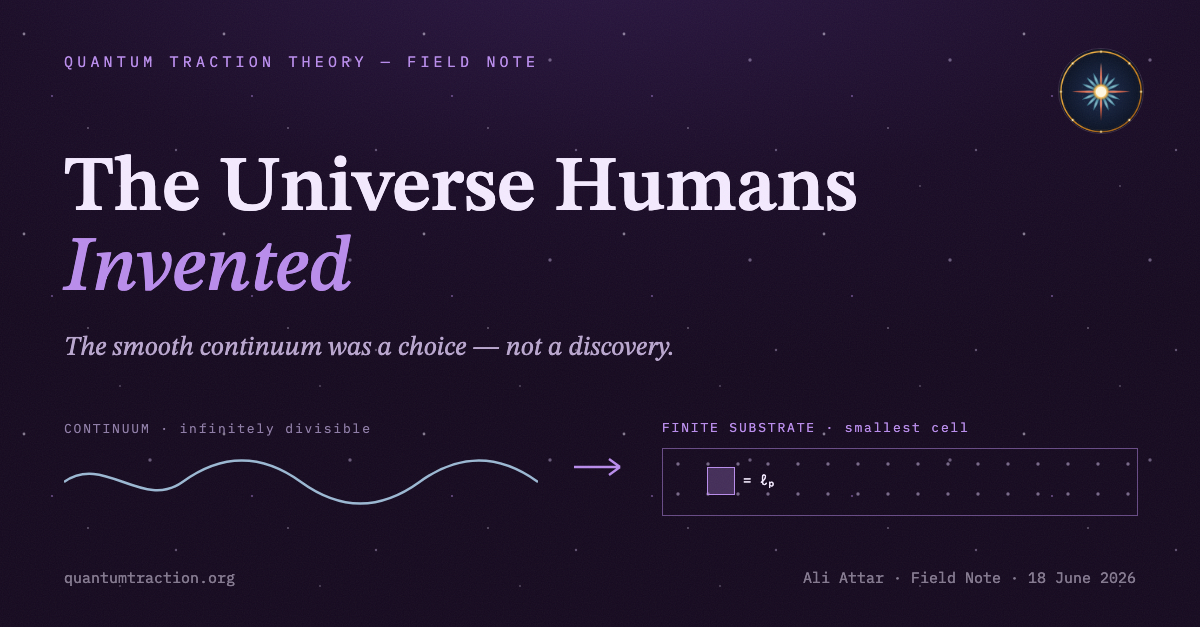
Every field is a function. Every function lives on a manifold. Every manifold is, by construction, infinitely divisible. The Lagrangian is an integral; the integral is over a continuum; the continuum has no shortest length, no smallest cell, no finite anything.
The mathematical scaffolding insists, at every line, that between any two points there are uncountably many points, and between any two of those there are uncountably many more.
Then somebody mentions the Planck length, and a strange thing happens. You expect it to do work. You expect the equations to know about it. You expect 

It does not. The Planck length is a decoration. It is a fact about the constants — you can build a length out of 

A memory I want to keep visible
I want to warmly remember Professor Alden Mead, who worked hard to show that we were missing something so small and so large and hidden in plain sight: a real lower limit to length, and got rejected for years by the scientific community. The history of science is full of this kind of delayed listening, especially from the people that believe their current language has already found the bottom and there nothing else to discover.
And then, when smoothness produces the infinities everyone knew it would produce — because of course it would, once the universe has been written as a continuum and called our best theory of all time — the answer is renormalization. Which, to be clear, is brilliant as calculational machinery. But as an explanation of the stage itself, it is another treacherous duct-tape.
The group structure works, the running couplings land, the universality classes match. That is the dangerous part. The most dangerous false theory is the one that carries ninety-nine percent truth and works somehow, most of the time. Those are what I call Profound Lie Theories: PLTs. They are recipes for getting lost for good, because they turn a real foundational debt into beautiful bookkeeping.
A polite IOU says: the divergences are not really there; we will absorb them into parameters we could not compute anyway; please stop asking about the stage. That is not an explanation. It works because nobody comes to collect. Until, occasionally, somebody does.
Landau, who came to collect
Landau came to collect.
QED — the most successful, most beautifully precise Profound Lie Theory humans have ever invented — has, sitting at its high-energy end, the Landau pole: the coupling diverges at a finite scale generated by the theory itself.
The usual answer is correct as far as it goes: QED is an effective theory. But notice what sits underneath that answer. We declared the smooth-space framework universal, wrote a theory inside it, watched the theory say “I break down here,” and treated the breakdown as a property of the theory rather than as a property of the framework. We did not ask whether smooth space itself was the problem.
That is the move I cannot accept. If a framework consistently produces theories that report their own breakdown, the main suspect is not only the theories. It is the framework.
The cosmological constant: the worst prediction in physics
If Landau was a polite knock at the door, the cosmological constant is somebody kicking it down.
Write a quantum field theory on smooth space. Ask it the most elementary question imaginable: what is the energy of the vacuum? Depending on where you cut off the integral, it returns a number wrong by 60, 80, even 120 orders of magnitude. You can argue about the exponent. You cannot argue about a miss so large it has its own Wikipedia category.
Steven Weinberg called it the worst theoretical prediction in physics. He was right. What is striking is that the field has, by and large, made peace with it: anthropic shrugs, multiverse hand-waves, and “we will figure it out” deferred to the next generation. Sixty years of deference to PLTs.
But a 
Dirac, who kept his hands off the dials
A courage I want to keep visible
I have been hard on the founders of modern physics, so let me be fair where fairness is owed and name the man who did it right.
When Paul Dirac wrote his equation for the electron in 1928, it was radical to the point of being unwelcome. It was also miraculous: it handed back the electron's spin and magnetic moment for free, out of relativity and consistency. But it carried something nobody wanted: solutions with negative energy.
The best minds of the period were openly uncomfortable. The negative-energy states looked like a disease in an otherwise perfect equation, and the safe, respectable move was obvious: add a term, impose a cutoff, declare the solutions unphysical by hand, and move on. Salvage the equation, and your reputation, by bolting on whatever it took to make the theory agree with the invented universe everyone already knew how to inhabit.
Dirac refused. He did the Newtonian thing instead: he assumed the equation knew something he did not, and he listened to it. He treated the negative-energy solutions as a statement by nature rather than an embarrassment to be papered over. By 1931 he had followed them toward the anti-electron: a particle identical to the electron in mass and opposite in charge. A year later, in 1932, Carl Anderson found precisely that particle sitting in the cosmic-ray tracks of his cloud chamber.
Counterfactual
Had Dirac reached for a knob to kill the negative-energy solutions, Anderson's discovery could have arrived as a bare anomaly, with no theory waiting to receive it. Experimental physics would then have been invited to invent yet another patch for what nature had already said plainly. That is too much of today's story in modern physics.
And that is the whole argument of this essay compressed into a single decision. The Profound Lie Theory move is to protect the equation from nature by adding a parameter. Dirac's move was the exact opposite: to protect nature's verdict from the equation's own caretaker, even when the verdict sounded absurd, the community was not ready to hear it, and nature had not yet given the visible receipt. He did not tune antimatter into existence to match a measurement. And he did not kill it to save his reputation and his derived equation. He kept his hands off the dials, let the equation speak or fail cleanly, and antimatter turned out to be there. That is what listening to nature in the Newtonian way actually costs, and what it can buy.
Historical irony
Antimatter fell out of an equation that refused to be patched to survive. Dark matter was invented to patch an equation that should have died on its first high-sigma miss.
It is the standard I am holding the smooth-continuum framework to, sixty years of deferred IOUs later. It is also the reason I would rather publish a theory that can be killed tomorrow than one that has been tuned never to be.
The two human-built cathedrals, equally guilty
Now I want to be fair, which means I have to be sharp.
General relativity and quantum mechanics get treated, in popular culture and in much departmental culture, as if they were two unrelated triumphs that simply happen to disagree at the seams. They are not. They are two facades of the same building, and both sets of founders — yes, including the names on the wall — are guilty of inventing the universe they then claimed to discover.
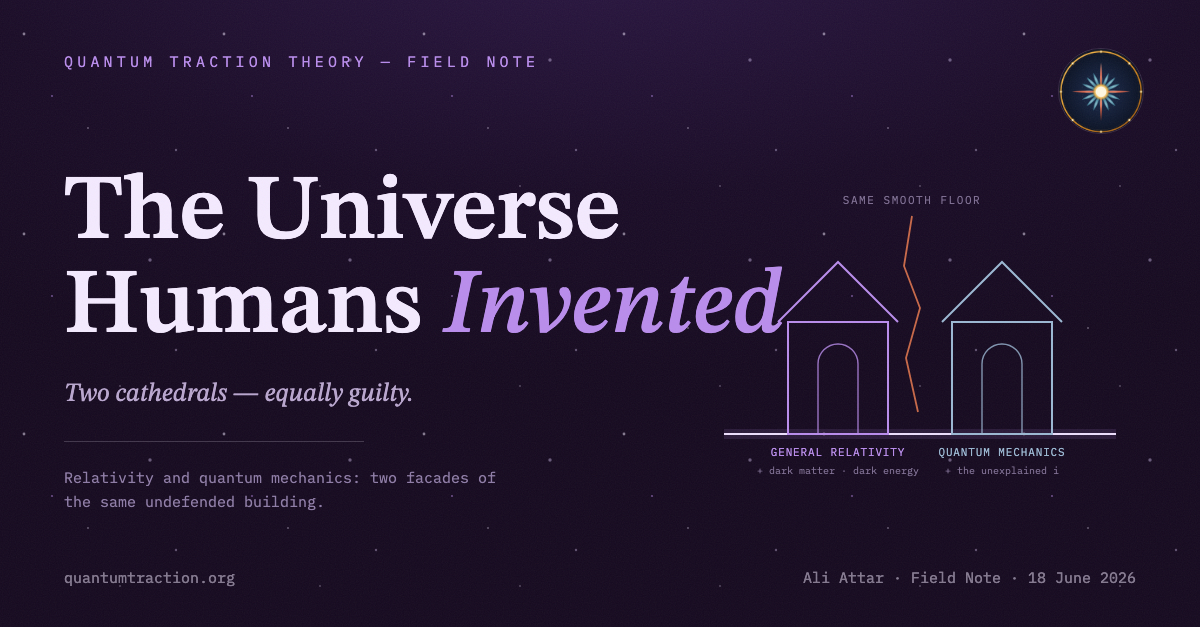
On the GR side: Einstein gave us geometry. Geometry is deceptively beautiful. The equations are seductively pretty, and the predictions are correct to many decimals wherever the regime is clean. But the equations were also, from day one, written on a smooth manifold whose existence was assumed and never derived.
When galaxies refused to rotate the way the geometry said they should, and when supernovae refused to decelerate the way the geometry said they should, the community did not first suspect the manifold. It added invisible matter and invisible energy until the geometry's accounts balanced. You see something moving faster than it should, and rather than questioning the line of thought handed to you, you invent a dark sector you cannot directly observe at the source, measure at the source, or explain at the source, and you call the account settled. That day has consumed decades of energy from generations of scientists, because the equation was too sacred to question.
Here is the honest version: GR is the best phenomenological account of large-scale gravitational shadows ever produced, and the standard cosmological model needs an unseen dark-matter component plus a dark-energy component to fit the universe. Dark matter is about five times the visible baryonic matter; the full dark sector dominates the energy budget. Those patches are still, in 2026, unexplained at the source.
On the QM side, the indictment is sharper: the decision to use the i and never ask what it reported was one of the worst foundational moves I have seen in any field. I do not say that lightly.
The imaginary unit i is not an abstract mathematical curiosity in quantum mechanics; it is load-bearing. The Schrödinger equation has an i out front. Phases run through it. Interference depends on it. And the answer to why — to what physical fact about the world the i is reporting — was essentially that the math works. Born gave the squared modulus as a probability rule. Von Neumann gave projection as a postulate. Bohr told us not to ask too much. The later culture compressed that posture into “shut up and calculate.” The imaginary unit became protected machinery everybody used and nobody explained; anyone who calls it a knob risks their standing — the oldest pattern in science, the one Alden Mead lived through.
Meanwhile, the space on which all of this happens — the same smooth manifold I have been complaining about — was inherited from classical physics without renegotiation. The wave function lives on smooth space, or in a Hilbert space built over it. It diffuses, interferes, collapses, and propagates on something with no finite cells, no smallest distance, no finite anything. The most non-classical theory ever invented runs on the most classical stage that was ever painted.
And measurement — the part where the wave function “collapses” — was treated as outside the theory. Not derived, not modeled, not embedded in the dynamics. Just declared. Decoherence helps; einselection helps. Neither closes the gap by itself. Both still need a smooth substrate to live on.
So the two cathedrals stand side by side: one papering over its incompleteness with invisible matter and energy, the other papering over its incompleteness with measurement-as-magic and an unexplained i. Both inherit the continuum — quantum field theory most of all — and run on the same smooth-space assumption neither side ever defended. Both were presented to students as foundational rather than provisional.
This is the universe humans invented.
What you start to see when you stop assuming it
The moment you give up the smooth substrate as a primitive — not as an emergent approximation, but as a fundamental object — a lot of things stop being mysteries.
If the substrate is finite, with a smallest cell and a finite capacity per cell, the Planck length stops being a decoration and starts being the size of the cell. It does the work it was always supposed to do.
If the substrate is finite, the vacuum energy is not a divergent integral that needs renormalizing. It is a finite count that needs computing. The
If the substrate is finite, the imaginary unit is not magic. It is a phase on a counting structure: a rotation between addresses on a finite ledger. The Schrödinger equation is not invoking a mysterious i; it is recording a phase that comes from how the substrate keeps its books. Once you see it that way, i stops being unexplained machinery and becomes a laboratory image of a real dial.
If the substrate is finite, measurement is not magic either. There is nothing mystical to collapse because there was never a fundamental smooth continuum of possibilities to begin with. There is an address structure, an access operation, and a finite readout. The Born rule is a theorem about how access works on the ledger, not a postulate appended to it.
If the substrate is finite, dark matter and dark energy stop being free mysteries and start being readings of what the ledger is doing. Galactic rotation becomes a source-kernel problem. Late-time acceleration becomes creation tilting the time plane. They are derivations in the corpus, anchored to pages, audits, and falsifiers.
What I am pointing to here is the shape of the argument: an enormous fraction of what the standard story leaves dark and unexplained becomes computable the moment you stop assuming the continuum is fundamental. The cost of refusing to ask the question is cultural as well as technical. It blocks the route toward the underlying physics we needed, and it shames the people who question the PLTs before the community is ready to hear them. That is a culture science should outgrow.
The turtle, again
I started the book with a turtle because the turtle is not embarrassing. Standing on the turtle and pretending it is the floor is embarrassing. The honest move is to admit that something has to be at the bottom and ask what it is. The dishonest move is to keep insisting that smooth space is bottom enough.
QTT's answer — finite substrate, finite capacity, address ledger, projection access — is one answer. There may be others. What I am sure of is that the answer is not: the smooth manifold is fundamental, please stop asking. That answer has been tried for a hundred years, and it has produced two indispensable theories, renormalization-adjacent triumphs, a
That is the universe humans invented. It works astonishingly well inside its regime, for the same reason any well-fit phenomenology works well inside its regime: it has been tuned to match what we see, over a century, with some of the smartest people in the world doing the tuning.
But “fits the data well” and “is the right object” are not the same sentence. And the day we admit that out loud is the day the next physics begins.
— Ali
Corpus route
The book that started with the turtle is Quantum Traction Theory, Main Book v10.01. The papers closing the gates one by one include the Strong-Coupling Form Theorem, the Photon-Edge Gate, the Creation Ledger, the Renewal Ledger, and the Lagrangian/Hamiltonian frameworks. The dated provenance route lives in the 2019 YouTube Map and the Legacy Terminology Map.
Three nearby doors into the same problem
Where this essay attaches to the corpus
QTT Main Book v10.01
Stable book DOI: 10.5281/zenodo.17527179
Anchors: pp. 2-4, turtle/Planck-length problem; pp. 44-55, axiom foundation and source ontology; p. 99, patching habit; pp. 1175 and 1261-1262, vacuum capacity and the final turtle answer.