Quantum Traction Theory · Cosmology
The Three Faces of Time
How QTT converts the universe’s master clock into the clock we read in the lab — through three structurally different effects that are easy to confuse.
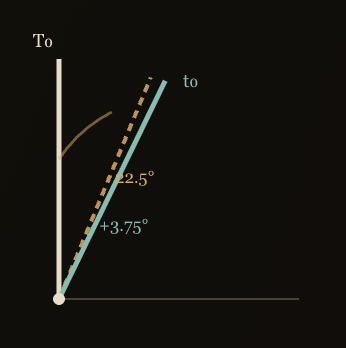
t0 = T0 · cos(7π/48) = 15.40 Gyr × cos(26.25°) = 13.81 Gyr
The combined lean splits cleanly: 7π/48 = π/8 (Tilt, 22.5°) + π/48 (Drift, 3.75°). Time Dilation acts separately, on top, per observer.
✓ Matches the measured cosmic age (Planck 13.797 ± 0.023 Gyr, ~0.65σ) — with zero fitted parameters.
Scientific cut
The general clock ledger is dtmeas = Iclk Fdrift Ndil dT. The age-map picture above is the declared homogeneous projection convention t0 = T0 cos(θtilt + θdrift). Those are compatible readings, but they should not be silently merged into one fitted multiplier.
Tilt is fixed. Drift must be derived from the creation ledger. Dilation is the already-tested SR/GR local clock row. None of the three changes the null cone or renormalizes c.
The two QTT-native faces — Tilt and Drift — are about the universe’s master clock: universal, the same for everyone, and independent of your motion. Dilation is the familiar relativistic effect: local, personal, and observer-dependent. Tilt is frozen; Drift grows with cosmic history; Dilation varies with your own situation. The same projection idea also predicts the Hubble-tension ordering and a ~3% old-star-vs-Cepheid gap — a falsifier decided by JWST / SH0ES within ~5 years.
Source: Time Drift from the Law of Creation · doi.org/10.5281/zenodo.20042612 · quantumtraction.org
Related routes
Field note
Past is past, gone is gone
The Arrow-of-Time companion: sealed past, quantized Now, and the one-way ledger reading.
Field note
The Two Second Laws
How thermodynamic entropy and QTT source-time monotonicity separate and then meet in the same counting ledger.
Field note
The Turtle: Observer of the Light
Observer, light, handshake, and why time readout is an access question rather than only a speed-limit story.
Concept DOI
Time Drift from the Law of Creation
The source paper for the 15.40 Gyr absolute age, the 13.81 Gyr lab projection, and the drift rail.
Concept DOI
ABC/WV Closure Theorem
The single-clock closure behind the cosmological-constant, galaxy-knee, and Hubble-ladder readings.
Concept DOI
Triple-Anchor ABC Closure
The 15.40 Gyr absolute-background-clock calibration and its ABC/WV consequences.
Book pages and map anchors
Current QTT Main Book v10.01, concept DOI 10.5281/zenodo.17527179. Relevant reading: two-clock/ABC construction around p.169, cosmology and clock projection around the ABC/WV closure chapters, and time/arrow ledger sections near the current time-framework chapters.
The fundamental cut
Time Tilt is a fixed property of the clock-map itself. Time Drift and Time Dilation are sourced corrections sitting on top of it — each generated by something actually happening.
Tilt is structural / kinematic. It is the projection, not an effect inside the projection. Tilt is the fixed angle, cos(π/8), of the map that carries the absolute clock T0 onto the lab clock τ. It says: the lab clock is a tilted projection of the master clock. That is a fact about the architecture of time in QTT — the A1 two-clock split — not a thing that happens in time. It is uncaused. Nothing sources it. It is identical at the first instant and the last, in a crowded universe or a perfectly empty one. It carries zero information about any event, any motion, or any history. It is the shape of the lens.
Drift and Dilation are dynamical. Each is a response to a real source, riding on top of the base projection. This is why the paper writes the map as the fixed projection cos(π/8) plus a creation correction π/48, with dilation as a further per-system factor.
Drift
Drift is sourced by A3, the Law of Creation. It exists because the ledger keeps minting new addresses, and it accumulates with cosmic history. It is the map slowly bending because the universe is still being made.
Dilation
Dilation is sourced by motion and gravity: a system’s energy-state. It is the map bending locally because of how a particular thing is moving or where it sits in a gravitational well.
Tilt is the light passing straight through the lens. Drift and Dilation are two different things that bend that light — one cosmological, one local. The cleanest test of the distinction is: can you turn it off?
Dilation goes to zero for an observer at rest with no gravitational gradient. It is contingent on a state.
Drift goes to zero in the no-creation / frozen-homogeneous limit; it is a correction tied to the A3 source channel and behaves differently in different regimes. It is contingent on a process.
Tilt can never be zero. cos(π/8) is baked into the very existence of two clocks. To remove the tilt, one would have to abolish the A1 two-clock structure itself: the distinction between absolute and lab time. It is irremovable.
So the axiom map is the giveaway: Tilt traces to A1, the existence and geometry of the dual clock, while Drift traces to A3, a creation process, and Dilation traces to relativistic dynamics: motion, energy, and gravity. Tilt is the only one of the three that is not about anything happening. It is about how time is built.
In one line: Tilt is the map. Drift and Dilation are weather on the map — and the same constant cos(π/8) that sets the Tilt shows up far from cosmology, including inside the neutrino ratio, precisely because it is a structural constant of the substrate, not a cosmological effect at all.
Once the nonzero source vector (0, 1, ρ) is supplied, Δm231 / Δm221 = ρ2 follows exactly. The audit closes a necessary correction: common completed-bundle and A1 factors cancel, so they cannot by themselves supply a relative ρ.
A finite asymmetric branch pair and a finite certificate for the five-fold neutral completion remain amber gates. The frozen JUNO target remains a separate observational test of the conditional line.
Read the A1 neutral-branch audit · 10.5281/zenodo.21721466Citable sources for this field note
Concept DOI is the citation target. The latest version under the concept family speaks. The full live index is the QTT DOI Map.
Artian Geometry & Quantum Traction Theory
Main book record and ontology map; the stable citation anchor for the whole corpus.
Concept DOI: 10.5281/zenodo.17527179
A parameter-free derivation of the neutrino mass-squared ratio Δm²₃₁/Δm²₂₁ = 4π² cos²(π/8) in Quantum Traction Theory
Citable QTT source used by this field note.
Concept DOI: 10.5281/zenodo.19960813
Artian Lorentz Compliance and Radiative-Stability Audit: A1, the Absolute Background Clock, the exact Collins response, and SME closure in Quantum Traction Theory
Citable QTT source used by this field note.
Concept DOI: 10.5281/zenodo.21138337
The Artian Keystone Audit
Citable QTT source used by this field note.
Concept DOI: 10.5281/zenodo.21141060