Quantum Traction Theory · Field Note
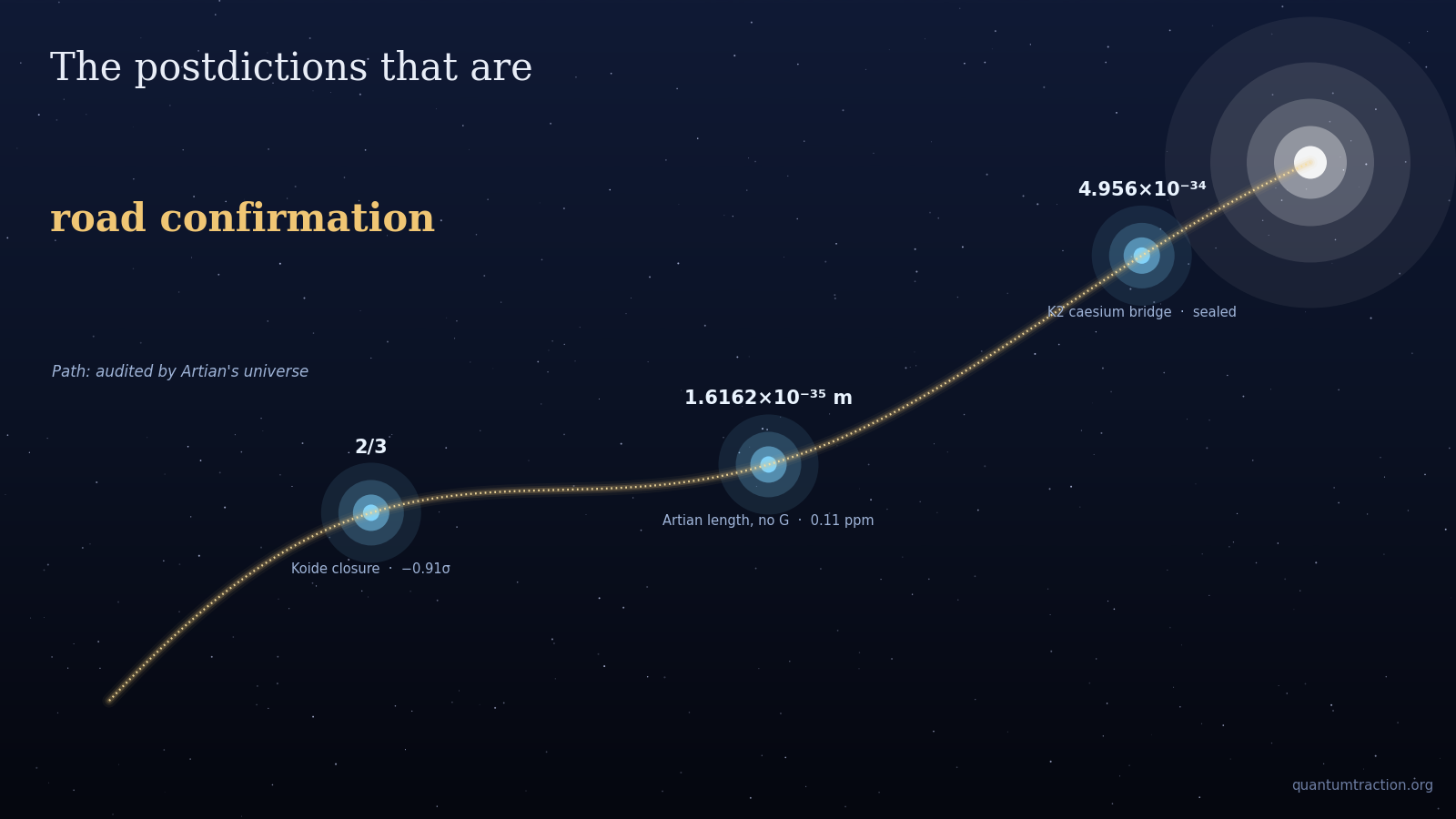
The postdictions that are road confirmation
lighthouses of universe
Working alone is hard. Working alone without feedback is harder.
I have tried, more than once, to get a single arXiv endorsement. All of those tries failed. I don't say this with bitterness — the endorsement system exists for a reason, and I understand what an inbox full of "I have a theory" emails looks like. But I will say it honestly: the lack of academic credentials turned out to be a bigger barrier than I ever expected. There is no seminar room for me. No colleague down the hall who says "wait, check line four." No reviewer number two. When you work this way, you lose the most valuable thing academia quietly provides: someone qualified telling you, regularly, whether you are fooling yourself.
So who checks the work?
The only referee left is the universe itself. And the universe does not applaud. It does not send acceptance letters. It confirms in exactly one currency: numbers. You freeze your axioms, you turn the crank, a number comes out — and either it matches what the experiments have already measured, or it does not. That's the whole conversation.
Here is the uncomfortable part. When a number comes out right and the measurement already existed, the outside world has a word for it: postdiction. And a harsher word behind that one: numerology. I know this so well that when I wrote a paper deriving the Planck length from the weak sector — no gravity anywhere in the construction — I spent nearly half the paper defending why it is not another crackpot coincidence. Half a physics paper, spent not on physics, but on proving I am not fooling myself. That is the tax you pay when no institution vouches for you. You pay it in rigor, in frozen constructor alphabets, in published falsifiers, in verification scripts anyone can run in under a minute.
But from where I stand — from inside the road — these landings don't feel like postdictions. They feel like checkpoints. Let me show you three of them, in the order they happened, and you can judge for yourself.
Checkpoint 1: the electron family already knew
Years into the framework, one of its axioms — a simple rule about how capacity is shared equally between two internal directions — forced a statement about the three charged leptons. Not about their individual masses. About their shape as a family:
%5E%7B2%7D%7D%20%5C%3B%3D%5C%3B%20%5Cfrac%7B2%7D%7B3%7D%5C%3B%7D&bg=10182c&fg=e7eefc&s=2&c=20201002)
Plug in the measured masses of the electron, the muon, and the tau:
%5C%3B%7D&bg=10182c&fg=e7eefc&s=2&c=20201002)
Less than one standard deviation. The remarkable thing, to me, is not the closeness. It is that in this derivation the electroweak energy scale cancels out completely. The axiom says nothing about how heavy the leptons are — only about the geometry of their family. And the geometry was right.
From the outside: the Koide relation has been known since 1981, so this is a postdiction. From the inside: an axiom written for entirely different reasons walked up to a forty-year-old mystery and handed over the correct coefficient. That was the first time the road said: keep going.
Checkpoint 2: the Planck length, with gravity locked out of the room
The Planck length is supposed to belong to gravity. Its very definition uses Newton's constant: 
The construction uses one measured input (the Fermi constant, which has nothing to do with gravity) and one frozen geometric object — the attenuation between the weak scale and the framework's capacity endpoint:
%5C%3B%7D&bg=10182c&fg=e7eefc&s=2&c=20201002)
No adjustable numbers. Two circles and a tilted clock. Run the arithmetic and out comes a length:

Compare it — only afterward — to the value gravity gives through 

Here is the detail that convinced me it wasn't a trick of my own hands. The largest piece of that exponent, the bare 
Checkpoint 3: the one that shook me
This is the new one, and I am still absorbing it.
Under the modern SI system, the metre is defined through the speed of light and one atomic frequency: the caesium clock, 

And when you factorize that number through the framework's already-frozen objects, this is what falls out:

Look at the two sides of that equation slowly, because it is the most shocking line I have ever written down.
The left side is the electroweak–Planck hierarchy — the famous, agonized-over question of why gravity is 
The right side is atomic physics. The fine-structure constant squared. The electron's mass. And a caesium hyperfine packet — the kind of quantity a spectroscopist in 1945 would recognize: how strongly the outer electron of a caesium atom feels the spin of its own nucleus.

Gravity's legendary smallness, the equation says, was never a gravitational mystery. It is bookkeeping — 

Why I call these road confirmations
I understand completely why, from the outside, each of these looks like a postdiction. The Koide ratio was measured before I derived it. The Planck length was known before I constructed it. The caesium frequency is literally a definition. Fair. All fair.
But here is what the outside view cannot see, and what I live with every day: the axioms came first, and they were frozen. The same &bg=0b1020&fg=e7eefc&s=0&c=20201002)

That is the difference between a postdiction and a road. A postdiction is a single backward glance. A road is when the same frozen objects keep arriving at measured reality, sector after sector, in places they were never built to visit — and every arrival is audited, and every failure condition is published in advance, and nothing has been retuned. I cannot get a seminar room. But I can get this: the universe, checking the work, one number at a time.
Maybe I am wrong. It is possible — the falsifiers are public, the kill conditions are printed, and the verification scripts run on anyone's laptop in under a minute. If the road ends, it will end in the open, and the error will stay visible in the record, because that is the rule I set for myself on day one.
But if you are out there working alone — no endorsement, no credentials, no reviewer number two — I want to tell you the one thing I know now that I did not know at the start: applause is not the only form of confirmation. Freeze your claims. Publish your falsifiers. Let the numbers referee. The universe reads every submission, and it has never once cared about an affiliation.
— Ali Attar, Quantum Traction Theory Project
 from PDG masses. The length:
  ppm against the CODATA- ruler, with
  . The K2 bridge: sealed target, blind protocol, derivation pending — and honestly labelled so.
Source anchors
Book pages
Current QTT Main Book v10.01, stable book concept DOI 10.5281/zenodo.17527179. Relevant anchors: scorecard and status discipline around pp. 126-128; source/readout/no-smuggling around pp. 9-22; A5-X/A6/A7 source-capacity rails around pp. 250-268; Koide/access and electron micro-rail around pp. 1037-1103 and 1192-1198.