Elephant in the room of the Standard Model
The Standard Model has a secret it does not print on the poster: nineteen empirical numbers, ten of them sitting in the quark drawer.
It contains nineteen numbers that nobody can explain.
Not “hard to explain” — unexplained by construction.
We measure them, type them in, and the machinery runs beautifully.
Ten of those numbers live in one drawer alone: six quark masses and four mixing parameters.
Why is the top quark roughly 75,000 times heavier than the up quark? Why does quark mixing have exactly this pattern?
The honest textbook answer is: because that is what the detectors said.
For years I have been working on a strange question: what would it take for those ten numbers to be outputs instead of inputs?
Here is what that looks like when it works, in numbers anyone can check on a calculator.
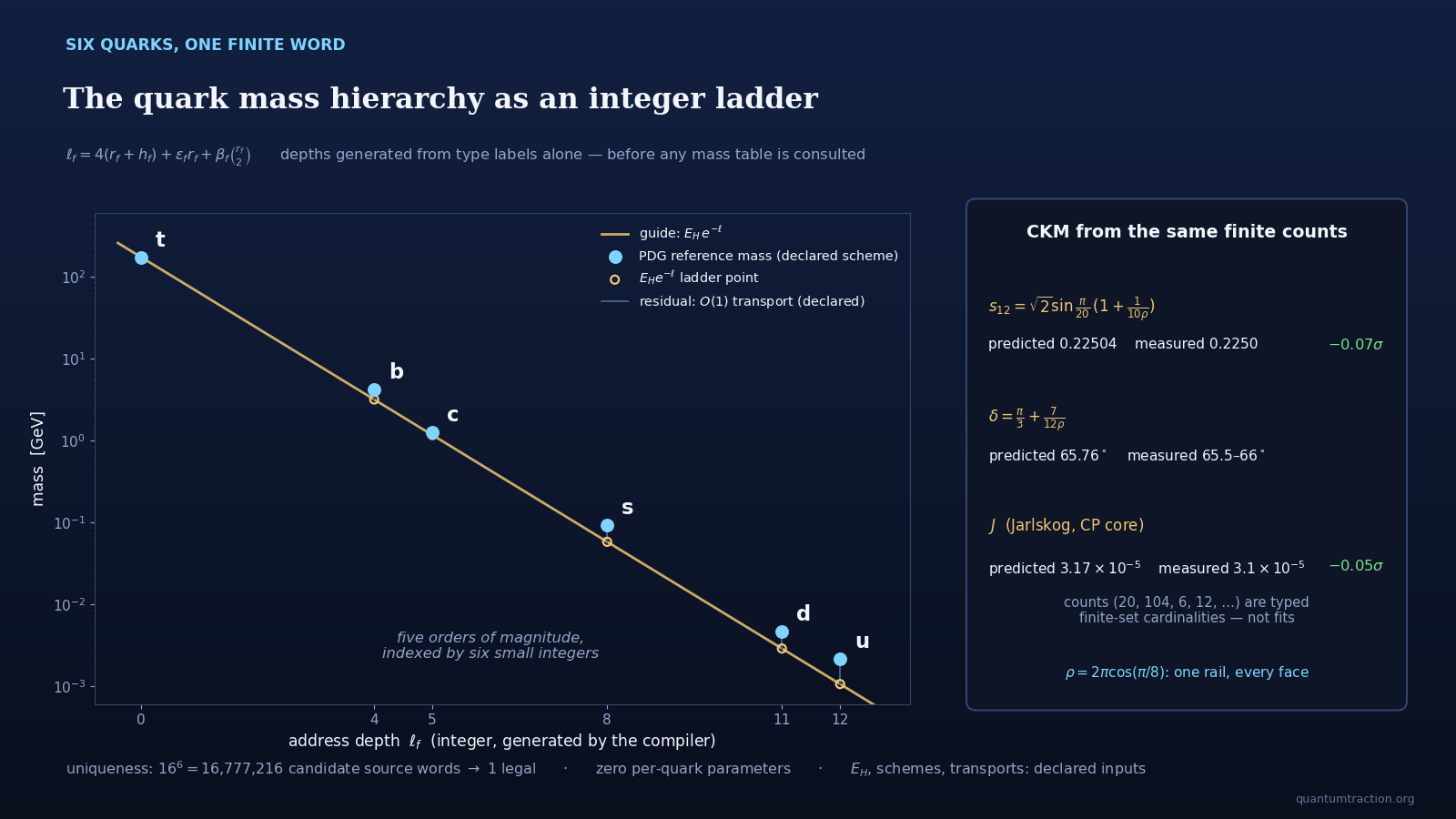
One typed rule declares what kind of particle each quark is, nothing about its mass. The compiler then generates six integer depths:
Those integers span the entire quark mass hierarchy, five orders of magnitude, before anyone looks at a mass table.
The Cabibbo angle, the most measured number in quark mixing, comes out as √2·sin(π/20) times a fixed geometric correction: 0.22504. The measured value is 0.2250.
The CP-violation phase lands at about 65.8°. Measured: about 65.5–66°.
The Jarlskog invariant, the single number governing all matter-antimatter asymmetry in quark mixing, lands at 3.17×10⁻⁵ against the measured 3.1×10⁻⁵.
And the part that stops me every time: the construction admits 166 = 16,777,216 possible six-quark configurations.
The internal consistency rules eliminate all of them except one. Not the best-fitting one. The only legal one.
I keep a private ritual for every paper: a table scoring which of my seven foundational assumptions actually did work in the result.
Most papers lean on two or three. This one pulled the lever and every reel came up. Seven axioms, seven sevens. It felt like a jackpot, except the reels were derived before the lever was pulled, which is the entire difference between physics and numerology.
Now the part that matters more than the wins.
The same machinery predicts the proton mass to within 4.45 electron-volts, a relative accuracy of 0.00474 parts per million. Sounds like victory.
But modern metrology measures the proton so precisely that this same result is formally a fifteen-sigma failure.
Both statements are true simultaneously, and the paper prints both, because a number can be astonishingly close and still honestly fail the hardest available test.
The electroweak scale, the mass-scheme conventions, the laboratory transport maps: all still declared inputs, all listed as such.
Ask one question: did the reels spin before or after they saw the table?
Where this note sits in the QTT Main Book v10.01
Stable book DOI: 10.5281/zenodo.17527179.