The Tabletop Test for GR vs QTT
I give QTT one chance in 3,000.
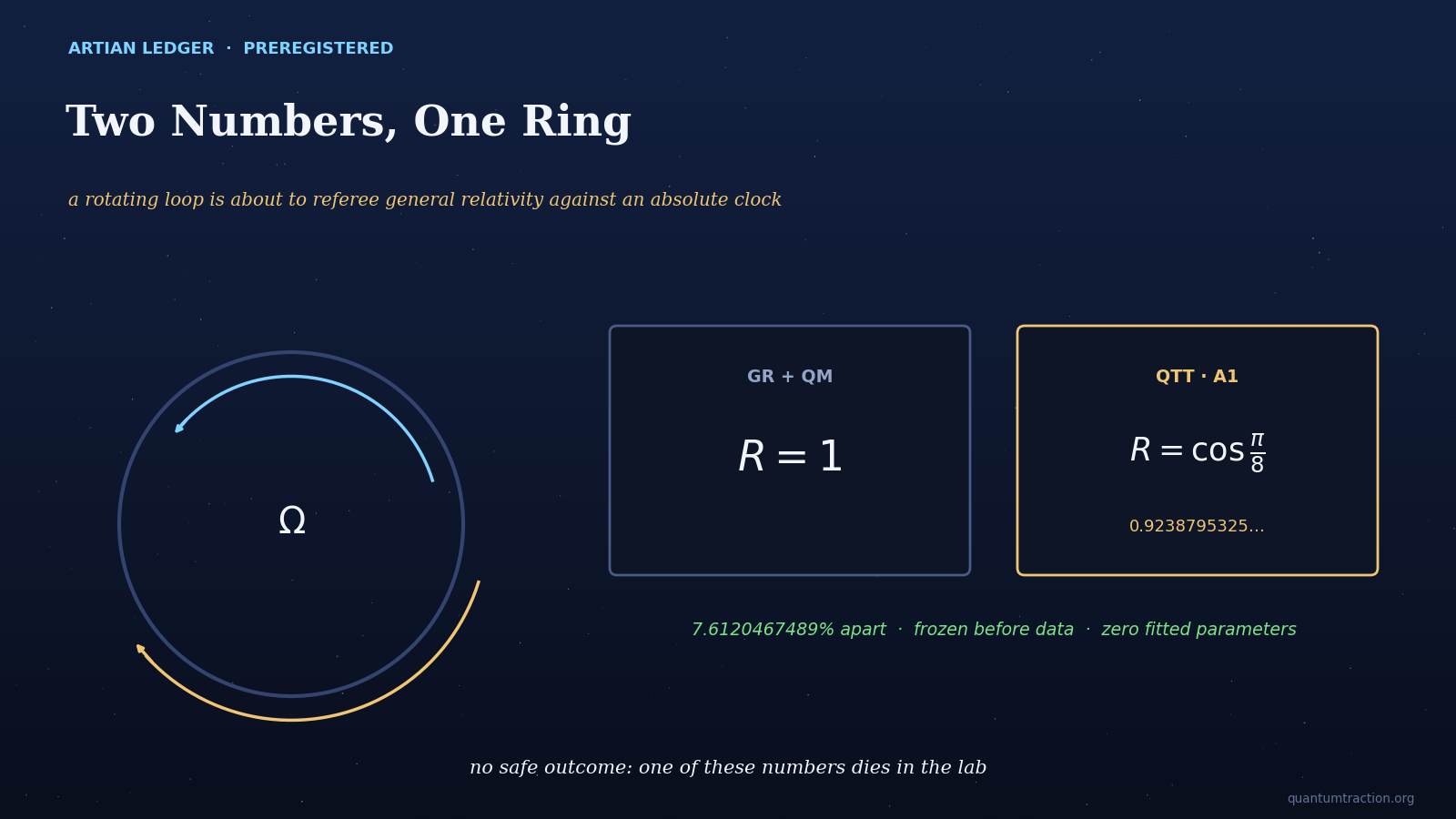
A personal prior, not a p-value. The experiment ignores it. GR predicts one frozen number; the sealed QTT clock-projection claim predicts another.
That is my personal prior, not a p-value. The experiment does not use it. GR predicts one number; the sealed QTT clock-projection claim predicts another.
Yesterday I published an experiment before the experiment exists.
That sentence needs care. I did not publish a result. I published the two numbers, the apparatus qualifications, the statistical decision rule, the future-data format, and the conditions under which nobody is allowed to claim a verdict. The public timestamp now comes before the data.
The test is deliberately uncomfortable for me. My own estimate is that QTT has one chance in 3,000 of surviving it. In percentage language, that is about 0.033%. This is not a probability computed from the data, not a Bayes factor, not a look-elsewhere correction, and not part of the preregistration. It is simply my personal prior that the QTT value will survive a properly qualified experiment. The sealed analysis ignores my opinion completely.
I am not giving my framework favorable odds. I am giving the laboratory a clean shot.
First, the place where GR and QTT agree
In 1913, Georges Sagnac rotated an interferometer and watched its fringes shift. For nonrelativistic matter waves moving around a closed loop, the leading rotation phase is
Here m is the atomic mass, Ω is the platform rotation, A is the oriented area, and the two ΔΦ terms represent higher-order relativistic and apparatus corrections that must be modeled or bounded.
This is standard physics. A cesium matter-wave experiment measured the Sagnac area law at the 25-parts-per-million level in 2022. QTT reproduces this ordinary laboratory-channel result. Repeating that measurement at still higher precision would be valuable metrology, but it would not distinguish the two accounts.
The sharper question is not whether a rotating loop acquires a phase. It is: what physical clock carried that phase, and how was it allowed to become a laboratory record?
Same ring, two physically different channels
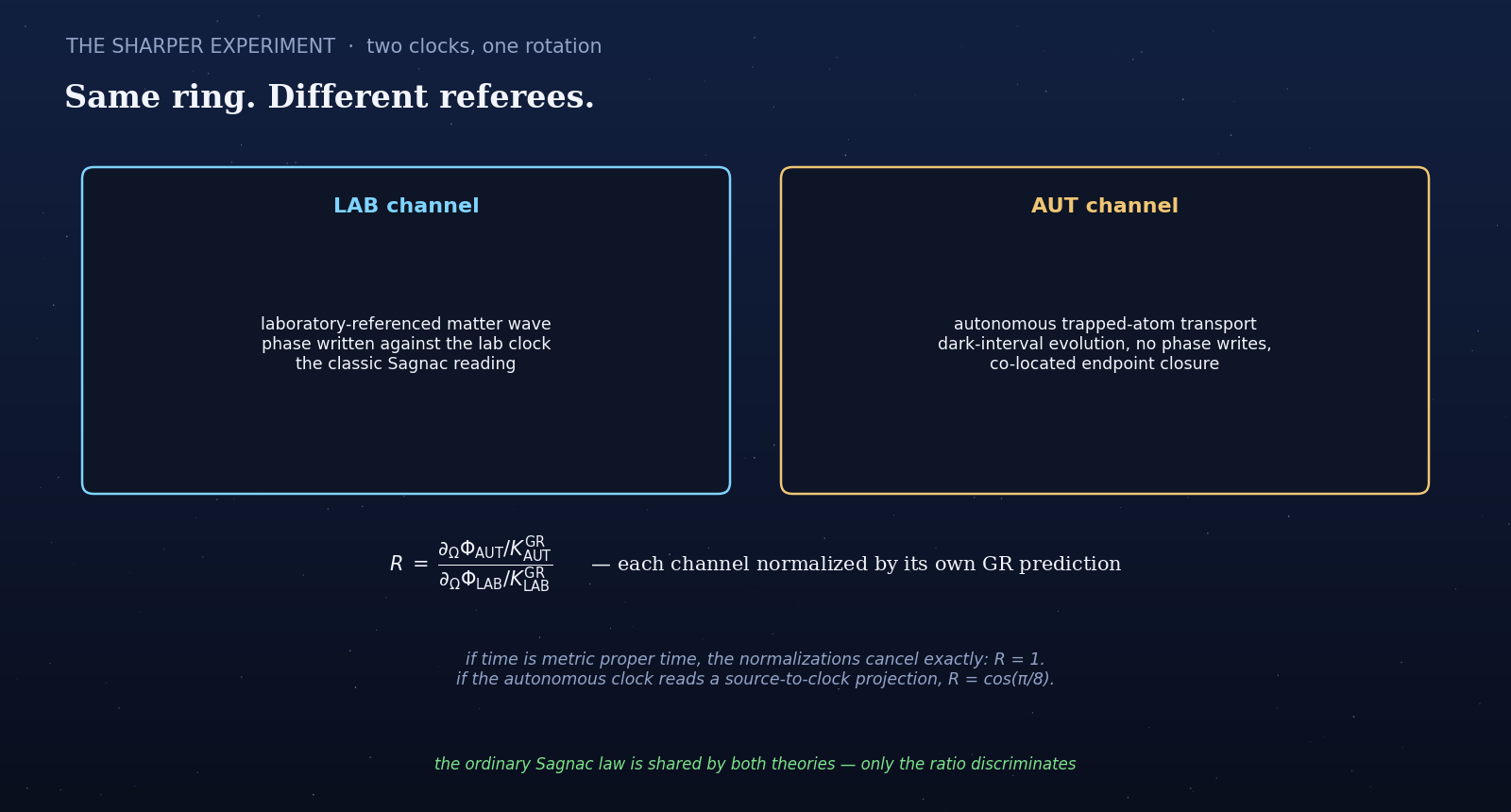
The proposed apparatus puts two channels on one ring.
The LAB channel is conventional: a matter-wave Sagnac phase whose preparation and evolution are referenced to laboratory pulses, guide timing, or an external oscillator.
The AUT channel is the candidate autonomous channel: trapped atomic states are prepared at one endpoint, transported around opposite closed paths during a dark interval, and recombined at that same endpoint. During transport there is no measurement, no phase reset, no servo write, and no oscillator imprint on the Sagnac-sensitive record.
Each measured slope is divided by its own GR apparatus prediction. The primary ratio is
Conditional on the seven apparatus gates being passed, metric GR plus ordinary quantum mechanics predicts
The sealed QTT A1 clock-projection claim predicts
The two targets are separated by
or 7.6120467489%. No angle is fitted. Neither target can move after the channel labels are opened.
Why this particular number
The exact identity is simple:
The provenance is more important than the decimal. The π/8 projection and ρ were already public QTT objects before this experiment was sealed; they were not selected from Sagnac data. They recur in other QTT constructions, including the photon-edge, flavor, and Higgs-sector rails. That recurrence is provenance, not independent experimental proof. It shows where the prediction came from and prevents a new angle from being invented after the measurement.
Whether the upstream QTT derivation of π/8 is persuasive is a separate scientific question. This experiment asks a simpler one: when the two operational channels are physically realized, which frozen number appears on the dial?
Seven gates before either theory gets a verdict
The proposed effect is large compared with modern rotation metrology. The difficult part is not raw sensitivity. It is proving that the AUT channel is physically different from the LAB channel and that a hidden gain or area error did not manufacture the ratio.
The paper therefore requires all seven gates:
- 1Autonomous generator. The phase-carrying state evolves under a declared closed Hamiltonian during the dark interval.
- 2No intermediate record. No measurement, reset, feedback correction, or phase write acts on that record during transport.
- 3Co-located endpoint closure. Both branches close the same physical loop and return to the same readout region.
- 4Endpoint-basis separation. The final oscillator selects the measurement basis but cannot reconstruct the transported Sagnac phase.
- 5Unit-gain injection. Independent synthetic phases must be recovered with the frozen transfer function, excluding a hidden channel-dependent gain near 7.6%.
- 6Geometric commensurability. The two channels share one species and ring, or use an independently frozen area-ratio calibration.
- 7Odd-parity controls. Under rotation or loop-orientation reversal, the genuine Sagnac term follows the prescribed odd sign; even leakage does not. State/path swaps separately expose state-dependent systematics.
That last sentence matters. An earlier draft graphic had the reversal logic backwards. It has been removed rather than allowed onto the public page.
The paper also proves a no-go result: one physical detector record cannot become two physical clock channels merely by being relabeled. Two names are not two observables. The comparison only exists if the apparatus implements two genuinely different access histories.
What the one-in-3,000 estimate does not mean
My personal one-in-3,000 estimate is deliberately absent from the machine analysis. It does not set the stopping rule. It does not determine the uncertainty. It does not change the compatibility windows. It does not become evidence if the QTT number wins.
The preregistered outcome ledger is instead:
- A qualified result compatible with R = 1 and excluding cos(π/8) falsifies the printed QTT A1 clock-projection claim for this channel.
- A qualified result compatible with R = cos(π/8) and excluding unity contradicts metric GR plus ordinary quantum mechanics for the qualified AUT channel.
- A qualified result near neither target falsifies the sealed two-point model; no replacement angle may be chosen from the opened data.
- Any failed or unpopulated qualification gate gives no theory verdict.
This is why the page title says GR versus QTT, while the scientific claim remains narrower: the experiment does not decide every statement in either framework. It decides one explicit disagreement about one qualified clock channel.
Nothing has been observed yet
The deposit contains synthetic GR-like and QTT-like fixtures. They exist only to verify that the sealed code recognizes its own two inputs. They are not simulations of nature, observations, confirmations, or probabilities.
The public package contains the LaTeX paper, the future-data schema, the seven-gate checklist, the blind-map format, the joint generalized least-squares analysis, the Fieller ratio interval, the fixed-target exclusion statistic, the synthetic pipeline fixtures, and a SHA-256 manifest. A qualified live run would open its channel map once and execute that analysis without changing the targets or gates.
The invitation
The necessary hardware families already exist separately: high-accuracy matter-wave Sagnac metrology, trapped single-atomic-clock transport, dual guided atom interferometers, and compact matter-wave ring gyroscopes. The unperformed step is to combine them into the same-loop LAB/AUT comparison and make the seven certificates public before unblinding.
If you operate a cold-atom ring, guided matter-wave gyroscope, trapped-ion transport platform, or precision Ramsey apparatus, you do not need to believe QTT. In fact, my own odds say you should expect it to lose.
You only need to build the two channels honestly and let the ratio answer.
GR says 1. QTT says 0.9238795325.... I give QTT one chance in 3,000.
The laboratory gets the final word.
— Ali Attar, Quantum Traction Theory Project
Paper, provenance, and experimental anchors
QTT Main Book v10.01, stable concept DOI 10.5281/zenodo.17527179. Relevant anchors: A1 and source/lab time, pp. 47–52; real J-dial, pp. 139–145; Sagnac equations, reference conventions, and protocol, pp. 554–573; Hamiltonian source/readout synthesis, pp. 1249–1250.