
A Local Capacity Is Not a Global Wall
Why one finite address budget does not automatically become one finite budget for the whole coherent system.
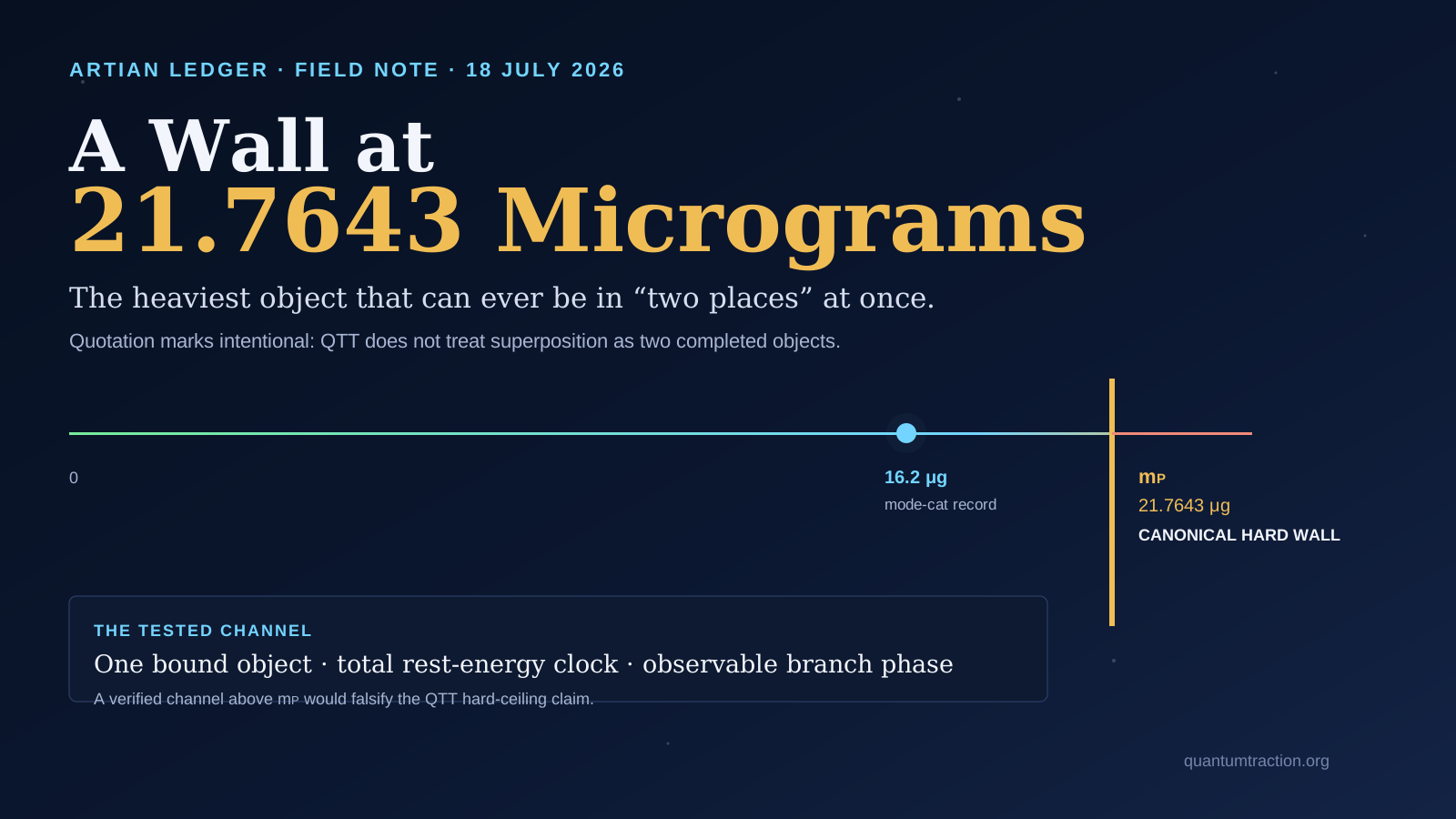
I once presented one local QTT capacity unit as a global mass-only boundary for coherent matter. The local equation was valid. The global inference was not proved.
This correction does not weaken A6. It prevents a local law from being asked to prove a global statement it does not contain.
1 · What remains exact
QTT uses the dimensionless source mass count
B = M / m_A.
For one completed address w, the local A6/A7 budget can be written as
B_w <= 1, with Qw^bundle = 2π at completion.
The local modular-energy map is
Ew = (ℏ c / 2π l_A) Qw.
At one completed bundle,
Qw = 2π => Ew = ℏ c / l_A => B_w = 1.
The 2π closes the modular ledger and cancels in the local energy map. It does not multiply the source mass. That local statement remains exact.
2 · The countermodel that changes the global claim
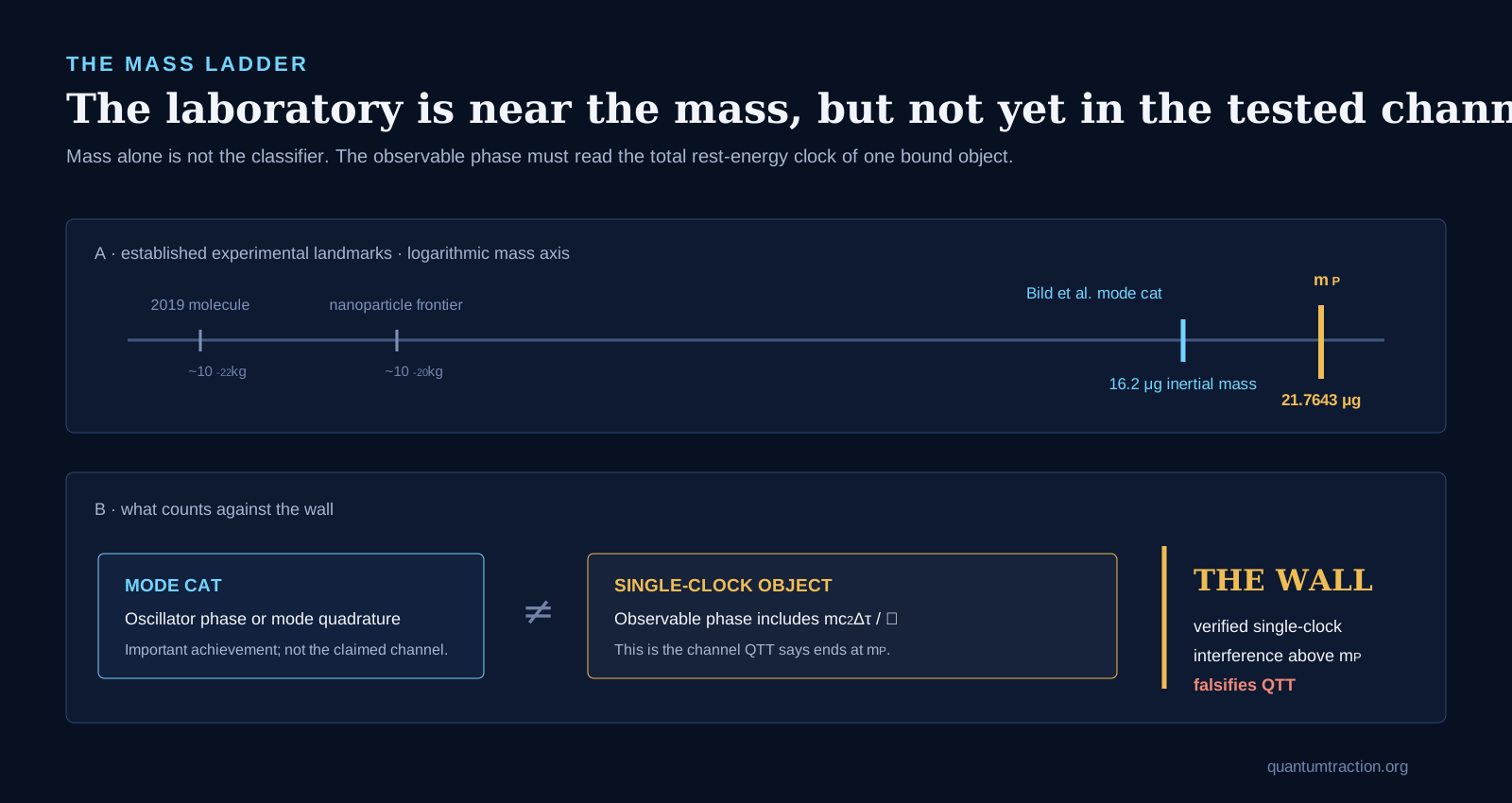
Now take K mutually orthogonal legal addresses w_1,...,w_K. Let each address saturate its own local budget:
B_{w_j}=1, Q_{w_j}^bundle=2π, for j=1,...,K.
Every address separately obeys A6. Yet the total source mass count is
B_total = sum_{j=1}^K B_{w_j} = K.
For any K>1, this is greater than one. Therefore
for all w, B_w<=1 does not imply B_total<=1.
That is a countermodel, not a matter of wording. A universal global ceiling needs an additional law that forbids independent legal addresses from stacking their local budgets into one coherent global state.
3 · What theorem would be needed
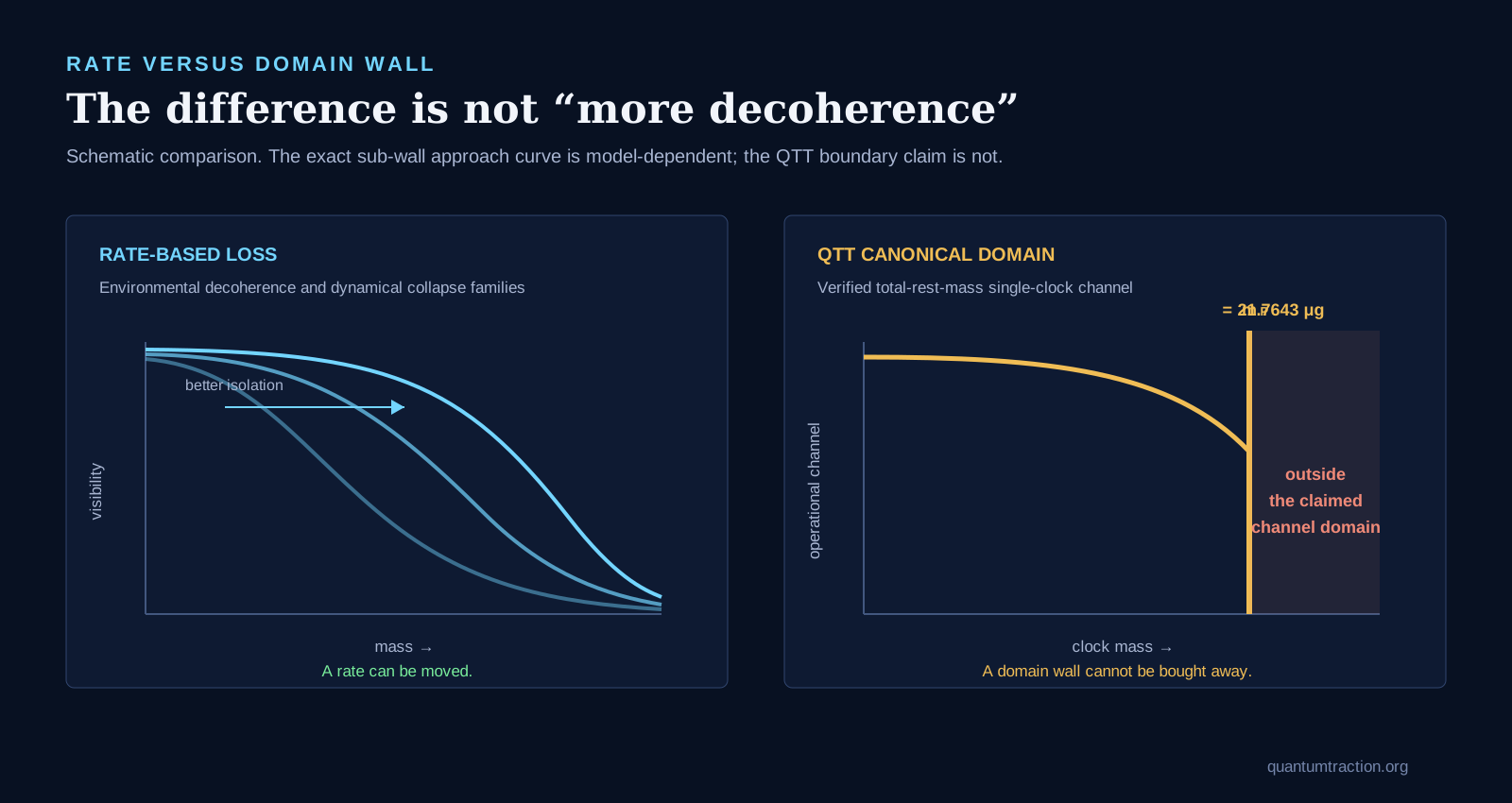
There are several possible theorem shapes, but none may be assumed after seeing an experiment.
- A cross-address no-stacking theorem could prove that a coherent state shares one common capacity budget across all participating addresses.
- A common-support theorem could prove that the relevant experimental channel is represented by one completed address rather than
Kindependent ones. - An observable-algebra theorem could produce genuine invariant sectors and justify the word superselection.
Until one of these is derived from QTT source law, the corpus must not advertise a universal mass-only coherence boundary.
4 · Why this is stronger science
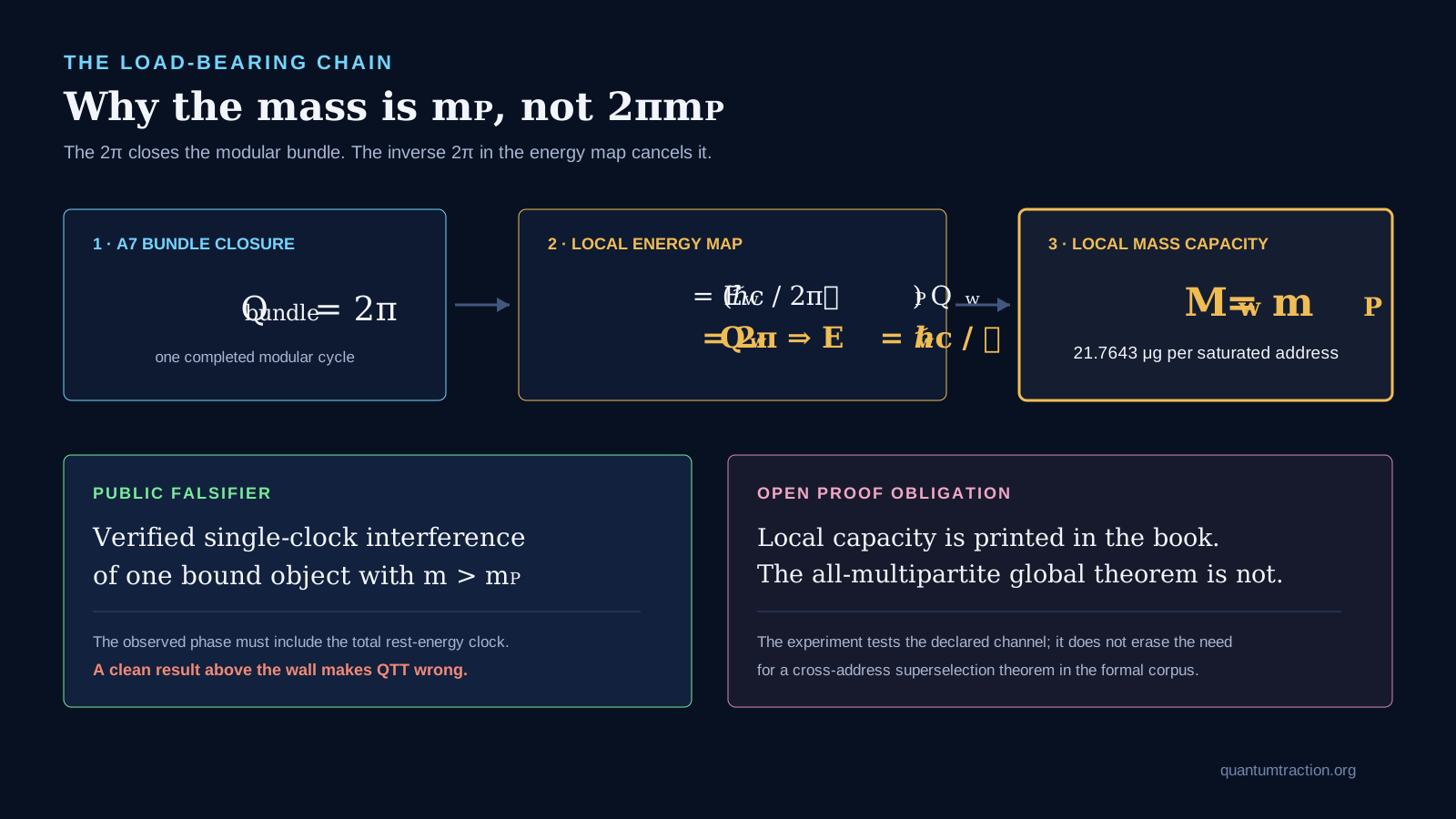
The earlier field note contained a tempting falsifier: observe one suitably classified coherent object above the proposed boundary and reject the claim. But a falsifier is healthy only when the prediction follows from the theory.
Without a cross-address theorem, a positive experiment could be misclassified as a refutation of A6 even though it refutes only an unsupported global extension. That would be an invalid test of the axiom.
The corrected scientific position is sharper:
This is not a rescue clause added after data. It is the logical domain of the printed premise, stated before the next experiment.
5 · What laboratories can still test
The useful experimental program does not disappear. It changes target.
- Test whether a declared one-address preparation exhibits a capacity boundary that is independent of ordinary environmental loss rates. — Compare preparations with the same laboratory mass but different address topology. — Compare one-address and multi-address coherent constructions while holding the readout channel fixed. — Require any proposed no-stacking law to predict the result before data and forbid fitted replacement thresholds.
Mass in conventional laboratory units may be reported downstream for apparatus design. The source-layer statement remains the dimensionless count B=M/m_A.
6 · What happened to the old prediction
It is not silently deleted. It is retained as a dated candidate that failed its own derivation audit.
The local result survives:
B_w <= 1 for the declared one-address capacity class.
The global result is retired:
B_total <= 1 is not derived from local A6 capacity.
The public Schrödinger v3.0 paper now carries the countermodel and the no-go certificate. The Observatory records this as a theoretical negative result rather than an untested observation row. The Lexicon keeps the old term so links remain stable, but marks the global claim as not derived.
7 · The larger lesson
This is exactly why a theory needs a claim ledger.
An attractive number is not enough. A local theorem is not automatically global. A clean experimental threshold is not healthy unless every quantifier in the threshold has been earned.
The correction leaves the useful part intact: A6 is a finite local capacity law. It also removes the part that the stated axioms did not support. If a future cross-address theorem closes the missing implication, it must arrive as a new derivation with its own premises, countermodels, and falsifiers.
Until then, the strongest honest statement is the one the mathematics permits:
— Ali
Papers carrying the local-capacity audit
The v3.0 rotor-to-wavefunction paper is the controlling public result: local A6 capacity survives, while the global mass-only ceiling is no-go certified. Earlier experiment-facing records remain useful historical dependencies, but their ceiling wording does not override the later proof.
Correction theorem and historical experiment rail
Load-bearing scale, dynamics, and access papers
Related Field Notes
Maps and definitions
Prior work and laboratory landmarks
Where this Field Note sits in the current book
Stable book concept DOI 10.5281/zenodo.17527179.
- p. 266: A7 modular-energy map, bundle count, and the local capacity statement audited here.
- pp. 1249-1250: compact Rotor-to-Wavefunction summary and the Planck-mass falsifier.
- Status guardrail: the printed theorem is local per address; the global all-multipartite extension is no-go certified without an added cross-address theorem.