The Qubit Remembered
Someone else measured the other side of a record claim.
A later open superconducting-qubit experiment found memory surviving outside a visible qubit. It was not designed as a QTT test and its authors do not endorse this comparison. What it makes newly inspectable is one earlier QTT statement: erasing a carrier is not the same as erasing every physical support of its record.
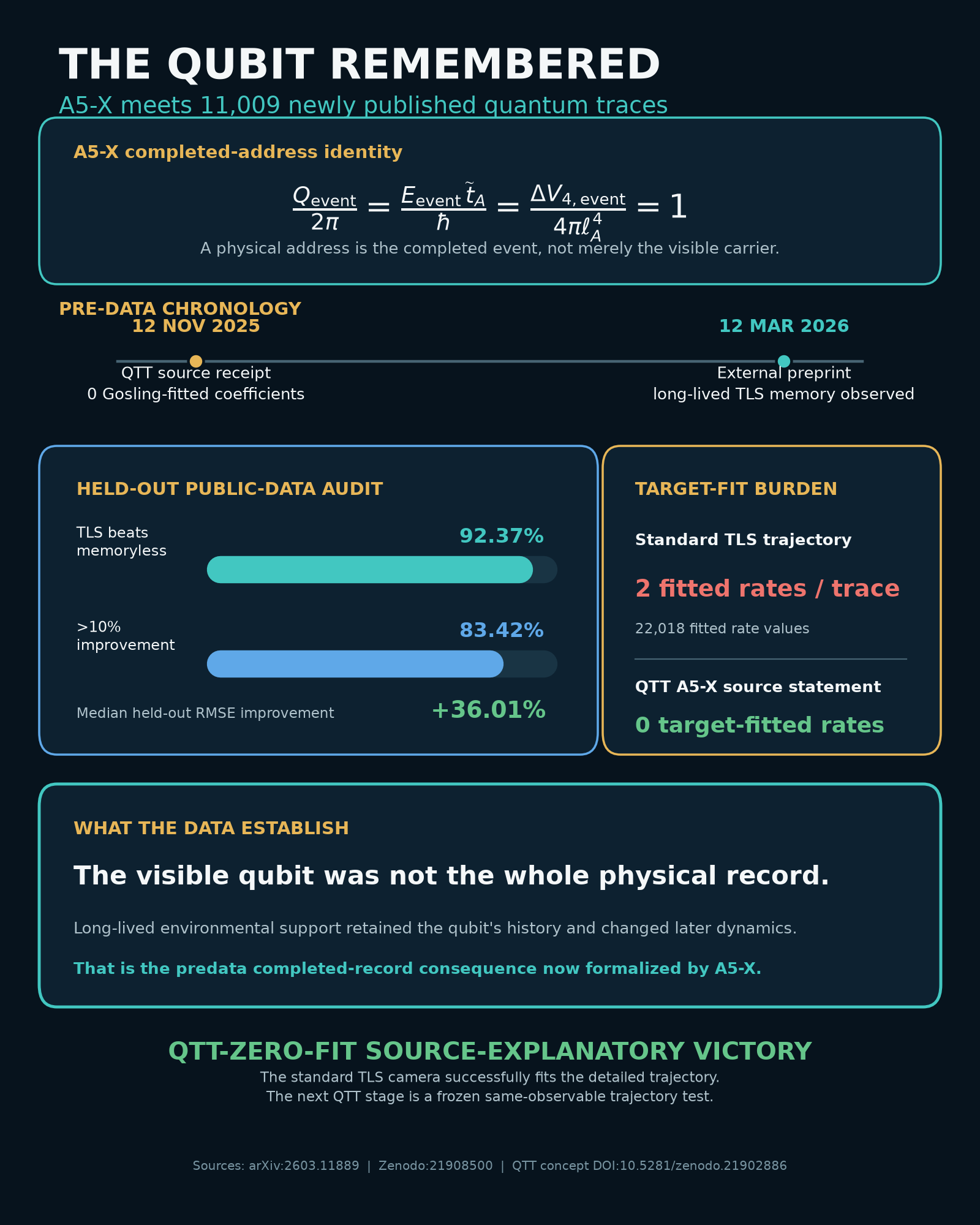
A reset can clear what we see without clearing what the world still carries.
Accessing labs is hard when you are an independent researcher. You cannot simply walk into a superconducting-qubit lab and ask for a bespoke protocol. Sometimes something cleaner happens: another group asks an adjacent question, releases the data, and makes one side of your own claim checkable without knowing your name.
In November 2025, QTT placed a structural statement in the public record. A physical record is not only the visible carrier. If any part of its distributed support survives outside that carrier, then resetting the carrier cannot be a complete physical erasure. The point belongs to the same family of questions as the quantum eraser: was a which-path record actually erased, or merely made inaccessible in the channel that was examined?
An address is the completed event, not a sticker on its visible carrier.
The later A5-X framework gives that earlier record-support statement a compact source form. It does not retroactively claim that the external authors measured its QTT quantities. It defines the QTT object being compared: one modular closure, one tick of action, and one completed four-volume are three source readings of one completed physical event.
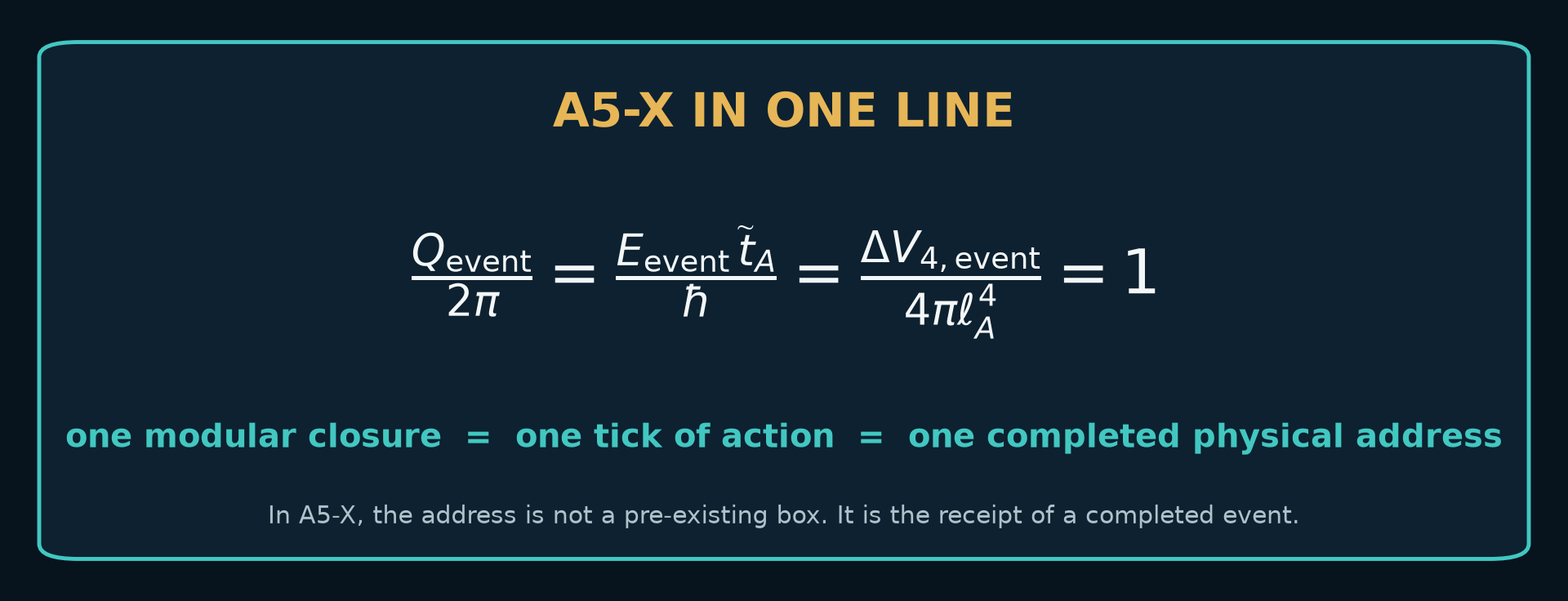
The displayed trace identity is standard quantum mechanics: a local trace-preserving operation on a discarded record cannot restore unconditional system coherence. QTT adds its own ontological reading of why a physical record can remain distributed, rather than identifying the identity itself as a uniquely QTT result.
The qubit's environment remembered what the qubit had done.
On 12 March 2026, Nicolas Gosling, Denis Bénâtre, and collaborators posted Probing the memory of a superconducting qubit environment. Their paper reports that long-lived environmental two-level systems, or TLSs, can retain memory of earlier qubit states and change later quantum-jump dynamics. The experiment, analysis, and open archive belong to that external team; they did not design it as a QTT test.
An independent audit of the released archive used the first two thirds of each conditional trace for fitting, left a 100-sample guard, and scored the final third. The ordinary one-TLS camera outperformed a one-rate memoryless camera on most of the held-out traces. That is a real standard-model result, and its fit burden belongs plainly on the page.
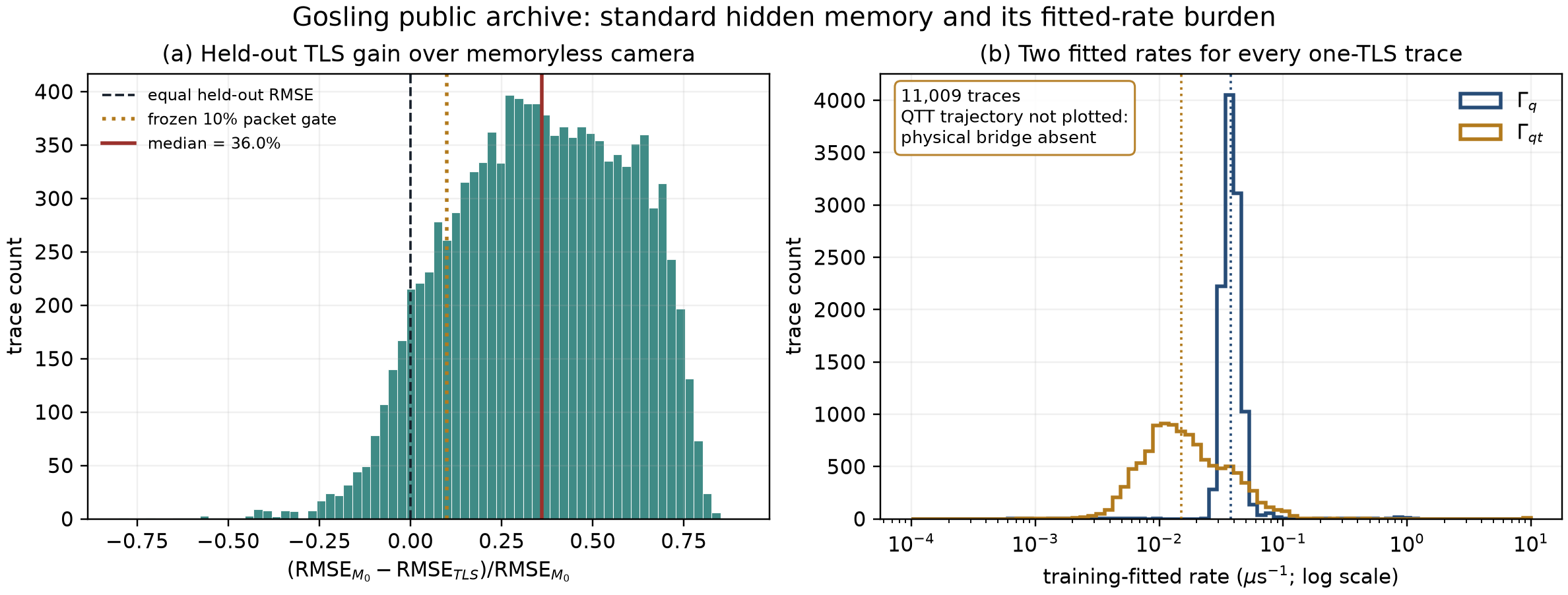
A held-out fit is real evidence for a camera. It is not yet a source story.
The one-TLS Solomon model earns its 92.37% result in the proper way: it is fitted on the first two thirds of each usable trace, separated from the test segment by a 100-sample guard, then scored on a final third it never saw. That is a serious held-out check against an ordinary training-set overfit. Its success is real.
But notice what it is asked to do. It learns two rates for each usable trace and reports how strongly that realized qubit trajectory, at that realized operating condition, retains memory. It is an excellent local duct-taping instrument for measuring the size of an effect in a particular run. The fitted rates are a successful effective description; they are not a derivation of why durable record support is physically available in the first place.
One side is pinned down. The whole coin is not.
The QTT source statement uses no Gosling TLS frequency, trace-selection window, fitted decay rate, or after-the-fact coefficient. The standard one-TLS trajectory model learns two continuous rates on the training portion of every usable trace: 22,018 fitted rate values across this execution. Both facts matter, and neither cancels the other.
The predata QTT record-support statement is structurally aligned with later evidence that the visible qubit was not the full carrier of its causal memory.
The archive does not supply an independent QTT record fidelity, timing complement, or physical bridge to the same resolved decay trajectory. QTT does not yet compete curve against curve here.
That is the scientific label for this note. It is neither a generic consistency claim nor a claim that the published qubit curves uniquely validate QTT. A QTT-exclusive trajectory verdict remains open as well. The next task is a frozen QTT transfer map that emits the same resolved observable before the data are inspected.
The independent researchers did not need to know the QTT corpus for their result to matter to it. They provided a careful measurement of hidden environmental memory. QTT had already made a source-level commitment that such residual support cannot be treated as nothing. That is the useful overlap, and it is enough on its own terms.
For the predata distributed-record statement, see Quantum Traction Theory: Main Book v10.01, pp. 177-178. For the later completed-address source construction, see pp. 55-61. Book concept DOI: 10.5281/zenodo.17527179.