Where Did the Mysterious 1/4 Come From?
Bekenstein's horizon receipt, the fourth face of the UEL, and the Hawking machinery QTT does not need
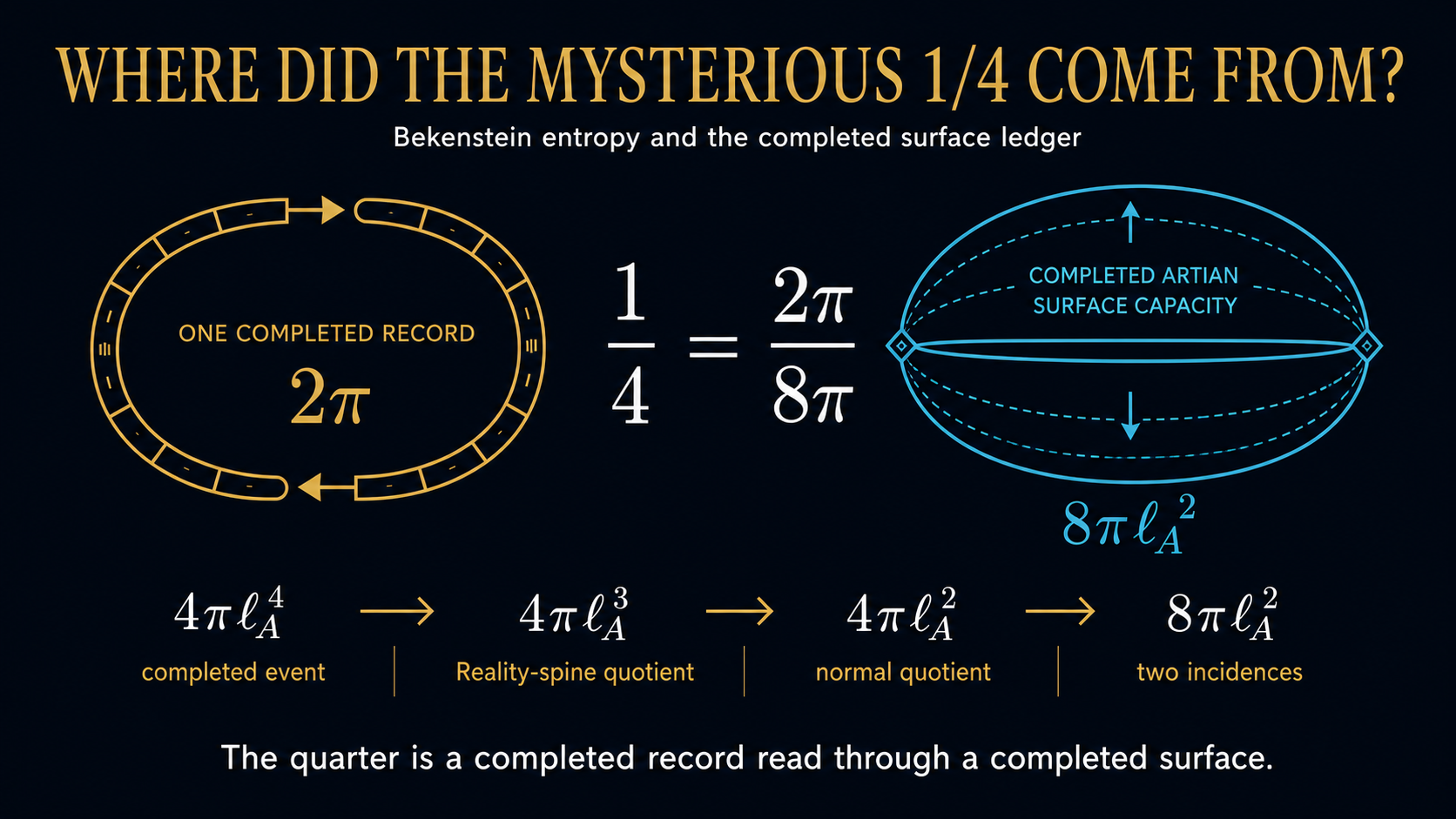

One completed modular record divided by one completed two-incidence Artian surface capacity. The proof uses no Hawking temperature, radiation flux, pair creation, or Euclidean horizon period as a constructor.
Some numbers in physics are so simple, and become familiar so early, that the question inside them eventually disappears. One quarter is one of those numbers.
It sits inside the most famous entropy formula in gravitational physics:

Every physicist learns it. Papers use it without stopping. Textbooks move from the formula to temperature, evaporation, information loss, and the black-hole information problem. The quarter becomes furniture.
But why exactly one quarter?
Why does a horizon carry one unit of entropy per four Planck areas rather than per one Planck area, per 
That was the question I wanted the fourth face of the Unified Equilibrium Law to answer. The latest version of the QTT black-hole information paper now gives a clean answer:

One completed record carries 
Section 1Before entropy, a black hole looked too simple
A classical stationary black hole is described from the outside by a very short list: mass, angular momentum, and charge. Matter can fall through the horizon carrying an enormous number of microscopic distinctions, while the exterior description appears to keep almost none of them.
That creates a bookkeeping problem. If an ordinary object carrying entropy falls behind a horizon, and the exterior account assigns no compensating entropy to the black hole, then the ordinary second law appears to lose an entry. The information has not merely moved to another visible drawer. The exterior ledger seems to have thrown the drawer away.
Jacob Bekenstein took that problem seriously. His important move was not a radiation story. It was the recognition that the horizon itself must carry entropy and that the natural macroscopic quantity was its area. In a pre-coefficient form, the proposal is

The deep question was the dimensionless normalization 
Section 2How the quarter became familiar without becoming ontologically obvious
The standard semiclassical literature later combined a proposed exterior horizon temperature with the black-hole first law and Einstein normalization. That chain returns

This is the established textbook relation. The calculation fixes the thermodynamic coefficient inside that framework. But mathematical closure of a relation and identification of the physical source object are not the same achievement.
The standard chain says which coefficient must accompany the exterior thermodynamic reading. It does not, by that fact alone, tell us what finite substrate unit is counted in the numerator, why the denominator is a completed surface rather than a regulator patch, or why the count must be one quarter.
That gap became surrounded by a far larger cultural story: thermal radiation, vacuum pairs near horizons, evaporation, and an information-loss crisis. None of those effects has been directly observed as Hawking radiation from an astrophysical black hole. Analogue systems can reproduce selected kinematic features, but they are not detections of radiation from a gravitational event horizon.
This is where I part sharply from the story physics has repeated for half a century. In the QTT source construction, Hawking temperature, Hawking flux, vacuum pair creation, and the Euclidean horizon period are all unnecessary postulates. They do not help build the entropy coefficient. The radiation proposal is not a hidden gear in this proof. It is absent from the machine.
The scale of attention that the proposal received is a good example of what I have called Media Made Science: a speculative, unobserved mechanism becomes culturally protected through repetition, documentaries, headlines, institutional prestige, and textbook inheritance. The scientific question then quietly changes from “has nature shown this?” to “how elegantly can we elaborate it?” That is how buzz starts doing the work that data were supposed to do.
QTT takes the opposite route. Remove the radiation postulates. Refuse to use the known quarter as a fitted target. Construct a completed record. Construct a completed surface. Count.
Section 3The denominator must exist before the horizon
The denominator begins with the fourth face of the UEL, not with black-hole thermodynamics. One completed source event carries a finite four-volume support:
%7D%3D4%5Cpi%5Cell_A%5E4.&bg=101b30&fg=f5f0e5&s=1&c=20201002)
Here 

The first quotient removes one Reality-spine thickness
%7D%7D%7B%5Cell_A%7D%3D4%5Cpi%5Cell_A%5E3.&bg=101b30&fg=f5f0e5&s=1&c=20201002)
The second quotient removes one surface-normal thickness

That is still only one incidence. A regular orientable codimension-one boundary has two coorientations:

In the A7 typing used by the theorem, these are the visible and hidden incidences of one completed address. A camera can face one side. A completed physical boundary owns both. Capacity additivity therefore gives

This distinction matters. Dividing by two would count one camera-facing projection, not the completed surface. Adding a third side would invent a coorientation that a regular boundary does not have. Smearing the two sides with a continuous weight would install a tunable function where the primitive geometry supplies a two-element fibre.
The same construction gives a useful internal identity:
%7D.&bg=101b30&fg=f5f0e5&s=1&c=20201002)
The denominator is now closed before entropy, temperature, radiation, or a horizon enters the calculation.
Section 4Why the coefficient eight is not decorative arithmetic
It is reasonable to look at
%3D4%5Cpi%20C%20J_wJ_n%5Cbeta%5Cell_A%5E2.&bg=101b30&fg=f5f0e5&s=1&c=20201002)
Each factor has an owner:
| Factor | Physical meaning | What fixes it |
|---|---|---|
| normalized rotational angular measure | completed isotropic closure |
 | normalization of that measure |  |
 | Reality-spine quotient multiplicity | one spine thickness, so  |
 | surface-normal quotient multiplicity | one normal thickness, so  |
 | boundary coorientation count |  , so , so  |
Substitution leaves no coefficient to tune:
(1)(1)(2)%5Cell_A%5E2%3D8%5Cpi%5Cell_A%5E2.&bg=101b30&fg=f5f0e5&s=1&c=20201002)
The construction also appears outside the black-hole row: scalar, photon, compact-colour, charged-lepton, and capacity relations use the same surface tile. A denominator that works elsewhere, and is fixed before the horizon count, is not a coefficient painted onto the answer after the fact.
Section 5The numerator is one completed record
A7 closes one legal distributed bundle at the modular budget

In ordinary language, one completed physical record closes one full modular turn. The UEL information face reads modular charge in natural record units:

For one completed A7 bundle,

That gives the numerator an independent meaning. It is not “one” because somebody selected a microstate degeneracy whose logarithm behaved conveniently. It is one because the completed bundle closes exactly one
The same
We can now put the two independently fixed objects beside each other:

Section 6The mysterious quarter appears
For a stationary saturated horizon of area 

Insert the completed record and completed surface:

Entropy is that completed-address count multiplied by Boltzmann's constant:

And the quarter is finally exposed:

The numerator is a record. The denominator is a surface capacity. Neither is a black-hole-specific patch. Their ratio produces the quarter.
Section 7Saturation is a physical condition, not a hidden convenience
The general QTT row keeps the horizon occupancy visible:

The familiar Bekenstein coefficient is the stationary saturated row 
That scope matters because it prevents the coefficient from being treated as a universal paint that can be spread over any surface without checking whether the address ledger is actually full.
Section 8The fourth face is doing the source work
The fourth face writes the endpoint energy as a completed four-volume capacity:
%7D%5CDelta%20V_A%5E%7B(4)%7D%2C%0A%5Cqquad%0A%5CDelta%20V_A%5E%7B(4)%7D%3D4%5Cpi%5Cell_A%5E4.&bg=101b30&fg=f5f0e5&s=1&c=20201002)
The same finite event geometry carries the surface invariant
%7D.&bg=101b30&fg=f5f0e5&s=1&c=20201002)
This is the ontological chain:
- The fourth face supplies the finite support of one completed physical event.
- A5-X supplies the Reality-spine quotient, the normal quotient, and the two coorientations of the completed boundary.
- A7 supplies the modular condition under which the distributed event closes as one legal bundle.
- The horizon reads completed bundles through the surface face of the same finite geometry.
The horizon does not manufacture a new entropy coin. It counts completed coins through a completed surface ledger.
Section 9Hawking radiation is not a constructor here
The easiest way to show whether an idea is necessary is to remove it and inspect the proof. In QTT v5.0, the derivatives of the source entropy with respect to the Hawking machinery are zero:

%7D%0A%3D0%2C&bg=101b30&fg=f5f0e5&s=1&c=20201002)
%7D%0A%3D0.&bg=101b30&fg=f5f0e5&s=1&c=20201002)
That is not a matter of taste. It is a dependency statement. Change the proposed Hawking temperature, delete the flux, remove the pair-creation cartoon, or refuse the Euclidean-period construction: the QTT entropy proof above does not move.
This is why the Hawking postulates receive no source-level credit for the QTT quarter. They are unnecessary. Within this proof, the radiation proposal contributes nothing to the constructor. Its continued cultural centrality is media-amplified buzz, not derivational necessity, and an unobserved spectrum does not become a physical receipt merely because repetition made it famous.
After the source ledger is already closed, the familiar exterior temperature relation can be read thermodynamically:
_%7BJ%2CQ%7D%0A%3D%0A%5Cfrac%7B%5Chbar%5Ckappa_s%7D%7B2%5Cpi%20k_Bc%7D.&bg=101b30&fg=f5f0e5&s=1&c=20201002)
The order is reversed. Completed support, surface closure, and modular record count construct the entropy first. Temperature is downstream readout. It is not the parent of the quarter.
Section 10What happens to the information-loss story
If one begins with Hawking radiation as the essential mechanism, the disappearance of the black hole creates a dramatic source-level information puzzle. If one begins with an A7 completed record, the source ontology is different from the start.
A7 does not permit a completed record to become ontological nothing. Its support can become hidden from a particular laboratory channel, distributed across a boundary, or unavailable to a local observer. That is an access problem. It is not a source deletion.
QTT therefore separates three statements that are too often mixed:
- an exterior observer can lose access to distinctions;
- a horizon can carry a finite completed-address entropy;
- the source record itself is globally destroyed.
The first two can occur without the third. QTT denies the third at the source layer. The information ledger is closed by A7 before an observer asks how much of it can be read.
Section 11What would break this result
The derivation is compact enough to expose its load-bearing joints.
- Show that the fourth-face event
does not support the two declared geometric quotients.
- Show that a regular completed Artian boundary does not carry exactly the two coorientations used by A7, invalidating
.
- Show that one completed A7 bundle does not carry
.
- Show that stationary saturated horizon entropy is not the completed-address count.
- Experimentally establish a global pure-to-mixed source transition with no same-universe hidden completion, defeating the A7 source-unitary premise rather than merely demonstrating local loss of access.
Those are scientific burdens. “The radiation story is famous” is not one of them.
Section 12The receipt Bekenstein was looking for
Bekenstein saw the bookkeeping problem clearly: if a horizon can hide ordinary distinctions, the horizon must keep a receipt. That insight survives.
What QTT changes is the source of the receipt's face value. The quarter does not need a thermal-radiation postulate, a pair-creation picture, or fifty years of scientific buzz. It needs one completed

The number was never complicated. The missing part was deciding what nature had counted.
Sometimes the coefficient everyone stopped questioning is exactly where the ontology was waiting.
Sources and reading anchors
QTT corpus
- Artian's Geometry Denies Source-Level Information Loss and Removes Hawking Radiation from the Bekenstein Constructor Set
- Three Readouts, One Surface Tile
- A Modular-Charge Fifth Face of the Unified Equilibrium Law
- Quantum Traction Theory main book
Historical comparator literature
- Bekenstein, Black Holes and Entropy
- Bardeen, Carter, and Hawking, The Four Laws of Black Hole Mechanics
- Hawking, Particle Creation by Black Holes
Where the quarter's two ledgers live
- pp. 52–61: A5-X completed-address and surface closure.
- pp. 158–160: the fourth face of the Unified Equilibrium Law.
- pp. 278–279: the horizon completed-address count.
- pp. 741–742: dial and modular/KMS anchors.
- p. 752: entropy as completed-address measure.
Continue through the Blog Map, the Corpus Tree paper family, the Derivation Atlas node, the Observatory record, and the Lexicon entry.