Field Note
It Is a Compass and It Is a Cross
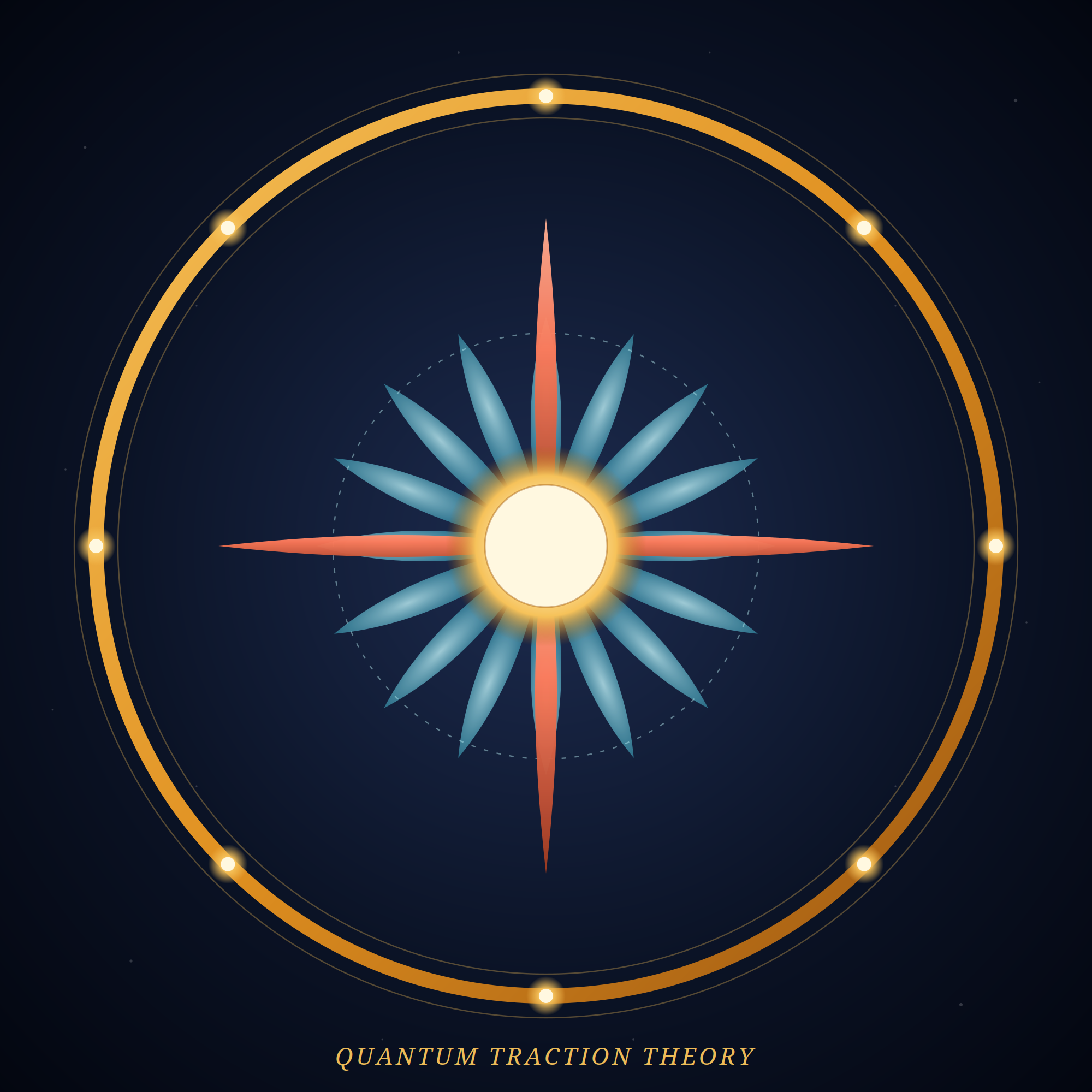
Most of QTT was written at a pâtisserie counter in Colombes. Then the community made me upload a square. I don’t like squares — I prefer spheres. So we built one that quietly contains all seven axioms: five drawn, two folded.
How to read this note
This is not a derivation note. It is the orientation piece for the public corpus: why the work had to become openly archived, why the logo matters, and why a reader should move from story to DOI records rather than stopping at story.
- Start here: the compass, the cross, and the public archive.
- Artian’s Origami: how to read the book.
- Duct-Taping Theoretical Physics: why the framework was built this way.
- Then use the maps below to reach citable papers, tests, terms, and book pages.
The public trail starts on August 17, 2019, long before the current formal papers. The old Fabrika/Barpa language is now mapped forward through the Legacy Terminology and Blog Map routes instead of being erased.
Most of Quantum Traction Theory was not developed in a university office, or even at a desk. It was developed in a bakery. La Maison Valmy in Colombes — the kind of small French pâtisserie they still call a pâtisserie without irony — has been my real workplace for longer than I care to admit. The staff are warm in the way that French neighbourhood staff sometimes still are. The croissants are very good. The cappuccinos are better. I take a corner seat, I order one of each, and I think for hours. Most of the axioms, most of the proofs, most of the rewrites came out of that corner. If QTT has a smell, it is a mix of baked baguette and espresso.
For a long time that was enough — me, the paper, the croissant. Then, slowly, the rest of the world started to matter. I sent papers out and the journals sent them back. Sometimes politely, sometimes not. A few of the rejections were that the QTT questioning established physics. Expected. Most were because I was nobody, no credential or postdoc, attached to no known institute, and because the work asks the established physics community to reconsider something they would rather not. That is also predictable. It is just expensive, in time and in faith.
So I did the thing nobody can stop me from doing: I opened my own Zenodo community. (Long live Zenodo. If you have not used it: it is the open archive run by CERN. It does not care who you are. It just takes the paper, mints the DOI, timestamps the deposit, and gets out of the way. That is most of what science needs from a publisher and almost all of what mine needs.) I called the community Quantum Traction and started depositing the corpus there one paper at a time.
And then Zenodo, very politely, asked for a square logo.
I do not like squares. I prefer spheres. (This is not a joke about geometry. It is a small, true preference. Squares end. Spheres do not.) So instead of designing a square, I asked my Claude assistant to design the logo — the one that the theory actually wants — and then to fit it inside the square Zenodo had asked for. The brief was severe: the logo had to be the axioms. Not “inspired by” the axioms. Not “evocative of.” Actually contain them, so that a QTT-literate reader could open the picture and read the equations off the geometry. Anything decorative was forbidden.
And — credit where it is due — Claude did it. Not “drew something nice.” It put the equations inside the picture. Every disc, every petal, every spike is doing work. I am going to walk you through it.
Small note for completeness: the avatar version on the Zenodo community drops the central QTT wordmark; the version above keeps it. The geometry is identical.
Eight short passes. Five of them carry an axiom directly, with the equation drawn in the geometry. The remaining two — A2, the Law of Endurance, and A3, the Law of Creation — do not appear as marks on the picture; they are the reason there is a picture. They get the author’s note at the end.
The whole picture sits on a dark navy radial gradient, not pure black. That is on purpose. In QTT there are two clocks, not one: T, the absolute background clock the substrate keeps, and τ, the lab clock the observer reads. The navy field is T. The faint asymmetric star points scattered through it are visual hints at the underlying countable address structure — discrete events floating in the deep ledger before any local observer chooses a frame. The fact that the field has a slow centre-out luminosity at all is the small statement that T is not “nothing”; it has internal structure, and lab spacetime is projected from it. The half-angle that does the projection is drawn in pass 04 below.
two clocks: T (substrate) , τ (lab) , with τ = T · I_clk
Every completed bundle of substrate carries exactly 2π of modular charge — no more, no less. The closed gold ring is the visual statement of that closure. It is closed, not an open arc; an arc with a gap would be A7 failing. The thick gold band is the active capacity; the two faint hairlines bracketing it are the upper and lower limits within which the modular charge sits. Gold, because capacity is a stored, finite resource — the word that fits is budget.
Q_w^(bundle) = 2π
On the gold ring sit eight identical bright dots, evenly spaced. The eight is not stylistic. A6 is capacity minimality: there exists a smallest capacity quantum S_min, and the Planck-scale surface tile is exactly 32 of them. A5 is address locality: those tiles are the places where records can actually form — they are the Artian addresses. So the dots are A5 sitting on A6, sitting on A7’s boundary. The cream-white inner core of each dot is the address’s writeable region; the soft golden halo is the surrounding capacity reservoir it draws on. The same 8 lands the famous 1/4 of Bekenstein–Hawking through the ratio 2π / Q_Σ.
S_min · Q_Σ = 8π ℓ_P² = 32 S_min
Sixteen identical leaf-shaped petals, in cool cyan-teal, at 22.5° intervals. The geometry is precise: 22.5° is exactly π/8 radians per petal, and 16 petals is exactly the full angular dial cut by that increment. What is being drawn is I_clk — the half-angle amplitude-projection rule that turns T into τ. The same cos(π/8) that lands the Tsirelson bound 2√2 in Bell experiments and the neutrino mass-squared ratio 4π² cos²(π/8). One rule, doing one job — turning the substrate’s clock into the lab’s clock — appearing wherever that job is done. The cyan is cool on purpose: this is a projection rule, not a stored quantity.
I_clk = cos(π/8) ≈ 0.9239 · 16 petals × π/8 = 2π
Just inside the rosette there is a thin dashed cyan circle. It is the geometric locus on which T and τ meet at the half-angle — the canonical refoliation circle at θ₀ = π/4. The dashes are doing real work: they say this is a gauge construct, not a physical surface. A solid line would lie. The π/4 circle is where the projection lives; it is visible to a theorist, invisible to a lab apparatus.
θ₀ = π/4 · gauge, not surface
Four narrow elongated spikes in warm copper-rose, pointing N, S, E, W. This is the real-J rotor — the dial bundle’s rotor — satisfying J² = −𝕀 and the rotation identity below, without ever invoking the imaginary unit i as a primitive. Four spikes encode two perpendicular axes (n = 2 dyadic) × 2 — the minimal non-Abelian dial structure, the geometric form of the dyadic SU(2) closure that comes out of A6 + A7. And here is the part that pays off: rotate the picture by 360° and the four-point star looks identical to where it started — but the underlying rotor has picked up the ℤ₂ centre element −𝕀. To return to true identity it needs 720°. The 4π spinor periodicity, drawn into the figure by the fact that the rotor is self-similar but not self-identical under 2π. The copper is warm because this object rotates — it transports phase, it accumulates Berry phase, it generates spin.
J² = −𝕀 · e^(Jθ) = cosθ + J sinθ · SU(2) / ℤ₂ → 4π periodicity
At the exact centre, the brightest point in the picture: a soft golden halo around a cream-white core. This is w, the address. It is what observation actually lands on. The QTT Access Law is talking about this point — w-co-location: the system and the observer at the same address. The whole substrate (the navy), the whole capacity budget (the ring), the whole tile structure (the dots), the whole projection rule (the rosette), and the whole rotor (the star) are there to support one operation: reading w. So w is the brightest thing. And it is empty inside on purpose: the address is a where, not a what. Its content is whatever rails of substrate transport meet there.
M̂_w (w-co-location projector) · ΔX · ΔP ≥ (ℏ/2)(1 − η)
Take a step back. The picture is a compass: north points up, the axes are clear, you can orient yourself by it without knowing any physics. It is also an atom: a luminous nucleus surrounded by symmetric structure. And to a QTT reader it is a literal cross-section of a capacity bundle — outer 2π boundary, eight 8πℓ_P² tiles on the boundary, sixteen cos(π/8) projection sectors, a dyadic J-rotor inside the bundle, the address w at the centre, all sitting on the background clock T. Compass, atom, capacity bundle: same figure, three readings. None of them is the whole story; each of them is true.
A QTT-literate reader can read five load-bearing axioms directly off the geometry — A1, A4, A5, A6, A7 — with their equations drawn into the picture. The remaining two — A2, the Law of Endurance, and A3, the Law of Creation — are not lines on the figure. They are the move that makes the figure possible. See the note below.
It is a compass and it is a cross. Both are the same. And they are A2 and A3.
That line went into the margin of the spec the first time I saw the design, and I am keeping it because it is exactly the geometry. The compass-as-plane and the cross-as-point are not two different things being held together by a metaphor — they are the two faces of Artian’s Origami. The way to be guided and to be found.
Axiom A2, the Law of Endurance, is the fold itself: a piece of substrate, originally flat in the ledger, acquires surface structure by folding around a dyadic axis — and once folded, the structure holds. That is what gives the law its name. Axiom A3, the Law of Creation, is the apex condition: the fold’s tip pins to a single address — the place we have been calling w — and that pinning is the moment an address comes into being. The unfolded face of A2 is what the rosette, the ring, and the dots live on: the dial, the boundary, the tiles — all of it persists because the fold endures. The folded apex of A3 is the cream nucleus: a new address, lit because it was just made. The picture insists the two coincide because, in QTT, they do. There is no plane without the apex it folds around, and no apex without the plane that folds to reach it. Endurance carries creation; creation pins endurance.
So the figure does not depict A2 and A3 the way it depicts A1, A4, A5, A6, A7. It does not have a mark you can point to and say there is the Law of Endurance. A2 and A3 are the nature of the figure. They are the reason there is a figure at all instead of a list of axioms. The compass is A2 unfolded — the law of what holds. The cross is A3 anchored — the law of what comes into being. Hold the picture still long enough and you can feel the fold happen.
I do not think this is mystical; I think it is geometric. A compass orients you in a plane; a cross marks a point. The QTT figure does both, because endurance and creation jointly say that the plane and the point are the same physical move performed twice. Whether you see the compass first or the cross first probably says something about you. It says nothing about the picture.
The croissants, for the record, were excellent that morning.
QTT corpus (Book): 10.5281/zenodo.17527179 · Zenodo community: Quantum Traction
DOI map: quantumtraction.org/doi-map
Companion field notes: The Tbilisi Method · Payam Was Right. I Still Wasn’t Satisfied.
Find this note in the QTT Blog Map
This post belongs in the Start Here and Orientation route. Use the Blog Map for the reading sequence, the Corpus Tree for citable records, and the Atlas/Observatory/Lexicon pages for technical context.
Where this field note sits in the QTT Main Book (v10.01)
Use these page anchors to read the surrounding derivation in the current book version. The stable book DOI is 10.5281/zenodo.17527179.
-
p. 280
Kerr constant / Artian geometry
the current book anchor for the Kerr-constant route -
pp. 561-562
Reference-switch test family
the nearby Folman/reference-switch access-law test logic -
pp. 100-107
QTT substrate master equation
the compact operator skeleton behind the computational framework -
pp. 153-156
Space quanta and pixellates
the finite capacity units used by the local framework object
For DOI/version reconstruction, use the QTT DOI Map.
Citable sources for this field note
Concept DOI is the stable citation target. Version DOI and Zenodo record are kept visible for reconstruction. The full live index is the QTT DOI Map.
Field note · Book DOI 10.5281/zenodo.17527179
 QTT - Quantum Traction Theory