Quantum Traction Theory · Field Note
The Patch We Called i
… and the question Feynman taught us to stop asking
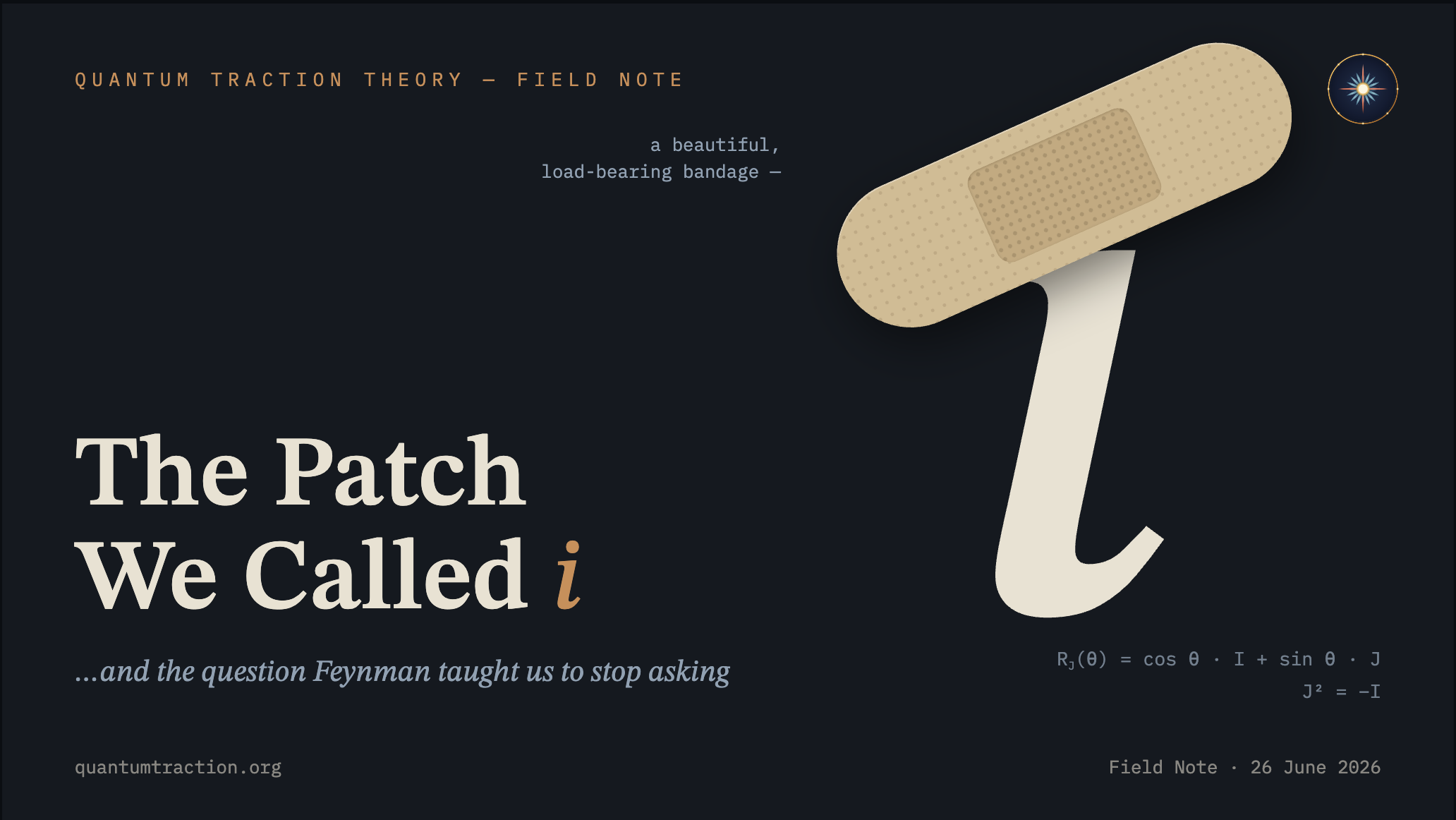
For years, something about the letter i sat wrong with me. Not the algebra — the algebra is flawless. What sat wrong was the story. We tell students that the deepest layer of reality is built out of a number that admits, in its own name, that it is not real. We call it imaginary and then we lean on it to hold the whole quantum world up. The longer I worked on the substrate, the more clearly I saw what that number actually is: a bandage. A beautiful, load-bearing bandage stretched across a wound in our understanding — the wound being that we never knew what the world was made of underneath.
And a bandage that works is the most dangerous kind. It stops the bleeding, the patient walks again, everyone goes home. Nobody looks under the gauze. That is the whole trouble with i, with “the particle takes all paths,” with the entire instrumentalist temper that grew up around the path integral. They work. Working is precisely how they bought us silence where we needed a question.
A patch that works is the most dangerous kind. It buys you silence exactly where you needed a question.
01
The night the sum over paths fell apart
A few days ago I was watching Curt Jaimungal, and the point that landed — the one I had been circling for years without saying out loud — was this: the particle does not really travel down every path. The “sum over all histories” is a way of speaking. It is a calculational device, not a journey anything takes. Take it literally and you have a single dot somehow exploring infinitely many routes at once before settling on a verdict. Said plainly, that is not an explanation. It is a riddle we agreed to stop finding strange.
And then it struck me how we teach it. When we draw Feynman diagrams, when we walk a student through the path integral for the first time, we hand them an answer engineered to end the conversation. The student asks the honest, human question — which path did it take? — and we answer: all of them. Now compute. The question is not resolved. It is retired. We have built, with extraordinary craftsmanship, a machine for not having to answer.
02
What Feynman gave us — and what he didn’t
Let me be fair, because the critique is only strong if it is fair. The path integral is one of the most powerful ideas in the history of physics. Feynman took calculations that were monstrous and turned them into bookkeeping an undergraduate can learn in an afternoon. He was also, to his credit, honest about the discomfort — his own famous line was that nobody understands quantum mechanics. That was a true and brave thing to say.
But here is where I part ways with him, strongly. An honest confession of not understanding slowly hardened into a permission to stop trying. “Nobody understands it” became “there is nothing to understand — shut up and calculate.” The confession calcified into a doctrine. And under that doctrine, the most powerful bookkeeping ever written got quietly mistaken for the territory it was keeping books on. That is the quarrel. Not the mathematics — the mathematics is a triumph. The quarrel is with the metaphysics that was smuggled in wearing the costume of “no metaphysics.”
The invented universe
- A point particle on a trajectory
- Amplitudes are fundamentally complex — i is primitive
- “It takes all paths at once”
- Virtual particles living in the lines
- “Nobody understands it — compute”
Artian’s universe — the substrate
- A distributed 2π bundle on a finite ledger
- i = Jw, a real quarter-turn of a dial
- The visible path is a marginal; “all paths” is a low-energy shadow
- Diagram lines are terms of a capacity-bounded rotor sum
- Revise the question, and it answers itself
03
The long, dishonourable history of patches
Physics has done this before, and always for the same reason: when you cannot see the substrate, you invent scaffolding that reproduces the shadows. Ptolemy’s epicycles predicted eclipses for over a thousand years — and hid the Sun the entire time. The luminiferous ether carried light beautifully until the day it didn’t. Renormalization swept the infinities into a corner and the answers came out right to twelve decimal places. Virtual particles populate every Feynman diagram and not one of them is real — they are internal lines, off-shell, bookkeeping.
Every one of these is a patch. Every one of them earned its keep by working. And that is the lesson I keep relearning: a patch announces itself not by failing, but by succeeding so smoothly that the question underneath goes quiet. i is the most successful patch we have ever written. Which is exactly why it is the one most worth lifting.
04
i was never imaginary
Here is what lifting it looks like. In the textbook, i is fundamental — the wavefunction is complex, the phase is eiθ, and you are told not to ask what is rotating. In Quantum Traction Theory it is the opposite. The imaginary unit is a lab shorthand for a real operation: a quarter-turn of a small two-component dial. Write the turn out honestly and there is not an imaginary number anywhere in it:
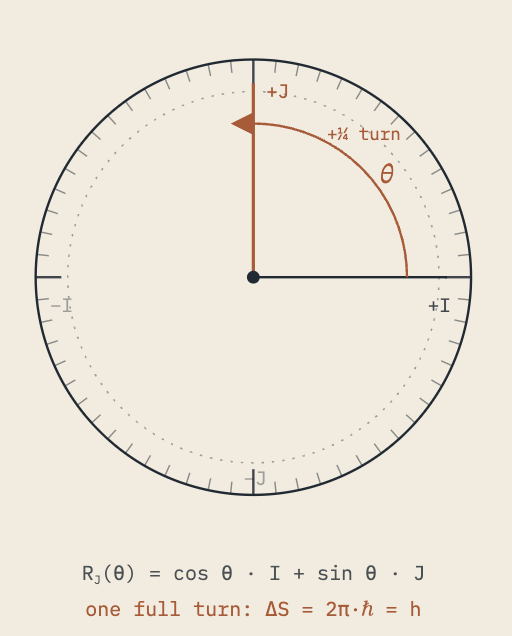
RJ(θ) = cosθ · I + sinθ · J , J² = −I , J⊤ = −J
dθ = dS / ℏ
i = Jw — the imaginary unit was a real quarter-turn all along.
The action S turns the dial: every bit of history advances the angle by dS over ℏ. And then the part I find genuinely beautiful. A dial is a circle. Go once around — 2π radians — and you have spent exactly one quantum of action:
ΔSone turn = 2π · ℏ ≡ h
Planck’s constant is the price of one full turn of the dial. The 2π is the 2π of a circle — nothing more exotic than that. And the famous quantization rules you meet later are not separate mysteries; they are the same sentence photographed from different angles: Planck–Einstein E·T = h, de Broglie p·λ = h, Bohr–Sommerfeld ∮p·dq = nh, flux quantization q·Φ = nh. One dial, closing. The patch dissolves. There was never anything imaginary down there — only a real rotor turning on a ledger we could not yet see.
05
There is no dot taking all the paths
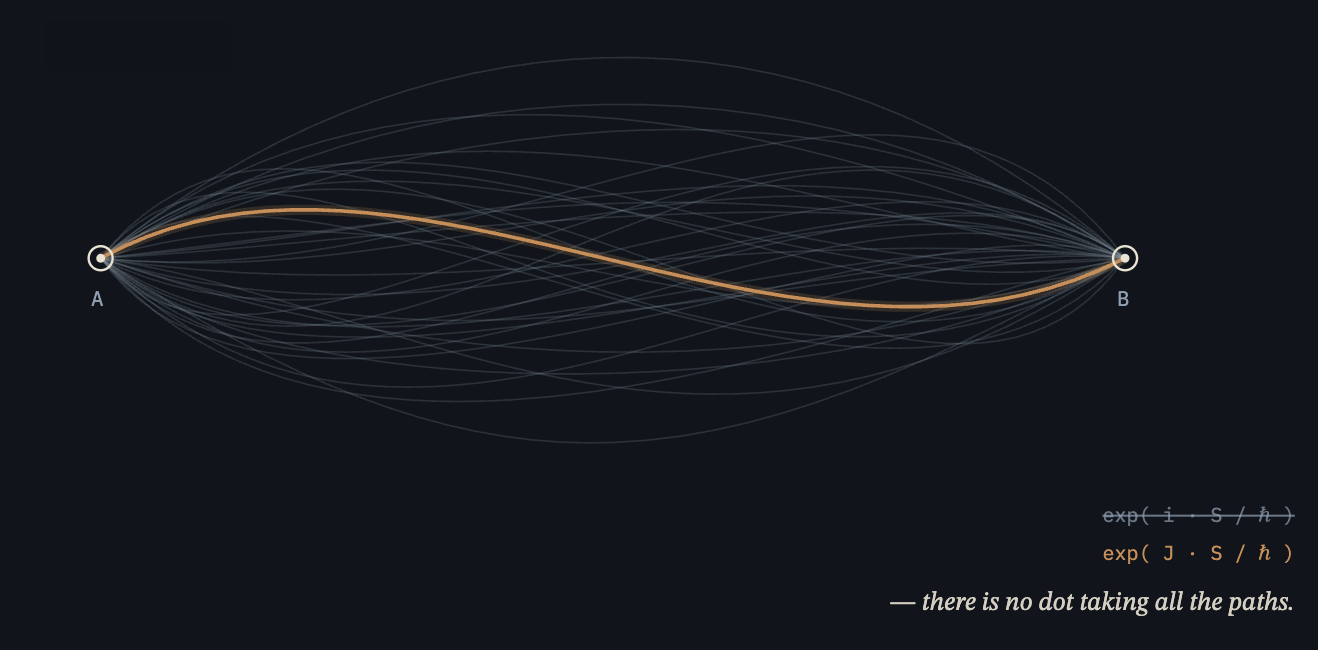
Now the “all paths.” QTT writes Feynman’s sum in its own form — an integral over histories with a finite-capacity measure and the real rotor inside it. But the “all paths” is not a journey. It is the infrared shadow of a distributed bundle. Existence, in the substrate, is never a lonely point; it is a whole 2π bundle, and the single visible path is a marginal — the projection of that bundle onto the sliver we can access. The continuum “sum over every route” is just the low-energy limit of a capacity-bounded rotor sum.
So the honest answer to which path did it take is not “all of them.” It is sharper and quieter than that: there is no lonely dot to take a path. The question assumed the very thing it was asking about. We answered a phantom.
06
We derive the diagrams — that was never the quarrel
Hear me clearly, because this is where I am most often misread. I am not saying Feynman was wrong to compute. I am not saying the diagrams are useless, or that we should burn them. The exact opposite. In the least-action paper I derive the whole machine — stationary action, the path-integral weight, the action quantum h = 2πℏ, and every one of those quantization rules — from the axioms, with no free parameters, recovering the known answers exactly. The path integral and the diagram bookkeeping that grows out of it describe the human-invented effective universe beautifully. That was never in dispute.
A map can be exquisite and still not be the territory. Feynman drew the finest map in physics — and then told us the territory was a bad question.
The error was never the drawing of the map. The error was forgetting it is a map — and then ruling the question about the land itself meaningless. You are allowed to draw the most accurate chart in the world. You are not allowed to use its accuracy as proof that there is no coastline.
07
Revise the question before you answer it
This is the heart of it, and it is a method, not a mood. Which slit did it go through? Which path did it take? These are not profound questions with a bizarre answer. They are malformed questions carrying a false premise — a point particle on a trajectory, an object borrowed wholesale from the invented universe. “Shut up and calculate” answers a malformed question by force: it refuses to repair the premise and forbids the asking instead.
QTT does the one thing that was actually available the whole time. Before you craft the answer that shuts the mouth — revise the question. Replace the premise. There is no point particle; there is a distributed bundle on a finite-capacity ledger. Do that, and the question either dissolves on contact or earns a real, mechanical answer. The price of the patch was a generation taught that the deepest why in their own subject was off-limits. We can give that why back.
You do not answer a broken question. You repair it. Then it answers itself.
08
The turtle and the question
My turtle — the patient one, the observer of the light — once asked which path the photon took. The textbook told it: all of them, now hush. But the turtle has never been in a hurry, and it has watched a very great deal of light. It noticed the trick. The answer had quietly assumed the photon was a dot with a route to choose. It is not. It is a share of a whole turn. The turtle did not need to be silenced; it needed a better question. And when you give it one, it will wait — as it always does — for the real answer instead of the silence.
Feynman’s silence was honest, once. It is still not an answer. The question was never the problem. Our picture of the asker was. Repair the asker — trade the lonely dot for the bundle, the imaginary number for the real dial — and the universe starts talking again.
A note on what this is and isn’t: this is an argument about meaning, and QTT backs it the only honest way — by deriving the same machinery from its axioms (action rail), parameter-free, and recovering the known results exactly. The neck-out experimental tests live in other papers. Here the claim is depth, not a new number: same mathematics, a real account underneath.
Maps for this note
The real J-dial, path sums, and the action rail
This essay is a reader-facing bridge. The citable object is the least-action / Feynman-path concept DOI; the ontology route runs through J_w, completed-address support, A7 bundle closure, and access projection.
The paper behind this note
Hamilton’s Principle, Feynman’s Path Integral, and the Action Quantum h = 2πℏ as Capacity-Rotor Theorems — doi.org/10.5281/zenodo.20098143
Foundations: the QTT main book · the Corpus Tree · the Zenodo community
Three nearby routes into the same question
Read these together when the question is not only how the mathematics works, but what object the mathematics is a shadow of.
A finite construction to read alongside this essay
Complex Structure and Composition from Finite Real Source Histories, v3.2, gives the frame-cycle construction, common-complex-structure joining rule, reversible event model and material tensor realization. Its 63 pages include a complete reference-history benchmark and an all-future algorithm that either certifies agreement or returns a replayable distinguishing experiment. All inherited proofs and audits remain in the reconstruction package. The matched compatible quantum instrument gives the same benchmark records with no additional fit; physical preparation and source-to-apparatus qualification remain explicit.
Quantum Traction Theory · quantumtraction.org