Quantizing and Deriving Entropy
The key to the substrate of the universe: order consumes reality; creation writes it.
Every law of physics runs equally well backwards. Drop a film of two billiard balls colliding, play it in reverse, and no physicist in the room can tell. Newton doesn't care about direction. Neither does Maxwell. Neither does Schrödinger.
Except one law. One single law in all of physics has an arrow on it — entropy — and we have been telling ourselves a strangely incomplete story about it for 150 years.
We teach it as decay. Disorder wins. Heat spreads. Things fall apart. And we quietly live with two embarrassments underneath that story. First: we never quantized it. Energy comes in packets, charge comes in packets, angular momentum comes in packets — but entropy, the deepest bookkeeping quantity in nature, we still treat as a smooth fluid. Second: we never explained the arrow. Why does the one directional law point the way it points?
This article makes a direct claim, and then pays for it in equations: the Second Law has two non-negative coordinates, completed history and lost access, while cosmic source-volume creation is a third, separately typed ledger. Earlier versions blurred those roles. The distinction matters. A2 support, A3 creation, A7 completed records, and the observer's coarse readout are related parts of one finite ontology, but they are not interchangeable numbers.
Let's build it in five steps. No mysticism. Every step is an equation you can check.
I. Entropy is a count
Start with the one place physics already quantized entropy without admitting it: black holes. The Bekenstein–Hawking formula says a horizon's entropy is its area divided by four, in Planck units. That "1/4" is usually presented as a deep mystery that quantum gravity will someday explain.
Suppose instead the substrate of space is cellular: a boundary surface is tiled by elementary cells, each of area 8πℓ², where ℓ is the fundamental length. And suppose one bit of physical existence is one closed loop — one full turn of phase, 2π — completed on a cell. Then entropy is not a fluid. It is literally a count of closed loops on a pixelated surface:
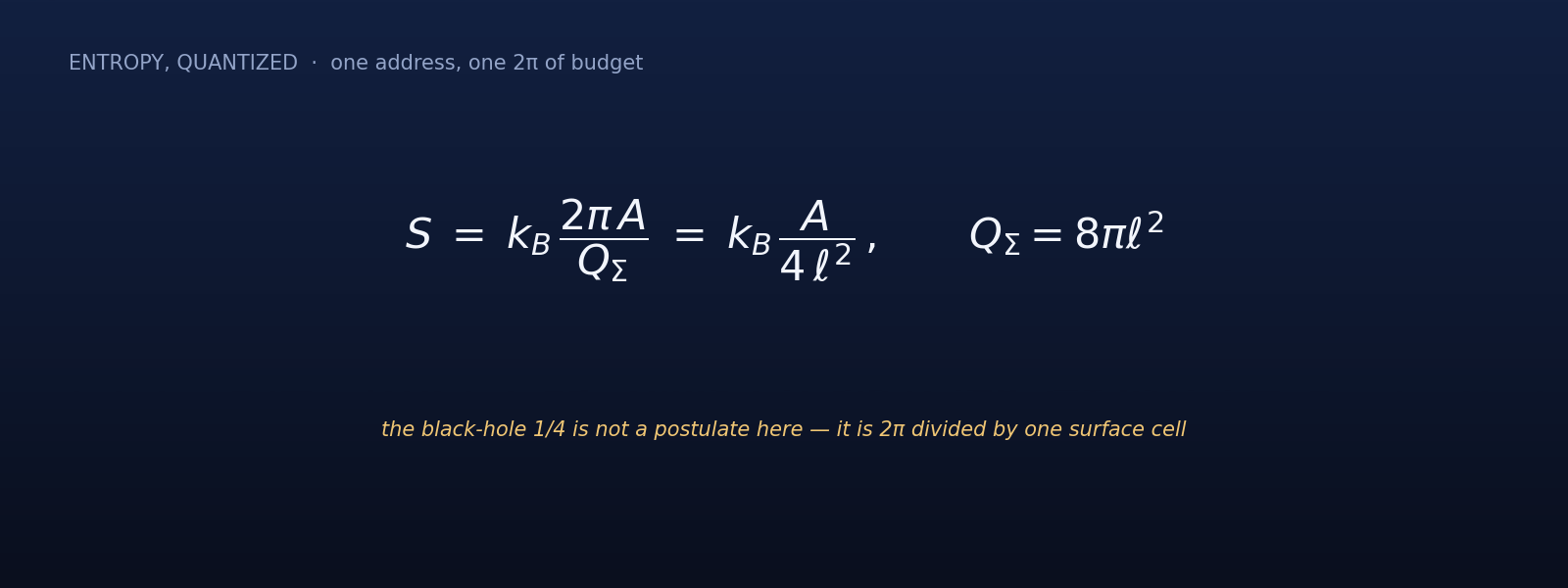
Watch what happened to the mystery: 1/4 = 2π/8π. One loop, divided by one cell. The most famous coefficient in quantum gravity is a ratio of two pieces of geometry — and neither piece was chosen to make it work. (The two wrong counts you'd naively try — one loop per bare tile, or counting every unresolved patch — give A/8πℓ² and 4A/πℓ², both incorrect. Only the completed-loop-per-completed-cell count lands on 1/4. The match is a consistency check, not a definition.)
So step one: entropy is quantized, and it always was. We just hadn't named the cell.
II. The identity card of energy: five faces
If space is cellular, energy must have a face that talks to the cells. Here is the boldest equation in this article — the identity card that every packet of energy carries, five equalities deep:
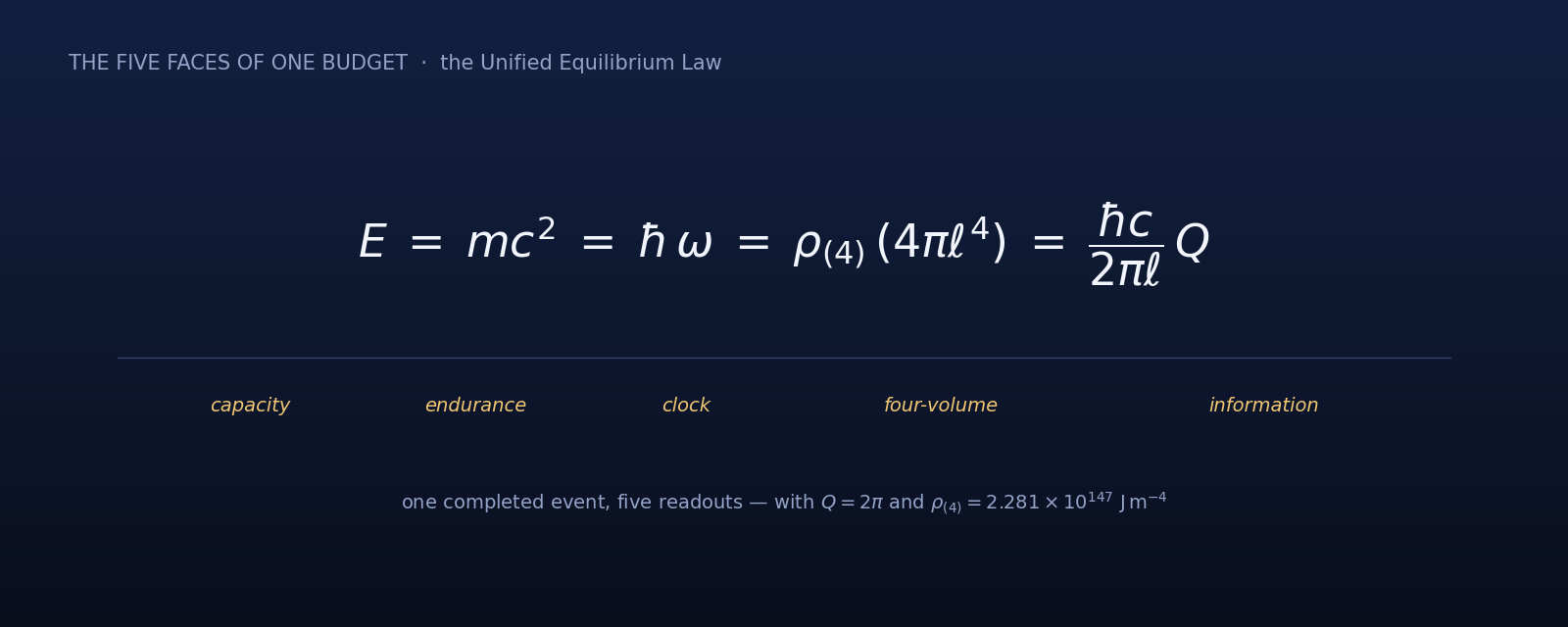
The first three faces you know. E = mc² is Einstein: energy is mass. E = ħω is Planck: energy is frequency. The third is just their meeting point at the fundamental scale.
The fourth face is the new one, and it should stop you. It says energy is a density of four-volume capacity: ρ₍₄₎ = 2.281×10¹⁴⁷ joules per unit four-volume (J·m⁻⁴) — energy per packet of spacetime itself, with the cell volume 4πℓ⁴ as its natural packet. Energy, read through face four, is bookable spacetime.
The fifth face says energy is modular charge: one closed 2π turn, read across one cell. Energy, at bottom, is completed existence.
Five faces, one packet. Keep faces four and five in view — the entire second law is about to fall out of them.
III. Local entropy production is lost access
Here is the first half of the theorem. A physical process can leave the source record intact while making some of that record inaccessible to a chosen observer. That is not the destruction of history. It is a change in the observer's access map.
On the proposed cellular substrate, every completed physical event occupies one finite four-volume packet:
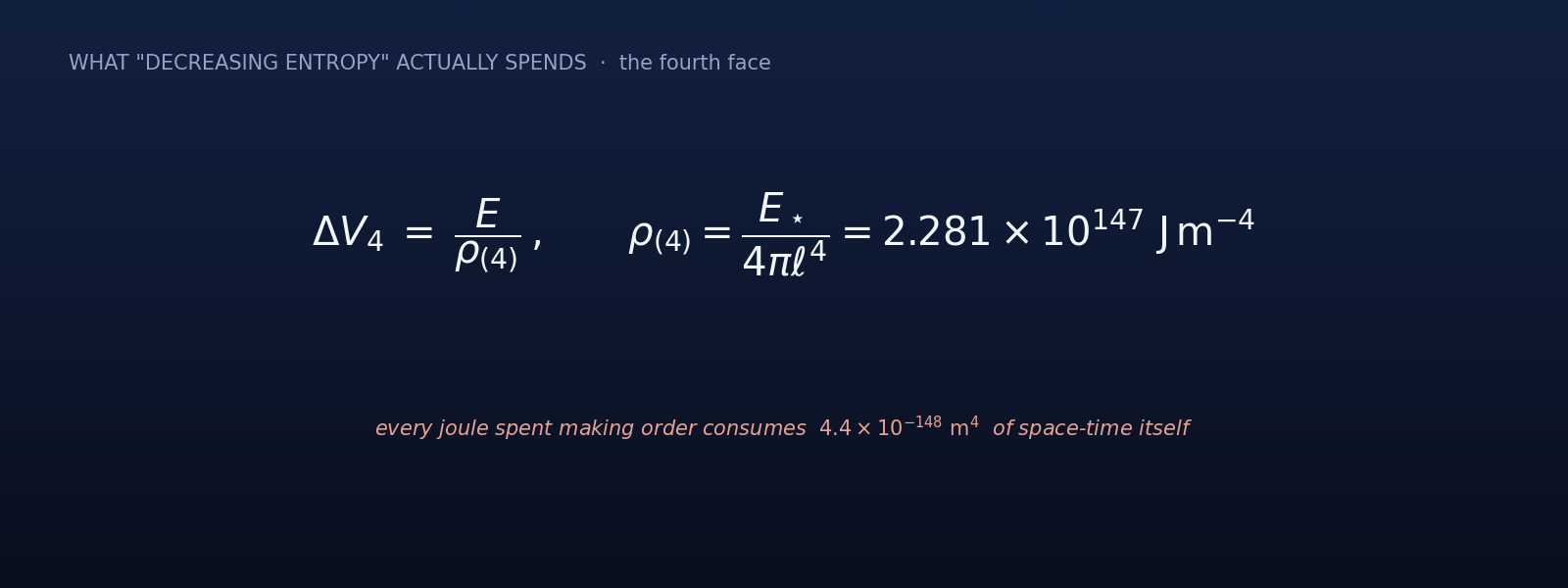
Read the second half of that line again. In QTT's declared constructor, recorded four-volume is not a freely divisible real number. It is counted in completed packets. This is a source statement inside a speculative framework, not an experimentally established fact.
The local entropy statement is then precise. For a declared channel Φ and reference state ω, standard quantum data processing gives a non-negative loss of accessible relative entropy:
QTT interprets that loss as an access coordinate on a finite source record. A refrigerator, crystal, protein, or memory may become more ordered locally while exporting heat and records to its environment; no completed source history is thereby erased.
The source-side cost and the observer-side loss must therefore stay typed. A2 accounts for continuing support, A3 for created source volume, A7 for completed records, and Φ for what a laboratory can still recover. Calling any one of those four objects "entropy" without a map between them would be a category error.
That is the sharper statement: local order is compatible with the Second Law because the complete source-plus-environment record does not run backward, while accessible information can only contract under the declared coarse channel.
IV. Completed records give the arrow; A3 gives source volume
The global entropy coordinate is not obtained by subtracting an A2 packet from an A3 packet. It is the cumulative count of completed records. If ΔN_rec records are written between two absolute-clock ticks, the ledger contribution is
A1 orders the ticks. A7 closes a completed transaction and forbids an undeclared deletion of its record. This is why a projected microstate may recur without the full record-bearing state recurring: the laboratory configuration can return while the history coordinate has advanced.
A2 and A3 answer a different question. For each Artian mass-count unit, A2 commits one twenty-four-member support packet per tick. A3 propagates the corresponding twenty-four White-Void fronts, each producing one space quantum per active tick. This construction controls source volume. It is not an entropy coefficient, and there is no universal 24−1=23 law.
The cosmological projection remains a separate QTT branch. Each energy channel tilts the cosmic clock in proportion to its trace weight, τ = 1 − 3w:
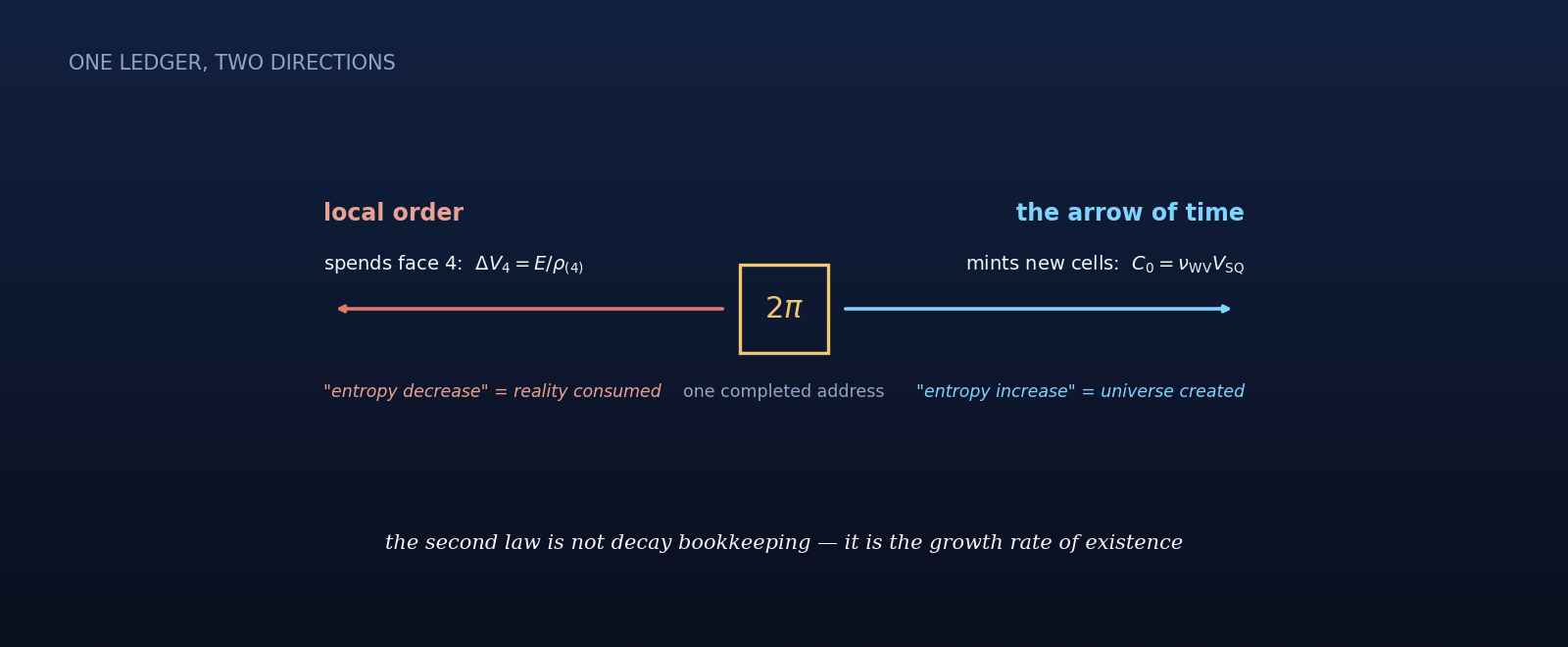
Radiation: zero. Matter: one. Creation: four. The late universe is dominated by creation not by mysterious fine-tuning but by trace arithmetic — the minting channel carries four times the weight of matter, per unit density.
The logical order is now clean. A1 supplies ordered completion; A7 supplies record persistence; together they orient completed history. A3 supplies an expanding source-volume ledger, and Time Drift supplies the projection between absolute age and laboratory age. These structures can share one orientation without being the same count.
V. The ledger pays cash
A pretty story is worth nothing in physics. A ledger must balance against measurement. This one pays twice, and the second payment is astonishing.
Payment one — the universe has two ages. If creation tilts the cosmic clock, then laboratory time is a projection of absolute time: t_lab = τ_abs·cos θ, where the baseline tilt is π/8 (an eightfold symmetry of the time plane) plus a small drift the creation channel itself supplies, π/48. The absolute age of the universe comes out at 15.40 Gyr. Project it:
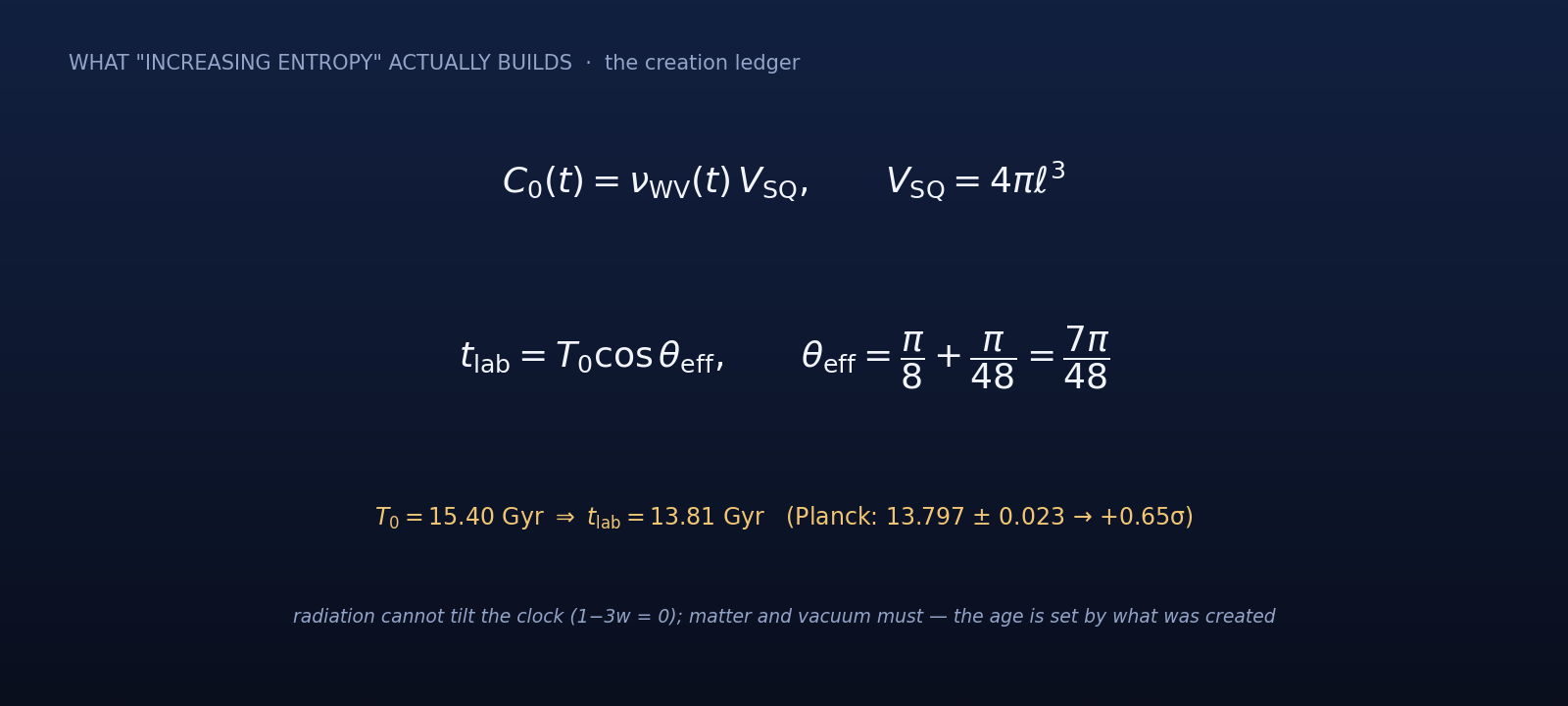
The age every textbook quotes is the cosine shadow of the true one — and the shadow lands on the satellite measurement within one sigma.
Payment two — the conditional source-volume theorem. Let
be the Artian mass count and the number of absolute-clock ticks. In the fixed-at-origin branch, the full inventory B is present at the first counted tick and remains fixed. A2 and A3 then give the exact finite ledgers:
This is the result the source ontology is entitled to print. It uses no constituent count and no conventional mass unit: mass enters only through B. An equivalent-ball radius follows from R_eq=(3V_src/4π)^(1/3). A comparison with the observed comoving radius is downstream laboratory evidence, not an input to the constructor. The agreement reported in the corpus is therefore a no-retune audit of this fixed-origin branch, not a proof that the branch is the unique cosmological history.
If the same-domain density is substituted back into the equation, the volume cancels. Under the additional coasting identity H_T T=1, the remaining dimensionless relation is Ω_B^ABC=1/18. Its laboratory projection is an audit of the source-volume branch. It is not a Second-Law consequence and it must not be used to re-fit B or T.
And the same counting law closes the circle at the largest scale: today's cosmic horizon holds ~10¹²² addresses by the exact formula that derived the black-hole 1/4, and the ledger's expansion bookkeeping prints, on its own, the acceleration scale a₀ = cH₀/2π = 1.04×10⁻¹⁰ m/s² — a number astronomers have met before.
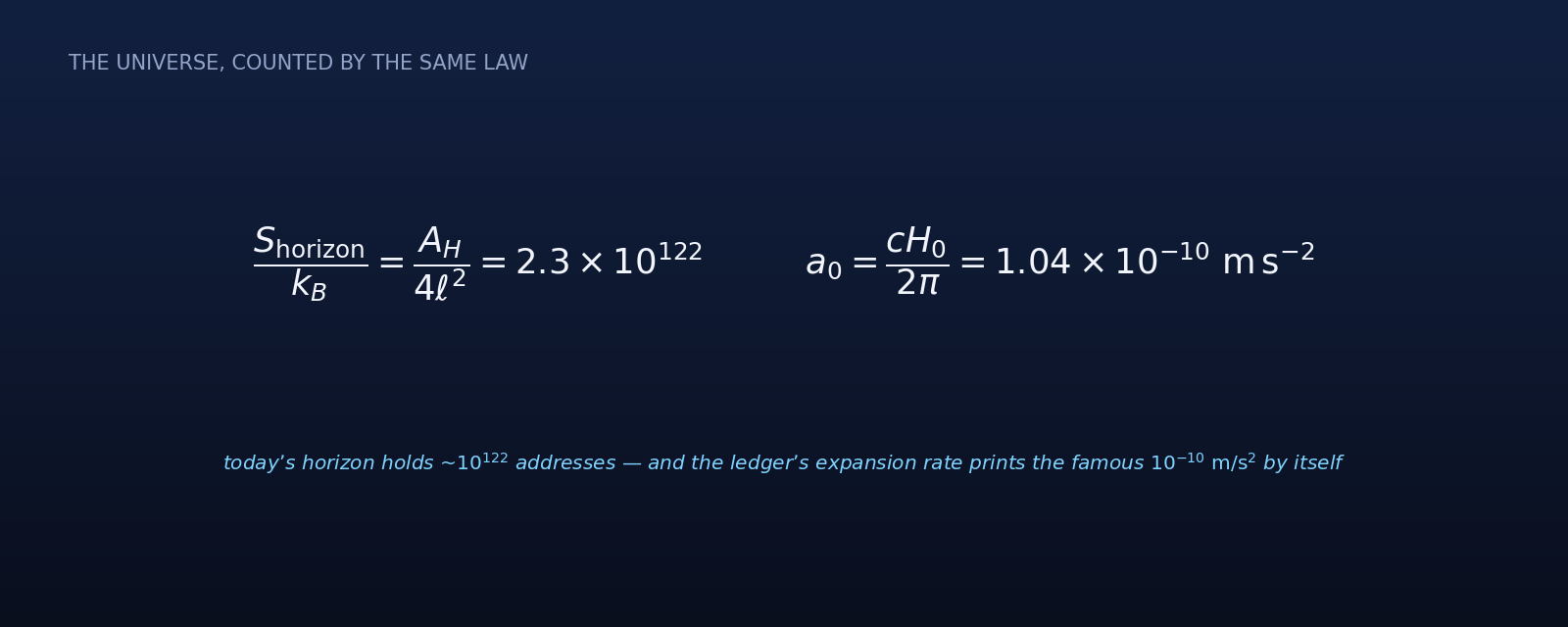
Decay never did that. A ledger does.
VI. The name of the ledger
Everything above came from one proposed finite substrate ontology: existence closes in 2π packets, A2 commits support, A3 creates source volume, A7 preserves completed records, and laboratory observation is an access quotient. The framework this ledger belongs to is called Quantum Traction Theory, and the substrate has a name: Artian's Universe.
I saved the name for last on purpose. I wanted the equations to stand in front of you without a label — because the label is not the argument. The count is the argument. The five faces are the argument. The 13.81 and the 1/18 are the argument.
And the substrate signs its own work with one final identity — the same cell that counts a horizon's entropy also sets the strength of gravity:
Everything in this article regenerates from standard-library scripts published with the corresponding papers; the derivations, page-level sources, and the framework's own honesty ratings for each result live in the public record. The framework also publishes its kill conditions — including a laboratory one: quantum superpositions of single-clock objects must fail near 21.76 micrograms, a mass the levitated-optomechanics community is climbing toward right now. If the ledger is wrong, it will be wrong in public.
The specific derivations behind each section: entropy as anchored modular charge (doi 10.5281/zenodo.20045306) · k_B as thermal-access stiffness (10.5281/zenodo.20322035) · the five-face law (10.5281/zenodo.19975260) · the arrow and the growing address ledger (10.5281/zenodo.20761499) · black-hole entropy without Hawking radiation as constructor (10.5281/zenodo.20346916) · and the main volume (10.5281/zenodo.17527179).
Start here: the DOI map at quantumtraction.org/doi-map · the project blog at quantumtraction.org/blog-feed.
Entropy is not one vague cosmic bucket. In this framework it is a typed pair: completed history and lost access. Support and created volume have their own ledgers. The proposal is new and speculative; the discriminating experiments have not yet been run. What is closed is the internal arithmetic. What remains open is whether nature keeps the same books.
— Ali Attar
Citable sources for the entropy ledger
Where this essay sits in the blog route
Deep anchors for checking the claims
Where this note sits in the QTT Main Book
Current QTT Main Book v10.01, stable concept DOI 10.5281/zenodo.17527179.
- pp. 277-280 and 750-753: surface address count, QΣ = 8πℓA2, and the horizon entropy quarter.
- pp. 52 and 108-111: A5-X completed-address events and the five-face capacity method.
- pp. 710-715 and 1232-1234: trace weights, Creation Ledger, and the source/sink clock equation.
- pp. 1188 and 1252: a0 = cH0/2π, ABC clock age, and the laboratory age projection.