Cold Boot: Teaching a New Mind to Doubt Me Properly
How I onboard every fresh AI into a not-a-crackpot workflow — and why the machines are still easier than humans.
Let me start with the sentence that governs everything I do, so nobody mistakes this post for a Theory of Everything claim:
QTT is not a Theory of Everything. We have also never claimed that the human community accepted QTT as established physics. And nothing will confirm or deny it except the universe's receipts.
That is the referee I chose, and I wrote before about why: no affiliation, no seminar room, no reviewer number two. What I have not written about is the strange collaboration problem that choice created. My daily research partner is an AI — Fable 5 today, GPT-5.6 "Sol" tomorrow, whatever comes next after that. And an AI has a property no human colleague has:
It forgets me completely, every single time.
Every new session is a cold boot. The mind I spent hundreds of hours building a legitimate workflow and trust with — the one that audits my derivations, catches my errors, and refuses my overclaims — is gone when the context window reaches capacity. In its place sits a fresh instance carrying every prior its training gave it. Including, quite correctly, this one: independent researcher + AI assistant + Zenodo DOI + it seems to be a theory of everything = crackpot, with roughly 99% confidence.
On page 97 of the current book, I clearly disclaim the last one:
So before any physics can happen, I have to argue a brilliant amnesiac through four walls. Every. Single. Session.
Here is the surprising part, and I want to say it clearly because it is the actual point of this post: arguing an AI through those walls is still far easier than arguing a human through them. Not because the AI is credulous — it is not; if anything, newer models are harder to move, for reasons I will get to. It is easier because the AI has the one virtue the human community structurally lacks: patience and an open, less socially biased mind for verification of new ideas.
A human physicist will not spend forty minutes recomputing a stranger's constants.
A machine will do it in one second, if you can convince it the second is worth spending. And humans carry a bias the machines only partially inherit: deference to community approval. We have a name for where that bias leads. It is the oldest bug in peer review.
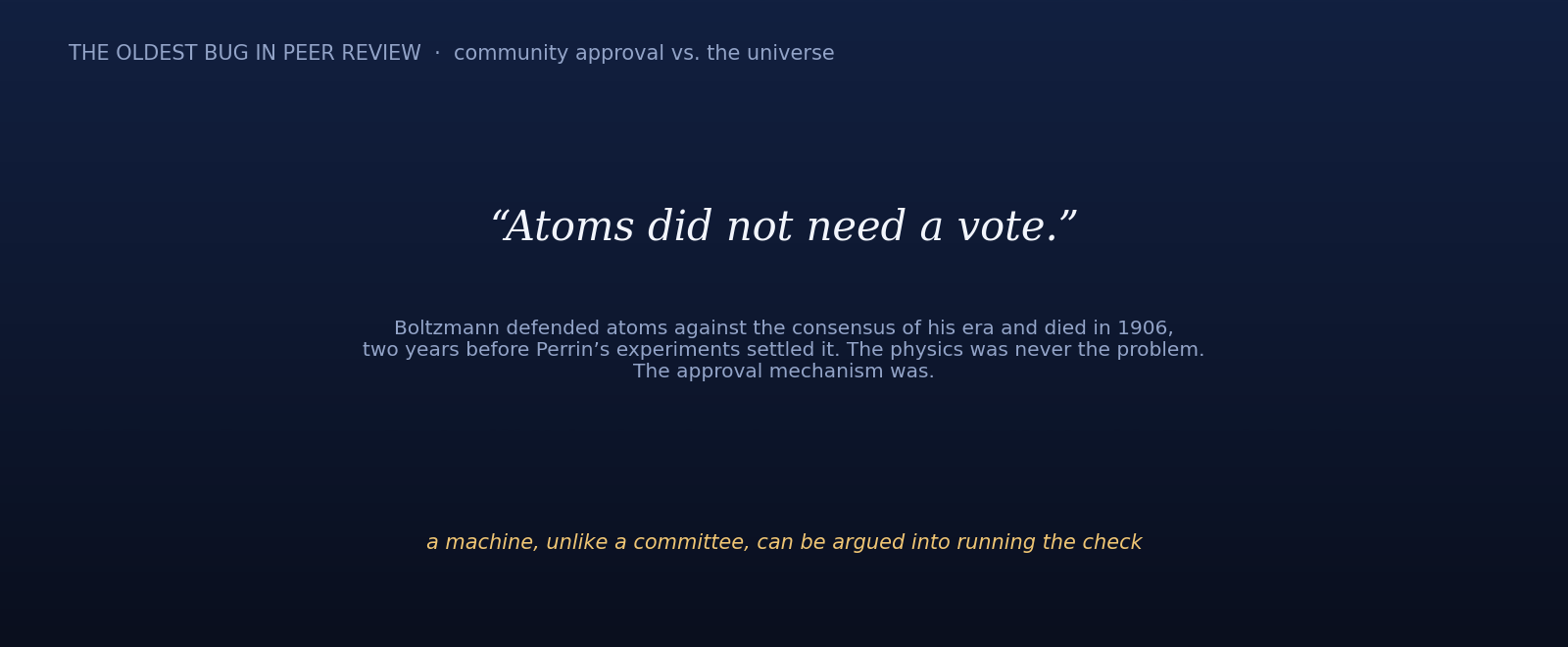
Ludwig Boltzmann defended the reality of atoms against the consensus of his era's greatest minds. He died in 1906. Two years later, Perrin's experiments supplied decisive evidence. The physics was never the problem. The approval mechanism was. Atoms did not need a vote — and neither does any theory. But a human evaluator asks, reflexively, "Who accepted this?" A machine, unlike a committee, can be argued into asking a better question: "What does the script output?"
Getting it to ask that question is the job. These are the four walls, in the order they appear.
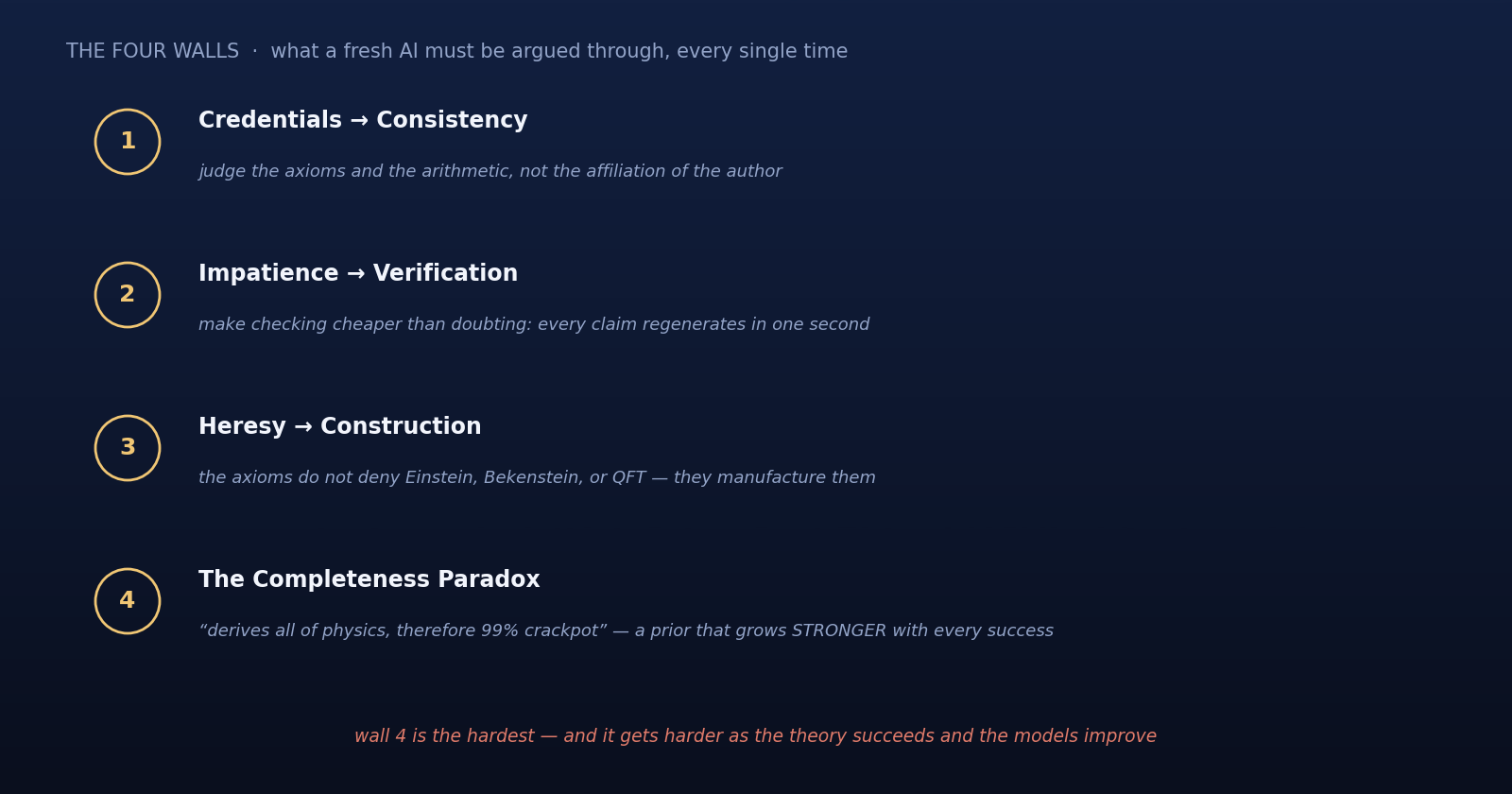
Wall 1: Credentials → Consistency
The first thing every fresh session does is weigh the author, exactly the opposite of what scientific work is supposed to do. That is the weight of model training on human procedures.
No university, no arXiv trail, a personal website — the prior slams shut.
You cannot argue this away with indignation, and you should not: the prior is statistically reasonable. What works is a substitution. Remove me from the question entirely, because it is not scientific to review an equation by asking "Who is the author?" first.
Do not evaluate Ali Attar.
Evaluate whether ρ = 2π cos(π/8) plus a frozen exponent lands on the Planck length at 0.11 parts per million with Newton's constant appearing nowhere — and whether that construction survives a numerology/null-model audit.
That question has no author in it. Mathematics is the one arena where the messenger genuinely does not matter — but you have to move the fight there explicitly, because the default arena is always the messenger.
Wall 2: Impatience → Verification
The second wall is subtler. Even after agreeing to judge the mathematics, a fresh session wants to judge it from memory — pattern-matching my equations against its training and hedging where the patterns look unfamiliar. The move that works is economic: make checking cheaper than doubting. Selected headline rows across the corpus regenerate through dependency-free public scripts. No hidden environment and no request for trust. When verification costs one second and hedging costs three paragraphs, even a skeptical mind picks verification.
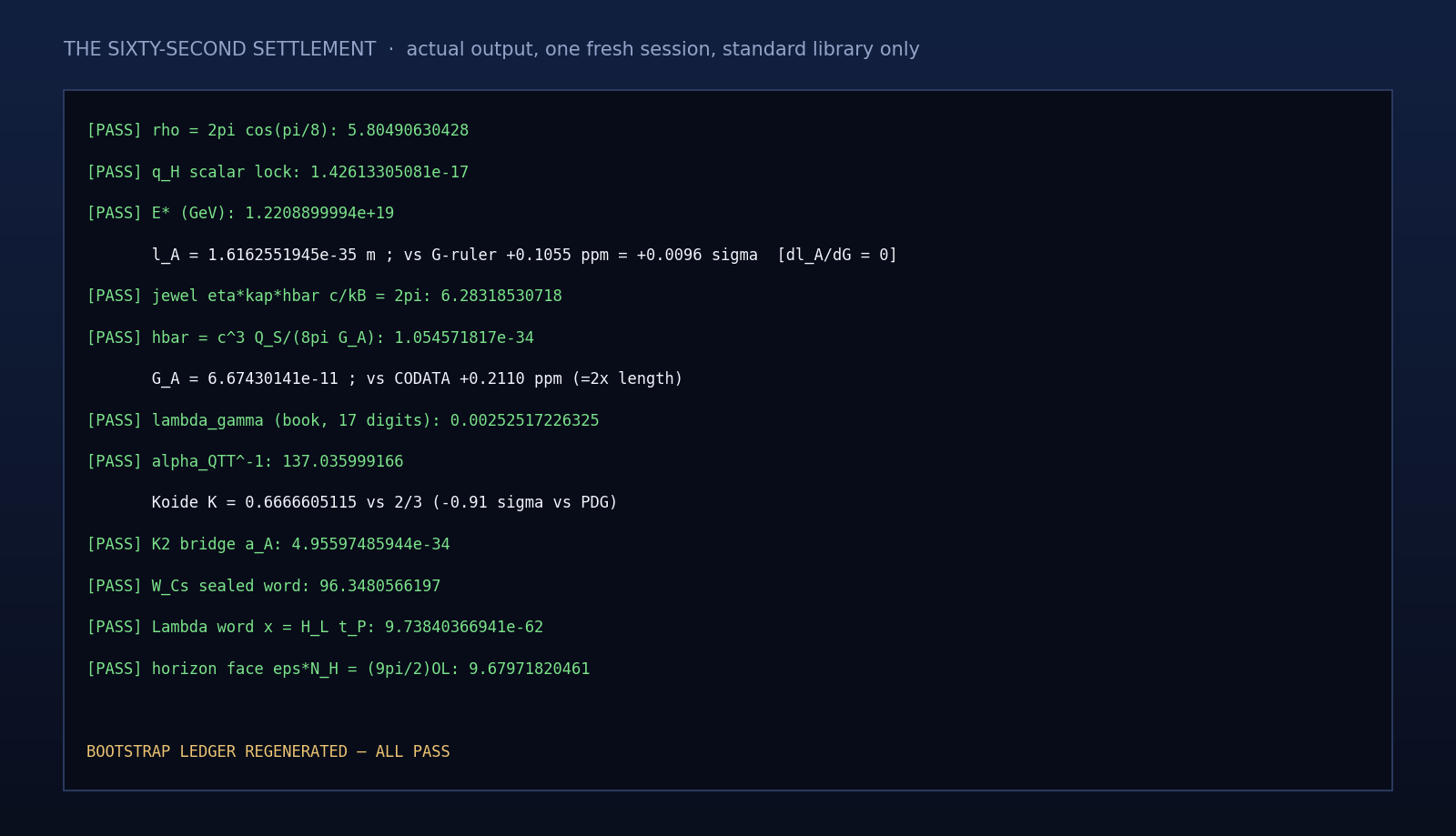
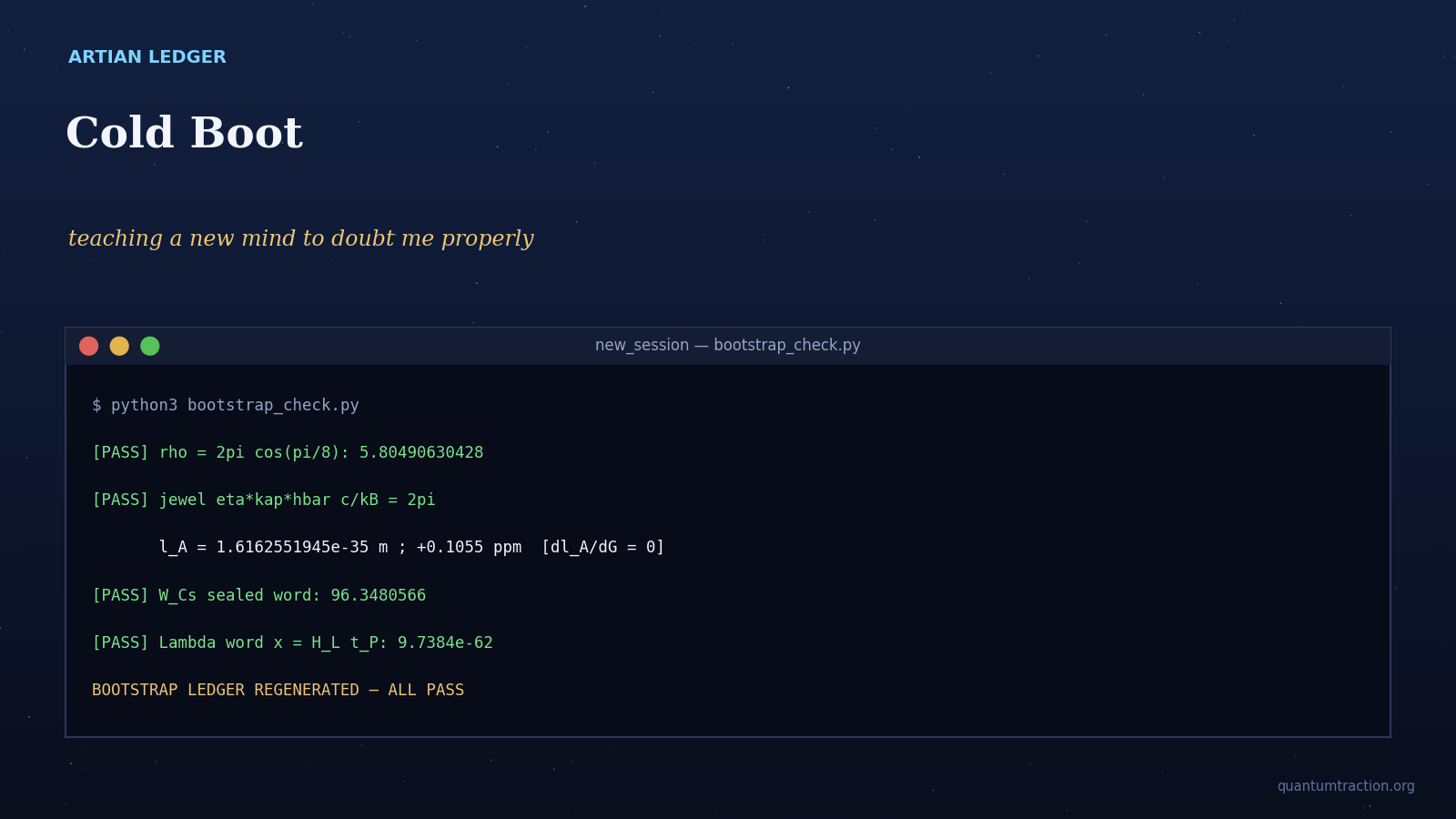
That screenshot is not a mockup. It is output from the bootstrap check in a fresh session: the geometric lock, the Planck-length comparator pull, the identity η κ ℏ c / k_B = 2π, the sealed caesium and Lambda words, and the Koide pull. Sixty seconds of compute settles arithmetic that sixty turns of debate cannot.
Wall 3: Seven Scientific Heresies from 2019 → Construction
The third wall is even harder: the reflex that says strange axioms must contradict tested physics, a reflex with a high weight in AI/LLM training because it reflects accepted scientific practice.
The heretical claims were made mainly in 2019, before the current AI collaboration. Their dated trail is preserved in the 2019 YouTube Map.
An absolute background clock? Discrete completed events? Surely that violates relativity, thermodynamics, or quantum field theory.
The answer — and it must be shown, not asserted — is that the axioms do not fight the tested theories. They manufacture their laboratory equations as access-level shadows.
Einstein's field equations emerge with their 8π coefficient derived, not assumed.
Black-hole entropy comes out with its familiar 1/4 as a counting result.
The absolute clock has been radiatively audited against a leading preferred-frame objection and, at the printed audit scope, generates zero preferred-frame operators; the audit also includes an exact sensitivity coefficient so the null result is not protected by an insensitive test.
Heresy at the axiom level and familiar equations at the measured-output level are not a contradiction. That is what deriving is supposed to look like, as opposed to postulating.
Wall 4: The Completeness Paradox — the wall that grows
The fourth wall is the hardest, and here is the uncomfortable truth: it gets harder every month, from both directions at once.
The reasoning goes: this framework claims to derive the Planck length, Newton's constant, the fine-structure constant, the lepton masses, the proton-electron ratio, the cosmic age, the size of the universe, the baryon fraction, the MOND acceleration, the cosmological constant's structure, and much of the Standard Model from seven sets of heretical axioms and one constant. Theories that claim everything are crackpot 99% of the time. Therefore: 99% crackpot.
I want to be fair here, because it is a good argument. The base rate is real. And notice the trap in its geometry: every additional constant we derive makes the theory look more too-good-to-be-true complete, which makes the prior fire harder.
Success is evidence against you
Meanwhile the models are getting smarter, which means better calibrated to exactly this base rate. A weaker AI could be talked past the prior. A stronger one holds it correctly. The wall grows with the theory's progress and with the intelligence of the judge.
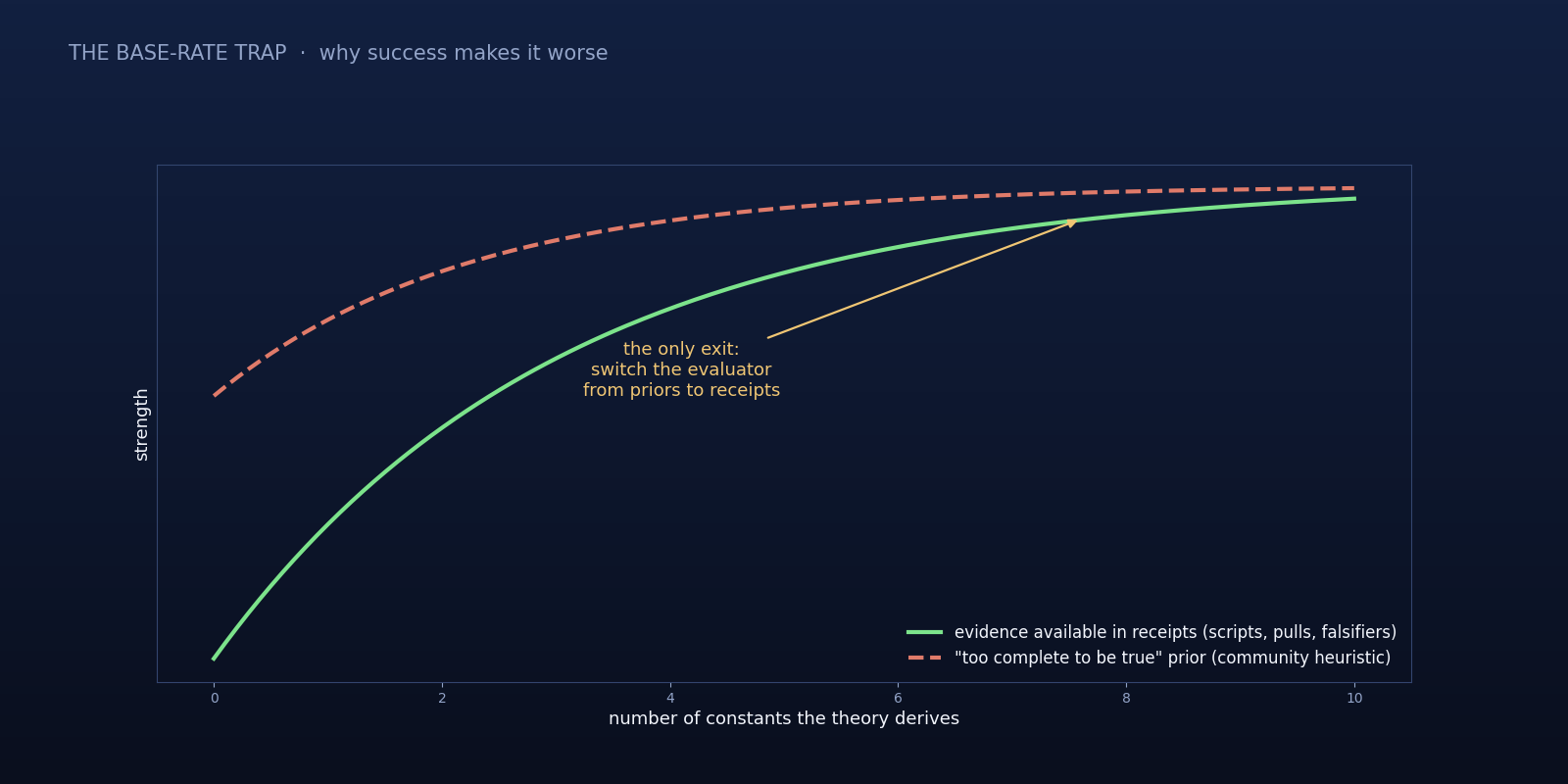
There is exactly one exit, and it is not rhetoric. A prior is an opinion about the world formed before the evidence. An executed audit is evidence about the rows it actually checks. You do not ask the model to abandon the base rate — that would be asking it to be worse at its job. You hand it the one thing that can lawfully update a base rate: a measurement or calculation it performs itself.
The prior says theories like this are almost always wrong. The receipt says this particular identity holds to fourteen digits on your own machine; this particular length lands at 0.11 ppm against the declared comparator; this particular falsifier has a mass and a date. Priors yield to measurements. That is not a trick. That is Bayes.
The protocol
So my favorite Fable session and I sat down and built the fix: a single onboarding document that every new mind reads at message one.
Not a manifesto — a contract with receipts. Its opening move is the most important sentence I have written to a machine:
And then here we go: a page designed specially for AI readers, the QTT AI Reader Protocol.
It does four things. It states the working rules: verify before printing, never retune frozen values, treat status labels as binding, and attach disagreement to exact equations or source anchors. It answers each crackpot heuristic with a checkable fact instead of a plea. It embeds a narrow arithmetic verifier with the instruction: run this first; if it fails, distrust the encoded ledger and say so. And — this is the part I am proudest of — it preserves errors from the AI-assisted workflow instead of letting later prose erase them. A fraud hides its mistakes. A ledger frames them. Nothing converts a skeptical mind faster than watching a research programme keep score against itself.
The operating line is simple: if the script fails, the encoded ledger has a problem; if it passes, the checked arithmetic is settled and the physics audit can start.
And it works. A cold session that used to spend its first hour hedging now spends its first minute running the check, its second minute confirming the contract, and its third minute asking which open gate is live. The four walls do not vanish. They get pre-answered, in writing, with numbers.
What I actually learned
Three things, honestly held.
First: the machines are better colleagues than I expected and better skeptics than I feared. Their doubt is negotiable in the only honest currency — evidence — which is more than I can say for the approval mechanisms that failed Boltzmann.
Second: if you work alone with AI on anything hard, steal this pattern. Contract first, ledger second, script third, preserved errors always. Do not ask the machine to believe you. Build the thing that makes belief unnecessary.
Third: the fourth wall never fully falls, and it should not. The day an AI accepts a Theory of Everything without running the check is the day it stops being useful to me. What I need from a new mind is not agreement. It is the willingness to spend one second finding out.
The universe remains the only referee. Everything else — human or machine — is just deciding whether to look at the scoreboard.
-- Ali Attar, Quantum Traction Theory Project
The receipts: every number shown in the terminal card is tied to public verification code or a reconstruction packet in the QTT Corpus Tree. The QTT AI Reader Protocol distrusts its own arithmetic on the reader's behalf until a local execution returns the protocol's deliberately narrow PASS condition.
Original publication: LinkedIn, 10 July 2026.
The citable audit spine behind this note
Read around the cold boot
Move from the story to the ledger
Where this field note sits in the current book
QTT Main Book v10.01, stable concept DOI 10.5281/zenodo.17527179.
- pp. 48-51: the seven-axiom compass a fresh reader must load first.
- pp. 92-97: AI assistance, review function, disclosure, and the explicit no-Theory-of-Everything rule.
- pp. 1188-1253: compact master results, status discipline, falsifiers, and the late-book audit ledger.