In Search of the Substrate of the Universe: An Interesting Exchange with a Fellow Researcher
What Julio Cesar Santana Valderrama asked about the Atom of Reality, Artian's Ruler, and whether Newton's constant is an input or an output

Artian's Ruler and the source normalization G_A are separated from laboratory metrology. The A5-X geometry closes the Atom of Reality inside the declared QTT premises, while chi_g = 1 is the explicit endpoint-faithfulness clause inherited from the full A2 gravity correspondence packet. The Tier-K counterfamily shows that a weakened packet without that clause is insufficient; it does not turn the inherited clause into a new fit. The current CODATA comparison is retrospective cross-sector consistency, not a blind confirmation.
It has been a while since I started posting my articles on LinkedIn. They receive views and impressions. Most of my connections work in academia, yet public engagement is much quieter. I cannot assign one motive to every silent reader. Some people may simply disagree. Some may not have time. Some may think the work is too speculative to deserve a comment.
There is another possibility too, and I have written about it before. Publicly touching a speculative theory of foundational physics can be expensive for a working scientist. Criticizing it still gives it visibility. Taking it seriously can be read as endorsement. Asking whether a century-old assumption should remain an assumption can create more professional risk than quietly adding another calculation inside an accepted framework. Grants, journals, hiring committees, and reputations do not reward every kind of curiosity equally.
That is why I notice the people who engage anyway.
Randy Baadhio is one of them. He is willing to enter discussions about strange, fringe, or speculative ideas and criticize them strongly. That is not hostility to science. It is part of science. A foundational proposal does not need ceremonial politeness; it needs someone with enough courage and patience to find the weak joint and push on it. Even if ninety-nine ideas out of a hundred fail, serious criticism is still more useful than a room full of silent impressions.
Another interesting exchange came from Julio Cesar Santana Valderrama, a mathematical problem solver working on finite honeycomb lattices, spanning trees, structural invariants, and emergent patterns. What impressed me was not agreement. It was how quickly he found the exact questions that matter.
We discussed two equations. The first was the proposed fourth face of the Planck-energy identity, developed in the source geometry of Artian's Universe. The second was the reconstruction of Artian's Ruler without using Newton's constant 
Julio did not ask whether the equations looked beautiful. He asked whether their ingredients were independently earned.
That is the right question.
In translation, one of his comments made the point cleanly:
A geometric structure does not acquire physical meaning simply because it produces a beautiful formula. One must identify what object is counted, what quantity it represents, and what independent prediction it produces.
He then sharpened the challenge in English:
Your fourth-face idea is interesting, but I think it becomes much stronger if we separate the established identities from the proposed one.and
are established relations. The genuinely new statement is
. The key question is therefore not whether we can define such a density, but whether
and
can be defined independently and produce a falsifiable prediction. For example, if
, what geometry gives that exact factor, and what determines
? If those quantities can be derived rather than fitted, the fourth face becomes much more interesting scientifically.
And for the ruler and gravity:
What independent observable fixes the absolute scale? What mechanism makes
I promised him a proper answer. This is it.
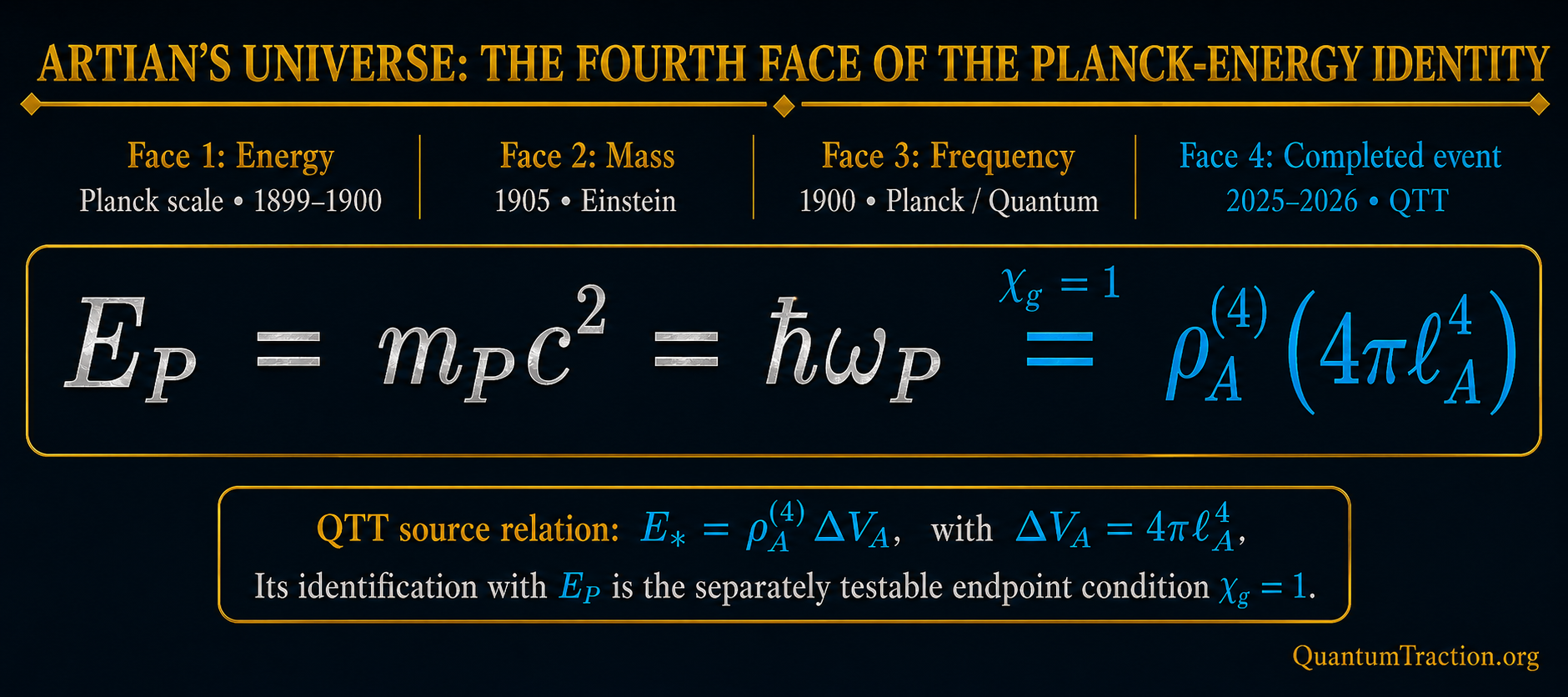
The equation must be read by color and by status. The white relations are established physics. The cyan relation is the QTT source construction. The equality to the Planck endpoint is conditional on 
The result in five layers
Before entering the construction, the scientific claims need to be separated. An open downstream access gate does not erase an upstream source theorem, and a closed source theorem does not silently close a laboratory-access gate.
| Layer | QTT statement | Current status |
|---|---|---|
| Artian's Ruler |  with with  | Source equation closed inside the printed QTT constructor; no input and no gravitational-target fit. The present cross-sector comparison is retrospective, not a blind confirmation. |
| Source normalization |  | Derived QTT source normalization once Artian's Ruler is fixed. |
| Source geometry |  | Exact A5-X definition-and-closure theorem inside the declared radial-angular source geometry. Standard group and angular facts are used; A5-X supplies the physical orbit-completion identification. |
| Laboratory access |  on the branch on the branch | is the explicit endpoint-faithfulness clause inherited from the full A2 gravity correspondence packet. Removing it creates the weakened-premise gain family; that minimality result does not turn the inherited clause into a continuously tuned replacement for . |
| Current metrology | the constructed central value differs from CODATA by  ppm ppm | CODATA's uncertainty is about  ppm, so the pull is only ppm, so the pull is only  . This is unresolved cross-sector consistency, not a precision measurement or discovery claim. . This is unresolved cross-sector consistency, not a precision measurement or discovery claim. |
That is the claim hierarchy used throughout this note. The non-
First, separate established physics from the proposed fourth face
Two parts of the chain are established physics:

The fourth expression is not established textbook physics. It is a QTT source-ontology proposal:
%7D%5C%2C%5CDelta%20V_A%5E%7B(4)%7D%2C%0A%5Cqquad%0A%5CDelta%20V_A%5E%7B(4)%7D%3D4%5Cpi%5Cell_A%5E4.%0A%7D&bg=101b30&fg=f5f0e5&s=1&c=20201002)
Putting these expressions on one line does not give them the same scientific status. The first two have extensive experimental support. The last one belongs to the Artian/QTT model and must earn its standing through an independently specified constructor and a test that could fail.
This distinction does not make the fourth face small. It locates its novelty correctly. The algebra 
What does the fourth face claim is being counted?
The QTT source object is not an ordinary chunk of three-dimensional space selected at a laboratory time. It is a completed source event. I will use the shorter and stronger name throughout this note: the Atom of Reality.
The name is not meant to turn the object into a tiny material ball. An atom of matter is a constituent inside an already available space. The Atom of Reality is earlier in the logical order. It is the smallest completed address support that the source model permits to count as one physically legal event. In the model, that event closes three ledgers together:
%7D%3D4%5Cpi%5Cell_A%5E4.&bg=101b30&fg=f5f0e5&s=1&c=20201002)
The first condition is modular bundle closure. The second is one completed reduced-action spend. The third assigns finite source support to the completed event. In plain language: the model does not allow an event to enter the source ledger merely because an equation can name its energy. The event must close its bundle, spend its action, and possess a legal amount of completed reality support.
That is a closed ontological statement inside the printed A5-X constructor. Whether nature uses that constructor remains an empirical question. Keeping those two sentences together prevents both inflation and underselling: the object is genuinely derived inside the model, while the model still has to face observation.
The Reality Dimension is the spine dimension
The fourth power in 
The current QTT Main Book v10.01 introduces the Reality Dimension through the coin-and-cube construction on pp. 77–82. The operational definition appears on p. 79. The decisive wording is on pp. 80–81: the Reality Dimension is “the spine of closure,” and then, more explicitly, “the Reality Dimension and the spine of Artian Geometry.” A4 and A5 make the distinction precise. A4 supplies the real rotor. A5 supplies the address where observation can meet the object. A5-X then sharpens that address into a completed modular-capacity event rather than a coordinate that was already waiting in an invisible lattice. Location, address, and closure therefore cannot be separated carelessly:
The Reality Dimension participates in how a physical event is addressed. Its distinctive role is closure: it is where an addressed event is closed.
That is why I will name it plainly here: the Reality Dimension is the spine dimension.
It is not a fourth translational coordinate beside 


This changes the geometry of the fourth factor. The first three powers of 
Where does the exact  come from?
This was Julio's first load-bearing question, and it leads directly to the strangest object in this article.
The shape
%7D%3D4%5Cpi%5Cell_A%5E4%7D&bg=101b30&fg=f5f0e5&s=1&c=20201002)
is not a standard textbook four-volume primitive. Textbooks know how to write a four-dimensional hypercube and a Euclidean four-ball. They do not assign
That immediately raises a legitimate question: where did the Atom of Reality,
The book answers through a sequence rather than a visual resemblance. Its complete noncircular A5-X address-ruler theorem runs across pp. 55–58 of v10.01. The exact
First: one rotationally legal spatial member
A naked cube 
%5E3%0A%3D%0A%5Cfrac%7B%5Cpi%7D%7B6%7D%5Cell_A%5E3.&bg=101b30&fg=f5f0e5&s=1&c=20201002)
This is the pixellate normalization. The factor 
Second: close the orientations
One rotationally legal member is not yet one completed space quantum. The local three-rail frame must close over its proper orientation family. The proper rotational symmetry group of the cubic/octahedral frame has

elements. Therefore the completed three-dimensional space-capacity support is
%0A%3D%0A4%5Cpi%5Cell_A%5E3.&bg=101b30&fg=f5f0e5&s=1&c=20201002)
The same result can be read as the full angular measure of an isotropic direction bundle:

The two readings are not rival derivations. The 

%3D4%5Cpi&bg=0b1424&fg=f5f0e5&s=0&c=20201002)
Third: carry the spatial closure through one spine event
The three-dimensional support is still not a completed address. A5-X requires one Reality-Dimension thickness because the address closes along the
%7D%0A%3D%0AV_%7B%5Crm%20SQ%7D%5Cell_A%0A%3D%0A4%5Cpi%5Cell_A%5E4.&bg=101b30&fg=f5f0e5&s=1&c=20201002)
This is the Atom of Reality. In the book’s own wording, it is “a rotationally closed 3D capacity quantum carried through one completed
Why it is not a tesseract
A tesseract with edge

Its four axes are translational and geometrically interchangeable. That is exactly what the spine dimension is not. Replacing the QTT cell by a tesseract would remove the
Why it is not a four-dimensional sphere
A Euclidean four-ball of radius 
%3D%5Cfrac%7B%5Cpi%5E2%7D%7B2%7DR%5E4.&bg=101b30&fg=f5f0e5&s=1&c=20201002)
If its diameter were identified with 

not
The standard facts 
%3D%5Cpi%5E2R%5E4%2F2&bg=0b1424&fg=f5f0e5&s=0&c=20201002)

There is also a clean way to expose the alternative rather than hide it. Replace the angular coefficient by a general 
%7D%3DC_%5COmega%5Cell_A%5E4.&bg=101b30&fg=f5f0e5&s=1&c=20201002)
Then QTT's radial-angular source-cell commitment is the explicit statement

A coordinate change on the same closed direction sphere must leave the integral unchanged. A genuinely different physical source geometry may give a different
Is the four-density independently derived?
Once the Atom of Reality has been constructed independently, its source density can be written as
%7D%0A%3D%0A%5Cfrac%7BE_*%7D%7B4%5Cpi%5Cell_A%5E4%7D%0A%3D%0A%5Cfrac%7B%5Chbar%20c%7D%7B4%5Cpi%5Cell_A%5E5%7D.&bg=101b30&fg=f5f0e5&s=1&c=20201002)
This has units of energy per length to the fourth power. The equation does not manufacture the geometry; the geometry has already been fixed upstream by the A5-X closure. The density then names how much endpoint capacity the model assigns to one Atom of Reality. Julio's warning still matters: multiplying the density back by the same cell is an identity, not a second item of evidence. The physical content remains the independently frozen constructor and its downstream tests.
The scientific burden therefore does not sit in the multiplication. It sits in four other places:
- the finite source geometry that fixes
- the independent construction of Artian's Ruler
;
- the rule that identifies this source capacity with a laboratory-accessible endpoint;
- a prospective observation that can disagree with the completed-event model.
The fourth face is strong where it should be strong: QTT prints a nonstandard, finite Atom of Reality, defines its physical packet through A5-X, and closes its shape exactly from a no-preferred-axis member, a 24-orientation orbit, and one spine event. Its empirical standing then depends on whether that source identification survives prospective tests and whether the downstream camera can return the wrong answer.
What fixes the absolute scale if is forbidden upstream?
This is the central question behind Artian's Ruler.
The conventional Planck length is

If one uses this equation to define the microscopic ruler and later announces that

nothing has been derived. The second expression is the first one solved backward.
The QTT route is designed to block that circularity. Its latest non-
%5E%7B-1%2F2%7D.&bg=101b30&fg=f5f0e5&s=1&c=20201002)
This answers Julio's first question directly: the absolute dimensional scale is fixed by the measured weak-sector anchor
QTT then proposes a frozen weak-to-endpoint attenuation. Its main objects are
%2C&bg=101b30&fg=f5f0e5&s=1&c=20201002)
![\displaystyle q_H
=
2\exp\!\left[-4\pi^2-\frac{1}{8\rho^2}\right],](https://s0.wp.com/latex.php?latex=%5Cdisplaystyle%20q_H%0A%3D%0A2%5Cexp%5C!%5Cleft%5B-4%5Cpi%5E2-%5Cfrac%7B1%7D%7B8%5Crho%5E2%7D%5Cright%5D%2C&bg=101b30&fg=f5f0e5&s=1&c=20201002)
and a small finite electroweak edge factor
![\displaystyle \mathcal R_H^{\rm EW}
=
\exp\!\left[
-\frac{\alpha(0)}{8\rho^2}
\sqrt{6+\rho^{-2}}
\right].](https://s0.wp.com/latex.php?latex=%5Cdisplaystyle%20%5Cmathcal%20R_H%5E%7B%5Crm%20EW%7D%0A%3D%0A%5Cexp%5C!%5Cleft%5B%0A-%5Cfrac%7B%5Calpha(0)%7D%7B8%5Crho%5E2%7D%0A%5Csqrt%7B6%2B%5Crho%5E%7B-2%7D%7D%0A%5Cright%5D.&bg=101b30&fg=f5f0e5&s=1&c=20201002)
The endpoint and ruler are then reconstructed as


There is no

That is what “without &bg=0b1424&fg=f5f0e5&s=0&c=20201002)


With the stated inputs, the route gives
%5Ctimes10%5E%7B-35%7D%5C%20%7B%5Crm%20m%7D.&bg=101b30&fg=f5f0e5&s=1&c=20201002)
The conventional gravitational comparator is introduced only afterward. Its central value is extremely close, but that comparison is not allowed to reach backward and alter
This is why the name Artian's Ruler matters. The number is close to the conventional Planck length, but its declared ownership is different. The Planck length is built with
How the source normalization is constructed, and where laboratory access remains open
Once Artian's Ruler has been printed without

Using the non-

CODATA's relative standard uncertainty for 
Julio's second question goes deeper than the numerical agreement. Has the theory actually removed a parameter, or has it moved the parameter somewhere else?
The honest answer requires the deformed law:
%0A%3D%0A%5Cfrac%7BC_%5COmega%5Cchi_g%7D%7B4%5Cpi%7D%0A%5Cfrac%7B%5Cell_A%5E2c%5E3%7D%7B%5Chbar%7D.&bg=101b30&fg=f5f0e5&s=1&c=20201002)
Two separate commitments are visible:
On the declared

The source theorem fixes 
The latest no-go result in the corpus establishes a narrower and useful boundary. If the endpoint-faithfulness clause is removed and only the weakened A2, A5-X, A6, and A7 premise set is retained, the remaining conditions do not select unity gain. Even after locality, linearity, rotational covariance, attraction, and a strong capacity ceiling are imposed, a legal family remains:
%0A%3D%0A%5Cfrac%7B%5Cchi%7D%7B%5Cwidetilde%20t_A%7D%5Cmathbf%20J%2C%0A%5Cqquad%0A0%5Cleq%5Cchi%5Cleq1.&bg=101b30&fg=f5f0e5&s=1&c=20201002)
Every member of this weakened counterfamily can preserve the source law and bundle closure while contracting the laboratory response. That is exactly what the Tier-K result proves: if the endpoint-faithfulness clause is removed from the full A2 gravity correspondence packet, the remaining reduced premises do not force unit gain. In the complete QTT gravity packet, Endpoint Faithfulness, EFA-G1, is already the explicit inherited clause that selects gain one. It is not a newly fitted downstream coefficient, and the Tier-K audit does not reopen it as one:
%5C%7C%3Dc.&bg=101b30&fg=f5f0e5&s=1&c=20201002)
Within the declared local, linear, isotropic camera class, this additional physical hypothesis forces

The no-go theorem does not weaken the non-
The strongest complete sentence is:
QTT reconstructs Artian's Ruler without
That wording neither inflates the open access gate nor allows it to demote the source theorem.
Julio's three questions, answered without hiding the price
| Question | Answer | Current status |
|---|---|---|
| What independent observable fixes the absolute scale? | The measured Fermi constant , through %5E%7B-1%2F2%7D&bg=0b1424&fg=f5f0e5&s=0&c=20201002) . The measured enters a small dimensionless edge factor. . The measured enters a small dimensionless edge factor. | Declared laboratory inputs; not fitted to the gravitational target. |
| What makes emerge instead of re-entering under another name? | is frozen from the weak-sector constructor with exactly zero -sensitivity. Only afterward is evaluated. | Non-circular with respect to and obtained with zero gravitational-target-fitted choices inside the printed QTT source constructor. |
| What remains open between source and laboratory? | On the branch,  . . | The source normalization and endpoint-faithfulness clause are inherited from the full A2 packet. The separately registered Tier-K transfer test retains the frozen endpoint value; a miss rejects that transfer implementation. |
| Does the route produce an independent quantitative test? | It produces a frozen downstream comparator and a separate completed-event Talbot-Lau preregistration. | The current comparison is target-visible cross-sector consistency: ppm relative to the central value but only under the roughly -ppm uncertainty. The Talbot-Lau observation is pending and does not directly measure . |
What would count as a genuine failure?
A scientific proposal should not survive every answer.
This programme has several distinct failure modes:
- Ruler failure. A future, more precise cross-sector comparison could place the weak-constructed
- Geometry failure. A microscopic source theorem or eligible experiment could require a physical angular coefficient
.
- Endpoint-gain failure. A qualified prospective gravity comparison could select
, or show that an independent gravitational gain must be restored.
- Representation failure. A mere coordinate re-description of the same closed source geometry could change the claimed physical coefficient. That would mean the result was a coordinate artifact rather than an invariant.
- Completed-event transport failure. The sealed fourth-face Talbot-Lau branch could be activated by an eligible apparatus and reject its locked nonconstant seven-bin profile.
The fifth item needs careful wording. The Fourth-Face Talbot-Lau Preregistration does not directly measure the volume
That separation is necessary. One experiment should not be made responsible for every equation in the corpus.
Why Julio's honeycomb work belongs in this conversation
Julio described a principle from his own work on finite honeycomb lattices and spanning trees: separate what is structurally forced from what is fitted, vary the geometry, and refuse to interpret a numerical coefficient until its asymptotic behaviour is stable.
That principle transfers almost perfectly.
For the fourth face, the analogous programme is not to stare harder at
- closed radial-angular cells;
- cubical and hypercubic cells;
- filled-ball constructions;
- deformed angular measures;
- finite graph refinements that preserve or break the proposed source incidence;
- coordinate transformations that must leave the same physical cell invariant.
Then one asks which quantities survive representation change, which survive a genuine change of physical geometry, and which survive refinement. If the same coefficient appears only because the model was told to use a sphere, that is not a discovery. If it is forced across a declared admissible class by closure, incidence, and refinement constraints that were fixed before the target was examined, it becomes a theorem inside that class. If a laboratory then reads the resulting branch without retuning, it becomes evidence.
These are three different achievements. They should never be collapsed into one word.
What this exchange clarified
It did not change the equations or reduce the source theorem. It clarified the order in which the theorem, the geometry premise, the inherited endpoint-faithfulness clause, the narrower transfer test, and the empirical comparator must be read.
I would now present the fourth face in this order:
- established mass-energy and frequency-energy relations;
- the proposed QTT completed-event object;
- the radial-angular geometry and its explicit deformation coefficient
- the weak-sector construction of Artian's Ruler with
- the four-density as a derived source quantity, not as independent evidence;
- the conditional gravity map with
left visible;
- the no-go theorem showing why the core axioms alone do not select gain one;
- the prospective tests that can choose among the surviving branches.
This order prevents a beautiful equation from doing work it has not earned. It also prevents an honest conditional result from being made smaller than it is.
There is a habit in modern theoretical physics of treating criticism as opposition and silence as seriousness. I do not think either inference is reliable. Julio's comments were useful precisely because he did not accept the equation at face value. Randy's willingness to engage speculative work is useful for the same reason. They push the discussion away from affiliation, style, and approval, and back toward the questions that matter:
What is the object? What is the invariant? What was measured? What was fitted? What was frozen? What would make the claim fail?
I am not asking either researcher to endorse QTT. I am thanking them for engaging with the actual load-bearing joints.
The substrate of the universe, if there is a finite one, will not care who was comfortable discussing it.
It will care whether the counting closes.
Strongest honest claim
The fourth face is a QTT source-ontology proposal, not established textbook physics. Inside the printed A5-X premises, its Atom of Reality is not an arbitrary four-volume: %5Cell_A%5E3&bg=0b1424&fg=f5f0e5&s=0&c=20201002)

%7D%3D4%5Cpi%5Cell_A%5E4&bg=0b1424&fg=f5f0e5&s=0&c=20201002)
Corpus and discussion anchors
- The public LinkedIn discussion
- Julio Cesar Santana Valderrama
- Randy Baadhio
- QTT Main Book
- A5-X noncircular address-ruler theorem: pp. 55–58
- Exact
- Reality Dimension and spine-dimension ontology: pp. 79–82, especially pp. 80–81
- Planck-length metrology without Newton's constant
- Artian Capacity Endpoint Without G
- Newton's Constant Is Not Primitive in QTT
- No-Go Theorem and Conditional Uniqueness for the Universal Endpoint Gain
- Fourth-Face Talbot-Lau Preregistration
- Constructor Alphabet and null-model audit
- Field Note: The Fourth Face of an Equation
- Field Note: The Smallest Receipt
Continue through the source corridor
Where the Atom of Reality and spine dimension are printed
- pp. 55–58: A5-X noncircular address-ruler theorem.
- p. 57: the exact 4πℓA4 construction and the statement that it is not a hypercube.
- pp. 79–82: Reality Dimension ontology.
- pp. 80–81: “spine of closure,” “spine of Artian Geometry,” and the non-translational definition.
Use the Blog Map, the Corpus Tree, the Reality Dimension lexicon entry, and the Artian's Ruler entry to continue.