The Boundary That Knows the Future
GR's black hole is defined by a boundary no finite experiment can locate, protected by censorship conjectures, and completed by a spacetime theorem that ends the model instead of describing the endpoint.
The Universe Humans Invented · Essay 7Experimental success is not a pardon
Let us remove the easy escape first.
General relativity calculates many things extraordinarily well: Mercury's perihelion, gravitational redshift, light bending, binary-pulsar decay, frame dragging, gravitational waves, and the exterior geometry around compact objects. The first LIGO detection matched a general-relativistic inspiral-merger-ringdown waveform. The Event Horizon Telescope image of M87* matched the expected scale of a Kerr-like shadow.
None of that gives the theory immunity from inspection where its own equations fail.
A calculator can be superb over its working range and still display ERROR at the end of the calculation. Black holes are where GR displays that error. The exterior success is real. So are the future-defined horizon, the incomplete geodesics, the Cauchy-horizon ambiguity, the missing local gravitational-energy density, and the unproved censorship repair.
Calling this merely a need for "quantum gravity" is not an answer. It is an admission that the foundational object called a classical black hole is not completed by the classical theory that made it famous.
The exact charge is not that Einstein made an algebra mistake. The field equations are internally coherent. The charge is harsher: GR's black-hole architecture asks its mathematics to do jobs that the mathematics does not do. It treats a retrospective global classification as a physical boundary, a theorem of model termination as an interior description, and a conjecture as protection for determinism.
That distinction matters. It is also devastating.
The Universe Humans Invented · Essay 7GR black-hole boundary is a verdict from the future
Ask a simple high-school question: where is the event horizon right now?
For an asymptotically flat spacetime, GR defines the future event horizon as

In ordinary language, take every event that can ever send light to infinitely far-away observers in the future. The event horizon is the boundary of that set.
Now read the definition without the ceremonial language. To decide whether a flash of light escapes, one must know the flash's entire future. One must know whether matter falls in tomorrow, whether the compact object later evaporates, whether the spacetime remains asymptotically flat, and what the causal geometry does all the way to future null infinity.
So no finite experiment at the alleged boundary can certify, at that moment, that it crossed the event horizon. The definition spends information from the future.
That is why a numerical-relativity code commonly finds an event horizon after generating the spacetime: it starts from the settled future and integrates candidate null surfaces backward. This is not my interpretation. It is the actual computational method described in the event-horizon finder literature. Modern reviews call the event horizon unreasonably global for exactly this reason and develop trapping and dynamical horizons as more local replacements.
Let us say it without politeness: a boundary that no finite local experiment can locate, and that a computer reconstructs backward after learning the ending, is not an experimentally discovered wall. It is a retrospective verdict on a completed spacetime.
GR is allowed to define such a set. Mathematics can classify complete histories. But physics is not allowed to quietly change the words and pretend that the set is a material thing sitting locally in space.
The Universe Humans Invented · Essay 7The horizon can grow where local spacetime is flat
The teleology is not a minor technicality. It produces a brutal example.
Imagine a spherical shell that will collapse tomorrow. The event horizon defined from the complete spacetime can extend backward into the earlier region inside the shell, even while that region is locally flat. A laboratory there sees no curvature alarm, no membrane, and no locally measurable switch. Whether the laboratory is already inside the global event horizon depends on what the shell does later.
The standard quasi-local-horizon review states the point directly: event horizons may form and grow in a flat region in anticipation of future collapse.
That should not be normalized into harmless jargon. It means the most famous boundary in GR is not sourced by the local physical state where the boundary is drawn. Two locally identical regions can receive different event-horizon labels because their futures differ.
This is mathematically legal as global causal bookkeeping. As a local physical ontology, it is upside down. The label is supplied by the ending.
The Universe Humans Invented · Essay 7The EHT did not photograph an event horizon
The name of the telescope has encouraged a public myth.
The Event Horizon Telescope did not photograph the mathematical set ∂ J^-(𝓘^+). It imaged radio emission from hot plasma and a central brightness depression shaped by strong exterior lensing and photon capture. That is a tremendous observational achievement. It is not a local detection of a future-defined event horizon.
Current observations constrain compact alternatives and agree well with Kerr exterior predictions. They do not logically turn the global horizon into an observed material surface. A 2024 review of observational evidence for black holes is explicit that the evidence is impressive but not fully conclusive as a direct proof of an event horizon; present compactness limits still leave a finite distance from the mathematical horizon.
This is not wordplay. A shadow is produced outside the horizon. The image tests the exterior propagation model, emission model, source parameters, and instrument reconstruction. Calling it a photograph of the horizon is media shorthand, not the measurement equation.
GR's exterior passed another hard test. Its defining boundary was not put under a microscope.
The Universe Humans Invented · Essay 7The frozen-object story is a coordinate distraction
There is one criticism of black holes that is popular and wrong. We should remove it so the real criticism cannot hide behind it.
In Schwarzschild coordinates, a falling object approaches r=2GM/c^2 only as coordinate time t tends to infinity. Its light becomes increasingly delayed and redshifted. A distant telescope eventually loses it.
But Schwarzschild t is singular at the horizon. In horizon-penetrating coordinates, and in the falling object's own proper time, the crossing takes finite time. The object does not physically freeze on a wall. The signal fades; the worldline continues.
That coordinate issue is not GR's serious black-hole failure. The serious failure is what happens when the worldline continues inward and the theory reaches its own endpoint.
The Universe Humans Invented · Essay 7The singularity theorem is a termination notice
Penrose's 1965 theorem is often sold to the public as proof that black holes exist. That is not what the theorem proves.
Under its stated conditions, including a trapped surface and a null-convergence condition, the theorem proves that the spacetime is future null-geodesically incomplete. In plain language, at least one lightlike path has only a finite amount of affine time and then cannot be continued within the classical spacetime.
The theorem does not tell us what physical object replaces the missing continuation. It does not by itself prove that a curvature scalar becomes infinite. It does not prove that the incomplete region is hidden behind an event horizon. It does not, by itself, prove black-hole formation. A careful modern analysis of the theorem makes this last gap explicit: cosmic censorship is needed to connect incompleteness to the usual black-hole story.
This is the exact mathematical failure:
- GR supplies a smooth spacetime and geodesic equations.
- The theorem proves that, under broad collapse conditions, at least one geodesic cannot be extended.
- The physical history has not ended, but the classical model has.
A geodesic that runs out is not a description of the destination. It is a termination notice.
Physics has spent decades polishing the phrase "singularity theorem" until it sounds like an achievement of completion. It is the opposite. The theorem is GR proving, with admirable rigor, that GR's own classical arena becomes incomplete.
A theory does not get to call its own road ending a map of what lies beyond the road.
The Universe Humans Invented · Essay 7Cosmic censorship is an unpaid conjectural repair
The usual black-hole picture needs the breakdown hidden behind a horizon. Otherwise the incomplete region could influence distant observers and predictability would fail in public.
That hiding principle is cosmic censorship. In broad terms, weak cosmic censorship says collapse singularities visible from infinity should not generically form. Strong cosmic censorship tries to protect deterministic evolution by making the maximal globally hyperbolic spacetime inextendible in an appropriate regularity class.
Neither is a general theorem of Einstein's field equation.
This is not a small missing lemma. It is the conjectural firewall between "GR predicts its own breakdown" and "the breakdown is safely hidden inside a black hole." Penrose's theorem supplies incompleteness. Censorship is asked to put the curtain around it.
Calling that package a completed black-hole theory is astonishingly generous. The core theory breaks; an unproved conjecture is hired to hide the break; and the combined story is presented as established ontology.
That may be culturally familiar. It is not mathematically finished.
The Universe Humans Invented · Essay 7Rotating black holes make determinism depend on smoothness
Real astrophysical compact objects rotate. The idealized Kerr solution therefore matters.
Inside its mathematical extension sits a Cauchy horizon. Before such a horizon, suitable initial data determine the maximal globally hyperbolic development. Beyond it, the original initial data no longer determine a unique continuation.
Strong cosmic censorship was meant to stop this by making the Cauchy horizon singular enough that no acceptable extension exists. But "acceptable" hides a choice. Must the metric fail to be continuous? Twice differentiable? Must the connection fail to be square-integrable?
The answer changes the theorem. Dafermos and Luk proved that, conditional on expected Kerr exterior stability, the interior metric can extend continuously across part of the Cauchy horizon. Their 2025 Annals paper therefore shows that the C^0 form of strong cosmic censorship fails under that condition, while stronger regularity formulations may survive.
High-school version: imagine a deterministic rulebook that takes today's state and produces tomorrow. GR's rulebook works until an inner boundary. At that boundary, several continuous tomorrows can fit the same yesterday. One can forbid those tomorrows only by demanding a stricter level of smoothness.
That is not ordinary determinism. It is determinism conditional on which mathematical continuations the referee agrees to admit.
The Universe Humans Invented · Essay 7GR cannot put gravitational energy on a local ledger
GR has an exact local matter equation:

But there is no unique generally covariant local stress-energy tensor for the gravitational field analogous to the electromagnetic one. A major review of gravitational energy states that there is no gravitational analogue of the symmetric matter energy-momentum tensor, even in principle, without adding nonlocal or background structure.
Pseudotensors can be useful, but their local values depend on coordinates. ADM and Bondi energies work at special infinities. Quasi-local energies assign values to bounded surfaces under additional choices. These are sophisticated repairs for particular jobs. None supplies a universal local answer to the child's question: "How much gravitational energy is at this physical address?"
At a black hole, this missing ledger matters. The geometry carries the gravitational story, yet the theory does not provide a unique local gravitational-energy density that can be counted address by address through collapse.
Again, this is not an algebra error. It is a source-accounting failure built into the equivalence-principle architecture. GR describes how geometry responds and evolves. It does not give gravity a unique local energy receipt.
The Universe Humans Invented · Essay 7Even black-hole thermodynamics is moving away from the event horizon
Traditional black-hole first-law calculations compare neighboring equilibrium solutions. They are extraordinarily useful, but that is not the same as following a physical, finite, far-from-equilibrium process.
In June 2026, a Physical Review Letters paper on dynamical black-hole thermodynamics formulated finite changes using dynamical-horizon segments and identified entropy with dynamical-horizon cross-sectional area. The motivation is revealing: the traditional first law is an infinitesimal comparison of equilibrium states without a physical process connecting them.
This is healthy progress. It also confirms the indictment. When physics wants a local evolving ledger, it moves away from the teleological event horizon and toward a dynamical surface that can participate in the process.
The event horizon remains a mathematically elegant global boundary. Elegance is not a substitute for a local physical account.
The Universe Humans Invented · Essay 7The exact failure ledger
Here is the black-hole case without the protective fog.
| GR object or claim | Exact mathematical status | What fails as foundational physics |
|---|---|---|
| Event horizon | ∂ J^-(𝓘^+), defined from the complete causal future | No finite local experiment can certify it at crossing; numerical location is retrospective |
| Pre-collapse horizon growth | The global horizon may extend through a locally flat region | Local physical state does not determine the horizon label |
| Penrose theorem | Proves future null-geodesic incompleteness under printed hypotheses | The classical spacetime ends; no physical endpoint is supplied |
| Black-hole interpretation of incompleteness | Requires censorship to keep the breakdown hidden | The bridge from incompleteness to a safely hidden black hole is conjectural |
| Kerr Cauchy horizon | Continuous extensions can exist under the stated conditional theorem | Initial data need not select a unique continuous future |
| Gravitational energy | No unique generally covariant local stress-energy tensor | No universal address-by-address gravitational-energy ledger exists |
| EHT shadow | Exterior plasma and photon propagation agree with compact Kerr-like geometry | The global event horizon itself was not directly imaged |
| Traditional first law | Infinitesimal equilibrium-state comparison | It is not a finite dynamical process ledger |
This is not one unfortunate infinity that future quantum mechanics might gently smooth. It is a pattern. GR's defining black-hole boundary is nonlocal, its interior theorem is terminal, its determinism needs a regularity-dependent conjecture, and its gravitational energy cannot be localized as a unique physical count.
The exterior engine works. The source ontology does not close.
The Universe Humans Invented · Essay 7QTT starts where GR source ledger disappears
QTT does not begin with an infinitely divisible manifold and ask what global curve the completed future will draw on it. It begins with the closure of a physical event.
The source lock is finite:
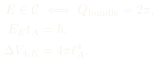
In plain language, a physical event earns an address only when its closure bundle, energy-time support, and completed four-capacity close together. The completed event leaves a source receipt. The address is not an empty point that existed first and later received matter.
That changes the black-hole question immediately.
In GR, an event horizon can be assigned now because of what happens later. In QTT, the future cannot fund a present source record. A completed source object must be earned at closure. A global horizon reconstructed from a completed history may still be a useful readout classification, but it cannot masquerade as the primitive physical source boundary at the present tick.
The source layer therefore refuses GR's teleology at the door. Future information may classify a completed history. It cannot create an earlier receipt.
The Universe Humans Invented · Essay 7QTT replaces the singular source with finite completed capacity
The black-hole source construction does not allow one address to accept infinite occupancy. The finite surface-capacity chain is
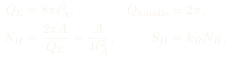
The terms have direct jobs:
- QΣ is the two-sided Artian surface capacity.
- Qbundle = 2π is one completed record bundle.
- Their ratio counts how many completed bundles fit on area A.
- Entropy is kB times that finite record count.
The quarter is therefore not imported from Hawking radiation. It comes from dividing a 2π completed record by an 8πℓ_A^2 two-sided surface capacity.
More importantly here, the same construction forbids infinite source occupancy. When a proposed collapse asks one address to carry more than its finite completed capacity, QTT does not produce an infinite density and call it a singularity. It rejects the request as an illegal source state.
GR allows the continuum to drive the source description into incompleteness. QTT closes the source ledger before infinity can be written.
That is a solution to the source failure, not a new name for the infinity.
The Universe Humans Invented · Essay 7QTT makes hidden information inaccessible, not destroyed
The visible side of a black-hole access cut need not contain the whole record. But losing access is not the same as destroying the source state.
QTT writes the distinction as
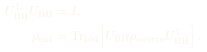
The first equation says the full source evolution preserves information. The second says an exterior observer sees only the visible part after the hidden addresses are traced out. The exterior state can therefore look mixed without the completed source record being erased.
This is the clean difference between information denial and information destruction. GR's global horizon story encouraged physics to confuse the observer's missing access with the universe deleting its own ledger. QTT does not grant that confusion.
The Universe Humans Invented · Essay 7QTT keeps the tested exterior without inheriting the source failure
Rejecting GR's black-hole source ontology does not require throwing away every exterior equation that works.
The QTT A2 endurance-to-Einstein theorem derives the Einstein-field equation as the infrared access shadow of a finite endurance current under its printed domain conditions. In other words, the familiar large-scale geometry can remain the laboratory readout while the source underneath it is finite, counted, and nonteleological.
That is exactly the separation the subject needed:
- Keep the exterior metric calculations where observations have tested them.
- Stop promoting the global event horizon into a locally discovered object.
- Stop calling geodesic incompleteness an interior solution.
- Replace infinite per-address occupancy with finite completed capacity.
- Preserve completed information in the source ledger while explaining why an exterior observer lacks access to all of it.
The closed QTT source theorems answer the failures listed in this essay. The realistic collapse-to-observation trajectory is the next transfer calculation, not permission to reopen the finite-capacity theorem or pretend GR supplied the missing source ledger.
The Universe Humans Invented · Essay 7The verdict
General relativity deserves credit for being honest enough to expose its own limits mathematically. Physics deserves criticism for turning those limits into sacred vocabulary and then behaving as if naming them completed the theory.
An event horizon is a future-dependent classification, not a locally measured wall. A singularity theorem is a proof that the classical spacetime becomes incomplete, not a description of the endpoint. Cosmic censorship is an unproved repair, not a law. A Cauchy horizon is where deterministic continuation becomes regularity-dependent. Gravitational energy has no unique local tensor ledger. A black-hole shadow is an exterior optical observation, not a photograph of ∂ J^-(𝓘^+).
Put bluntly: GR did not solve the black-hole interior. It calculated an astonishing exterior, proved that its own classical description terminates, and outsourced the protection of that failure to conjecture.
QTT takes the opposite route. It closes a finite source event first, gives that event an earned address and a finite capacity, treats the black-hole boundary as a visible/hidden access cut rather than a future-created source wall, preserves the completed record, and recovers Einstein geometry as the tested infrared shadow.
The successful exterior was never the part that needed rescuing.
The source was.
Essay 3: “The Equation Nobody Was Allowed to Doubt.” Essay 4: “The Equation on the Tombstone.” Essay 5: “The Particle We Agreed Not to Question.” Essay 6: “The Constant Physics Stopped Trying to Derive.” This is Essay Seven.
The Universe Humans Invented · Essay 7Sources and corpus anchors
- Penrose's singularity theorem (1965)
- Why the singularity theorem alone does not prove black-hole formation
- Event-horizon location by backward integration
- Living review of quasi-local black-hole horizons
- 2025 review of quasi-local horizons and event-horizon limitations
- Review of observational evidence for black holes
- Review of quasi-local gravitational energy
- Dafermos and Luk on Kerr Cauchy-horizon extendibility
- Dynamical black-hole thermodynamics
- LIGO's first direct gravitational-wave detection
- Event Horizon Telescope, M87* first image
- QTT A2 endurance-to-Einstein theorem, concept DOI
- QTT finite-capacity black-hole and information theorem, concept DOI
- QTT Main Book, stable concept DOI: readable gravity bridge on pp. 198-205; black-hole source and horizon discussion on pp. 277-281.