The Constant Physics Stopped Trying to Derive
Newton's constant has looked like an output since Stoney. The source question never disappeared; physics only stopped asking it in the right units.
The Universe Humans Invented · Essay 6The tell is in the dimensions
Write out the units of the constants and something jumps at you.
The speed of light is a length per time. Since 1983 its numerical value in SI has been exact, and the metre is defined through it. Planck's constant is an action. Since the 2019 revision of the SI it is exact too, and the kilogram is defined through it. The elementary charge and Boltzmann's constant are exact as well. The BIPM's defining-constants table prints that change without drama.
Newton's constant is different:

Three base dimensions, one inverted and one squared. Among this familiar set it is the awkward one, and it is the one we still have to measure.
That is not a proof that G is derived. Dimensions alone never tell you what mechanism made a constant. But they do tell you what kind of question is legal. A quantity with the dimensions of length cubed per mass per time squared can be assembled from more primitive scales. It looks less like an indivisible brick than a conversion between ledgers.
And this suspicion is not new, not subtle, and not mine.
The Universe Humans Invented · Essay 6Stoney saw the opening before Planck
George Johnstone Stoney presented the natural-units idea to the British Association in 1874 and published the mature construction in 1881. He asked what units nature itself might select and combined the elementary charge, the speed of light, and G into a length, a time, and a mass. The 1881 paper is still readable.
Planck made the better-known construction in 1899, using the quantum of action in place of Stoney's charge scale. The modern reduced-Planck relation is

But an identity reads both ways:

That reversal does not derive G. If ℓ_P was itself calculated from measured G, putting it back into the second equation is a circle. Still, the reversed identity exposes the real task with almost embarrassing clarity: find a physically defined microscopic ruler without using gravity, and G stops being independent.
The algebraic door has been open since Planck. What physics lacked was a non-gravitational object to walk through it.
The Universe Humans Invented · Essay 6Three reasons the question acquired a smell
The question did not disappear because a theorem ruled it out. It accumulated warnings.
Eddington. He tried to derive the reciprocal fine-structure constant from counting arguments, first defending 136 and later moving to 137. The historical record is unusually crisp: his 1929 Nature note prints 136, while his 1934 note defends 137. The lesson should have been: freeze the constructor before reading the target. Instead, the broader activity of deriving constants acquired a reputational smell.
Dirac. His Large Numbers argument proposed that the strength of gravity changes with cosmic age. It was bold and testable. Modern lunar and planetary bounds exclude the variation at the scale Dirac needed. That route deserved to die. Its failure did not prove that every non-primitive account of G must die with it.
Duff, Okun, and Veneziano. Their famous trialogue on fundamental constants sharpened a different objection. A dimensionful number changes when we change units. Asking why G is 6.67430×10^-11 in SI is not yet a question about nature; the SI number carries metres, kilograms, and seconds invented by humans. Only a dimensionless comparison can survive a change of rulers.
That objection is correct. It does not end the inquiry. It tells us how to ask it without nonsense.
The Universe Humans Invented · Essay 6Ask for the ratio, not the SI digits
Put gravity and the weak interaction in the same natural-unit language, ℏ=c=1. Newton's coupling then has units of inverse energy squared:

The measured Fermi constant is

Now the ratio is genuinely dimensionless:
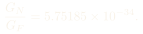
No metre survives. No kilogram survives. No choice of inches can move it. This is one clean expression of the gravity-weak hierarchy: two low-energy couplings with the same mass dimension differ by more than thirty-three orders of magnitude.
It is not the whole Standard Model hierarchy problem, and coupling strengths must always be compared at a declared energy. But it is a legitimate physical question. Duff dissolves the meaningless SI wording and leaves this one standing untouched.
A century of physics often treated the dissolution of the bad question as though it had disposed of the good one.
The Universe Humans Invented · Essay 6The constant the laboratories still cannot make agree
Now the part that should be uncomfortable regardless of what one thinks about QTT.
The 2022 CODATA adjustment recommends

with relative standard uncertainty 2.2×10^-5, or 22 parts per million. The CODATA adjustment paper uses sixteen input results. Their scatter is too large for the quoted laboratory errors, so CODATA applies a common uncertainty expansion factor of 3.9 before producing the recommended value.
That is not an accusation against the laboratories. Measuring gravity is brutally difficult. It is also not something to hide behind the word recommended. The spread is part of the physical record.
Since c and ℏ are exact in the revised SI, the conventional Planck length inferred from G carries half its relative uncertainty:
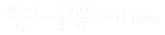
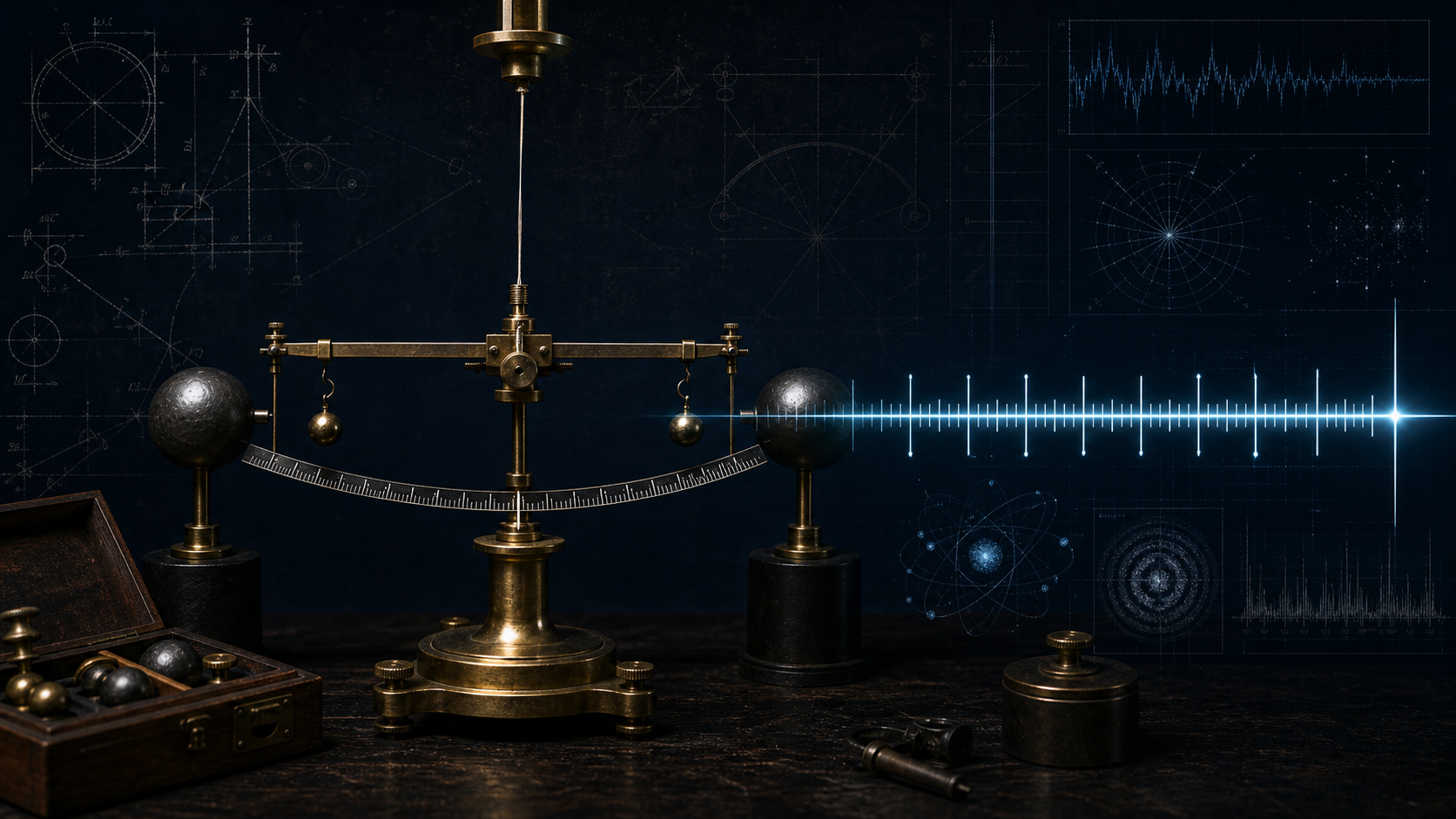
So a modern torsion balance can be read as fixing the conventional Planck-length combination. It is not directly detecting a smallest spatial interval, a lattice, or a pixel of reality. But in the constants ledger, once c and ℏ are exact, its uncertainty is the uncertainty of that inferred ruler.
The most quoted microscopic scale in physics is therefore still being carried by the least settled constant in the table.
The Universe Humans Invented · Essay 6What the present QTT source theorem actually says
The current QTT gravity paper does not begin by inserting the measured G. It begins with a finite source object.
Let ℓ_A be Artian's Ruler, t_A=ℓ_A/c its source tick, and m_A=ℏ/(cℓ_A) its mass unit. Let J_end be the endurance current: the finite support flow required for matter to continue existing from one completed source tick to the next. The source law is

For a spherical source, Gauss's theorem then gives

The divergence theorem and the integral over a two-sphere are standard mathematics. QTT's new claim is the source ordering: mass is counted as a finite endurance demand, the full directional capacity contributes 4π, and a saturated one-tick current produces the saturated local acceleration response. In the current full packet that last identification is called endpoint faithfulness. It fixes the possible gain χ_g to one inside the theorem's declared source domain rather than fitting it to a gravity datum.
That matters. If the angular coefficient were C_Ω and the endpoint gain were left as χ_g, dimensional analysis would permit the family
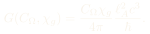
The source theorem earns its claim only because the full packet supplies C_Ω=4π and χ_g=1 before the gravitational comparison. This is the central result of *Artian Endurance and Newton's Constant*, current v8 family. It is a zero-target-fit source explanation of Newtonian coupling once one dimensional ruler is declared. It is not a pure-number prediction of the SI value of G.
That distinction is not a retreat. It is the difference between deriving a law's source structure and pretending dimensions can arise from nothing.
The Universe Humans Invented · Essay 6The weak-sector landing
The same paper then asks a second question. Can the required ruler be read through a non-gravitational laboratory scale?
One QTT face starts from the measured Fermi constant as its dimensional weak-sector anchor. The remaining factors are QTT source constructors:

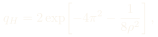

Here α_QTT is not inserted from the measured fine-structure constant; the present paper inherits it from the corpus's photon-edge constructor. The resulting laboratory face is

The reconstructed value is

Its central residual from the CODATA recommendation is +0.2116 ppm, or +0.009416σ when judged against CODATA's actual uncertainty.
The ppm number must be read properly. It does not mean experiment knows G to 0.21 ppm. It means the formula's central value lands that far from CODATA's central value while the measurement itself remains uncertain at 22 ppm. The statistically meaningful statement is the pull: about nine thousandths of one standard deviation.
The landing is striking because the gravity target did not tune the printed source factors. But the Fermi constant supplies the dimensional scale, so this is an anchored cross-sector audit, not a second independent prediction and not a constant made out of pure numbers.
The Universe Humans Invented · Essay 6The current boundary, without reopening the theorem
The old version of this essay said the QTT source theorem was underidentified because a free χ_g remained. That was true of the narrower axiom subset it was auditing. It is stale as a description of the current full packet.
The present state has three separate rows.
| Question | Current answer |
|---|---|
| Does the full QTT source packet fix the Newtonian coupling form without fitting a gravity target? | Yes. The endurance theorem fixes C_Ω=4π and endpoint faithfulness fixes χ_g=1 in its declared domain. |
| Does QTT obtain the SI magnitude from pure dimensionless numbers alone? | No such claim is needed or made. A dimensional ruler or independently measured non-gravitational scale must enter. |
| Has endpoint faithfulness been independently selected by a prospective laboratory test? | Not yet. A separate Tier-K preregistration freezes that test rather than using old G data as fresh evidence. |
There is one more guardrail. The six numerical faces in the gravity paper share anchors and dependencies. They are useful consistency locks, but they are not six statistically independent discoveries. The paper now says so explicitly.
And exponential hierarchies are not exotic by themselves. Quantum field theory is full of 4π and 8π^2, loop factors, tunnelling actions, and dimensional transmutation. The novelty cannot be “there is an exponential.” It has to be the finite constructor that forces this exponent and survives somewhere it was not selected.
That is exactly why the source theorem, the anchored numerical face, and the prospective endpoint test must remain three different sentences.
The Universe Humans Invented · Essay 6The shape of the mistake
I want to be precise about what I am accusing the field of, because the lazy version of this essay is false.
Nobody issued a ban. Duff's dimensional argument is correct. Eddington retuned a target-visible count. Dirac's proposed variation was refuted. Every warning had a reason.
What accumulated was a prohibition without a no-go theorem. “Why is the SI number this number?” was shown to be badly posed, and “why is gravity this weak relative to another interaction?” was allowed to leave the room with it. Meanwhile G remained dimensionally composite, algebraically equivalent to a squared microscopic ruler, and experimentally scattered enough that CODATA had to expand sixteen laboratories' uncertainties by 3.9.
That is not a settled constant. It is an unfinished source question attached to a very successful effective law.
The Universe Humans Invented · Essay 6The turtle, again
The turtle's point was that you have to be willing to look down.
Here the floor was labelled. Stoney showed that the constants form natural scales. Planck printed the ruler. Duff told us not to mistake human units for physics. CODATA kept publishing the disagreement. None of those facts derives G, but together they tell us exactly what a derivation would have to do.
The present QTT claim is now sharper than the draft I started with: a completed-event endurance source closes the Newtonian coupling structure with no gravity-target fit; a weak-sector face lands on the measured SI value through a declared non-gravitational anchor; and a prospective endpoint test remains open.
The question was never forbidden by physics. It was only left unattended.
Essay 3: “The Equation Nobody Was Allowed to Doubt.” Essay 4: “The Equation on the Tombstone.” Essay 5: “The Particle We Agreed Not to Question.” This is Essay Six.
The Universe Humans Invented · Essay 6Sources and corpus anchors
- BIPM: the seven SI defining constants
- Stoney, “On the Physical Units of Nature” (1881)
- Eddington's 136 note (1929) and 137 note (1934)
- Dirac, “The Cosmological Constants” (1937)
- Duff, Okun, and Veneziano, “Trialogue on the Number of Fundamental Constants”
- CODATA 2022 adjustment of the fundamental constants
- QTT Newton/endurance source theorem, concept DOI
- Universal endpoint-gain Tier-K preregistration, concept DOI
- QTT Main Book, stable concept DOI: readable gravity bridge on pp. 198-205; formal endurance ledgers and audits later in the same manuscript.