The Knob
A fitted value can close an equation while leaving the question completely open. This is the ledger that keeps the difference visible.
The Universe Humans Invented · Essay 9What a knob is
Let me define the thing plainly, because once you can see it you will see it everywhere.
A knob is an adjustable quantity whose value is selected from the same data the model is being asked to explain. Turn it and the output moves. Keep turning and the disagreement shrinks.
That definition matters. Not every number entered into a theory is a knob.
The measured electron mass is an input to the minimal Standard Model. A detector calibration is an instrument input. A nuisance parameter carries a declared uncertainty in distance, inclination or background. A universal constant fitted once and then tested elsewhere is not the same thing as a fresh coefficient fitted separately to every object. These quantities may all appear as symbols in equations, but they carry different scientific burdens.
The dangerous case begins when a mismatch is absorbed by new adjustable freedom and the repair is later spoken of as though it were a source explanation.
This is what I have called Duct-Taping Theoretical Physics. Duct tape can be an excellent engineering tool. It can keep a calculation operational and expose what needs better work. It becomes a problem when the repair is painted over and presented as the reason the structure stands.
There is a precise mathematical fact underneath the metaphor. With enough independent coefficients, a model can interpolate a finite data set. That does not mean every flexible model can explain every observation, because symmetries, priors, shared parameters and held-out tests restrict what the coefficients are allowed to do. It means something narrower and more important: local adjustable freedom can consume the very residual that would otherwise test the model.
The question is therefore not simply, “How many parameters?” The real ledger asks:
| Question | What must be printed |
|---|---|
| Where did the number come from? | Derived, independently measured, calibrated, fitted here, or selected after seeing the target |
| How far does it travel? | Universal, shared across a class, or separately assigned to each object |
| What else did it predict? | Held-out data, a new experiment, or only the data that fixed it |
| What would make it fail? | A residual it is not allowed to absorb |
Without that ledger, a derived constant and a fitted repair look identical after typesetting.
The Universe Humans Invented · Essay 9The oldest lesson
Ptolemy's planetary machinery used deferents, epicycles, eccentric circles and the equant. These were not random doodles. Their sizes, speeds and offsets were chosen from observations, and the resulting tables were a serious mathematical achievement. They gave ancient and medieval astronomers a practical way to calculate where planets would appear.
The simplified story usually told about this episode is wrong in two directions. Ptolemy did not keep adding an unlimited stack of little circles every time one point missed. Copernicus did not immediately throw every epicycle away. His heliocentric construction still used combinations of circular motion because uniform circles were part of the inherited mathematical language.
The real lesson is better.
The Ptolemaic apparatus could remain operationally useful while carrying the wrong physical architecture. Later observations did attack the strict Ptolemaic ordering. The full set of phases of Venus, seen telescopically in the seventeenth century, could not occur in the original Ptolemaic arrangement. Kepler then used Tycho Brahe's more accurate observations of Mars to replace the circle-and-equant machinery with elliptical orbits and an area law tied to the Sun.
The old system was not defeated because fitting is useless. It was defeated because a stronger construction explained more with fewer local geometric repairs and survived more precise data.
A good fit can preserve a wrong picture for a long time. That is the oldest lesson. The fit is real. The source story can still be wrong.
The Universe Humans Invented · Essay 9The repair that contained real physics
The ether story makes the accounting harder, which is why I like it.
In 1887 Albert Michelson and Edward Morley looked for the directional light-speed effect expected from motion through a stationary luminiferous ether. They did not see the expected ether-wind signal. The result was not literally a statement that every measured fringe shift was exactly zero; it was a null result relative to the predicted effect.
George FitzGerald and Hendrik Lorentz proposed that matter moving through the ether could deform along the direction of motion. In its mature form the contraction factor had exactly the velocity dependence needed to help remove the expected interferometer signal.
This was not a free scalar that could be turned to any value for every experiment. It was a compensating rule. That distinction should be kept. But it entered historically as an ad hoc repair to protect the stationary-ether picture, before it had the deeper structural reading it later acquired.
Special relativity changed the dependency graph. Length contraction became a consequence of Lorentz symmetry, simultaneity and invariant light speed. The stationary ether no longer did explanatory work. The same functional effect moved from “what matter must do so the ether stays hidden” to “how space and time coordinates relate between inertial frames.”
That is humbling. A repair can contain real physics. Its weakness is not always its numerical value. Sometimes the weakness is that the framework has put the right relation in the wrong ontological drawer.
Lorentz had part of relativity in his hands. Inside the ether framework it could only act as compensation.
The Universe Humans Invented · Essay 9Einstein's own term
Nobody is exempt.
In 1917 Einstein added the cosmological term to general relativity while constructing a static cosmological model. The value required for that static solution was tied to the assumed cosmic matter density and radius. The model was also unstable: disturb the balance and it does not naturally return to rest.
George Gamow later reported that Einstein called the cosmological constant his “biggest blunder.” The line has become folklore. There is no surviving primary document in Einstein's own hand containing that exact phrase, so it should be attributed to Gamow rather than printed as a direct archival quotation.
Then came the supernova results. In 1998 and 1999 the High-Z Supernova Search Team and the Supernova Cosmology Project found evidence that cosmic expansion is accelerating. A positive cosmological constant is the simplest version of the standard model that fits that acceleration.
That does not mean Einstein's static-universe value was secretly measured correctly in 1917. It means the same allowed term in the field equations returned with a different observational role and a value fixed by modern cosmological data. Under the six-parameter flat ΛCDM model, Planck's final analysis reported

Cosmic acceleration is observed. Whether its source is exactly a cosmological constant, vacuum energy or a more complicated dark-energy sector remains open.
Again the term survived while its source story changed.
The Universe Humans Invented · Essay 9Count the freedom, but count it honestly
The Particle Data Group gives a clean conventional count for the minimal Standard Model: 19 parameters determined from experiment. In that convention they are three gauge couplings, thirteen Yukawa-sector quantities, two Higgs-sector quantities and the QCD vacuum angle.
Neutrino mass changes the count. Three Dirac neutrino masses plus three mixing angles and one CP phase bring the total to 26. Majorana neutrinos add two further physical phases, bringing the same convention to 28.
The exact count is convention-dependent. The scientific point is not. The minimal Standard Model does not fix those numerical values from its gauge structure alone. It accepts them from experiment and then predicts an extraordinary range of other outcomes. That is a genuine empirical triumph with an equally genuine source ledger left open.
The base flat ΛCDM cosmology uses six fitted parameters. Planck's 2018 analysis finds a matter fraction near 0.315 and a dark-energy fraction near 0.685. Only about 4.9 per cent of the present critical density is ordinary baryonic matter in that model. The rest is represented by cold dark matter and dark energy.
Those names are not empty. They identify coherent empirical roles. Cold dark matter participates in the CMB peak structure, gravitational lensing, cluster dynamics and the growth of large-scale structure. A cosmological constant provides a sharply defined background term. But neither name identifies the underlying microscopic substance. A box can be operationally well measured while its contents remain unknown.
The 175-galaxy ledger
SPARC contains 175 nearby disk galaxies with 3.6-micrometre photometry and resolved rotation curves. A comprehensive seven-profile dark-halo analysis of those galaxies did not fit “dark matter” as one number. It marginalized over stellar mass-to-light ratio, galaxy distance, disk inclination, halo concentration and halo mass. The Einasto profile carried an additional shape parameter.
So the clean statement is this:
A conventional two-coordinate halo description assigns at least a halo mass and a concentration or scale coordinate to each galaxy: 2 × 175 = 350 galaxy-specific halo coordinates, before the shared observational nuisance ledger is counted.
The modified-dynamics comparison spends its freedom differently. Its characteristic acceleration scale is universal rather than redialled for each galaxy. The radial-acceleration analysis of the quality-cut SPARC sample found

across 2,693 points in 153 galaxies.
That does not make the full comparison “350 total parameters versus one total parameter.” Both sides still face stellar mass-to-light ratios, distances, inclinations, data cuts and model choices. MOND-like theories also have an interpolation law and, in some settings, an external-field calculation. The fair contrast is more specific and more revealing:
- halo fits introduce local dark-sector coordinates for each galaxy;
- modified dynamics introduces a universal low-acceleration law and must make that same law travel from galaxy to galaxy.
That is a real construction-burden difference. It should not be inflated, and it should not be hidden.
Dark matter also has evidence that no rotation-curve parameter count can erase. In the Bullet Cluster, most of the baryonic mass is in X-ray-emitting plasma while the lensing mass peaks are displaced toward the collisionless galaxy distributions. A pure “change the force law and keep only the observed baryons” account is not enough for that system; modified-gravity models still require additional unseen mass there.
At the same time, no non-gravitational dark-matter particle has received confirmed laboratory identification. The 2024 LUX-ZEPLIN exposure, for example, found no excess above expected backgrounds in its WIMP search region. That is not evidence that every dark-matter candidate is dead. It is the difference between a strong astronomical inference and an identified particle.
The ledger should print both facts.
The Universe Humans Invented · Essay 9The knob inside the uncertainty
Now to the number that experimentalists should know by heart.
The 2018 CODATA adjustment used 16 measurements of Newton's gravitational constant, G. The measurements were inconsistent at their published uncertainties. CODATA applied a common uncertainty expansion factor of 3.9 so that every normalized residual fell below two.
The resulting recommended value was

with relative standard uncertainty

or 22 parts per million.
The tempting arithmetic is
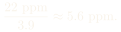
That 5.6 ppm is only the pre-expansion scale implied by dividing the final relative uncertainty by the common factor. It is not a second official CODATA adjustment and should not be advertised as one.
CODATA did not hide the operation. Its report says plainly that the measurements are inconsistent, names the two largest residuals and prints the factor. This is responsible metrology. When an official value must be supplied, a transparent expansion is better than deleting inconvenient experiments or pretending the scatter is understood.
But the multiplication does no physics. It does not identify the unmodelled torsion-fibre behaviour, gravitational coupling to apparatus geometry, calibration error or any other missing mechanism. It converts an unresolved inter-laboratory discrepancy into a usable consensus uncertainty.
So I will use the word carefully. The factor 3.9 is not a free parameter in Newton's law. It is a metrological uncertainty knob, publicly declared, applied because the input set would otherwise fail the adjustment's residual criterion.
The public constants table shows the usable result. The underlying paper shows the unresolved disagreement. Most readers see only the table.
That compression is the danger.
The Universe Humans Invented · Essay 9A plea to experimentalists
You spend years building an apparatus. You chase systematics that theorists never see. When your result disagrees with another laboratory, the first suspicion should usually fall on the apparatus. Most anomalies do become mundane after better controls. That instinct has saved science from thousands of false discoveries.
It also has a cost.
An unexplained residual is the most information-dense part of the experiment. Once it is folded into “other systematic,” multiplied into a common uncertainty or removed by a flexible background term, the public result becomes cleaner and the trail becomes colder.
I am not asking experimentalists to publish every twitch as new physics. I am asking for a second product beside the clean number: a permanent anomaly ledger.
Print what was absorbed. Print the size of the absorption. Print the alternate result before the correction. Print which controls would distinguish an instrument failure from a failure of the assumed physical equivalence. Keep it machine-readable. Do not let the final error bar become the only surviving history of the experiment.
The theorist's version of the same discipline is simple. A residual may motivate a new term, but the new term receives no prediction credit on the data that created it. Freeze the construction. Test it somewhere else.
That is how duct tape becomes either temporary repair or new physics.
The Universe Humans Invented · Essay 9The counterfactual Dirac
Here is an imagined history. It did not happen. That is why it is useful.
In 1928 Paul Dirac wrote a relativistic equation for the electron. The equation brought spin into relativistic quantum mechanics and also carried negative-energy solutions that the existing one-particle picture did not know how to interpret.
Dirac did not immediately understand them. He first tried to identify a hole in the negative-energy sea with the proton. By 1931 he had reached the anti-electron: a particle with the electron's mass and opposite charge. In 1932 Carl Anderson reported the positive electron in cosmic-ray tracks. Anderson received the 1936 Nobel Prize in Physics for the discovery of the positron.
Now imagine that the negative-energy sector had been removed in 1928 by a convenient projection chosen only because no such particle was known. Imagine that Anderson's wrong-curving track had then been absorbed into an unidentified background because the accepted equation had already deleted the possibility.
One repair in theory. One correction in experiment. Antimatter disappears from the record.
This did not happen. But the reason it did not happen is worth protecting: the unwanted mathematical branch remained visible long enough to demand an interpretation, and the unwanted track remained visible long enough to demand a particle.
From Dirac's equation to Anderson's observation took four years. The timeline was short because the anomaly survived.
The Universe Humans Invented · Essay 9What the knob does to knowledge
Science depends on a visible list of things we know we do not understand. Those are the questions people can attack.
A parameter can remove an item from that list without answering it. The unexplained number acquires a symbol, a measured value and a row in a reference table. One generation later it feels less like an open problem and more like furniture.
Ask why the electron has its measured mass and most physicists will answer honestly: the minimal Standard Model does not tell us. Ask why its input ledger has the structure it does, or why a separate Yukawa coefficient exists for each charged fermion, and the conversation often becomes less direct because the parameters have been normalized by familiarity.
They should remain visible as what they are: experimentally fixed inputs to an extraordinarily successful effective framework, and therefore invitations to a deeper construction.
A fitted value can close an equation while leaving the question completely open.
The Universe Humans Invented · Essay 9When a knob is honest
Parameters are not sins. Silence about their provenance is the problem.
An honest ledger separates at least four cases:
| Class | Scientific role |
|---|---|
| Derived output | Fixed by the construction before the target is read |
| Measured input | Taken from an independent measurement; the theory does not claim prediction credit for its value in that calculation |
| Nuisance or calibration parameter | Carries a declared instrument or astrophysical uncertainty and is profiled or marginalized |
| Target-fitted repair | Chosen using the same discrepancy it is then used to remove |
A fifth column should record chronology. A universal constant fitted on one data set and frozen before a disjoint test can earn prediction credit on the new test. A coefficient refitted for every object cannot.
The rule I hold myself to is straightforward: derive the number, inherit it from a separately declared measurement, or label it as fitted. Then state what observation it is not allowed to absorb.
No immaculate tables. No retroactive source stories.
The Universe Humans Invented · Essay 9Put the ledger on the front page
I am asking for something small and annoying.
Every theory paper and every precision fit should carry a front-page burden ledger:
- quantities derived before comparison;
- quantities imported from independent measurements;
- continuous fitted coefficients;
- discrete model or branch choices;
- nuisance and calibration parameters;
- uncertainty expansion factors;
- data-selected windows and cuts;
- held-out predictions;
- residuals the fit was forbidden to absorb.
The fitted and the derived should never look identical merely because both were printed in italic type.
This would not abolish fitting. Fitting is indispensable. It would restore the scientific identity of the fit. A six-parameter model that compresses a billion-pixel sky map is doing something remarkable. A 350-coordinate halo atlas can be the right phenomenological map. A common uncertainty factor can be the responsible way to publish a constant. None of those operational achievements automatically derives the source of its inputs.
That sentence should not be controversial. The fact that it still needs saying is the problem.
The Universe Humans Invented · Essay 9The turtle, again
The turtle asked what holds up the world and got another turtle.
The modern version is tidier. Ask what holds up a prediction and you get a parameter. Ask where the parameter comes from and you get a measurement. Ask why the measurement gives that number and, if you are lucky, you get an honest shrug.
If you are unlucky, you get a table.
We have not been dishonest. We have compressed unfinished questions into usable numbers, then allowed the compression to look like understanding.
Ptolemy's tables worked. The ether deformation contained real mathematics. The cosmological term returned in a different role. CODATA's expanded uncertainty gives the world a usable G. Each operation had legitimate practical value.
The ledger tells us what that value was, and what it was not.
The knob is where the unfinished question waits.
Essay 3: “The Equation Nobody Was Allowed to Doubt.” Essay 4: “The Equation on the Tombstone.” Essay 5: “The Particle We Agreed Not to Question.” Essay 6: “The Constant Physics Stopped Trying to Derive.” Essay 7: “The Boundary That Knows the Future.” Essay 8: “The Mass That Has No Exact Value.” This is Essay Nine.
The Universe Humans Invented · Essay 9Primary sources and technical checks
- Particle Data Group 2025 review: Grand Unified Theories, for the 19-parameter Standard Model count and the Majorana-neutrino extension.
- Planck 2018 Results VI: Cosmological Parameters, for the six-parameter base ΛCDM model and Ω_Lambda.
- Lelli, McGaugh and Schombert, SPARC, for the 175-galaxy catalogue.
- Li, Lelli, McGaugh and Schombert, dark-halo fits to SPARC, for the halo and nuisance-parameter ledger.
- McGaugh, Lelli and Schombert, radial acceleration relation, for g_dagger, the 153-galaxy quality-cut sample and 2,693 rotation-curve points.
- Clowe et al., Bullet Cluster lensing, for the separation of lensing mass and X-ray plasma.
- LUX-ZEPLIN, 4.2 tonne-years, for the reported absence of an excess above expected backgrounds in that WIMP search.
- CODATA 2018 adjustment, especially pp. 5, 7 and 41, for the 16 G measurements, factor 3.9 and 22 ppm recommended uncertainty.
- Michelson and Morley, 1887, for the ether-wind experiment.
- Einstein's 1917 cosmological paper and English translation, Riess et al. 1998, and Perlmutter et al. 1999.
- Dirac's 1928 electron paper, his 1931 anti-electron paper, and Anderson's 1932 report.