
The Vacuum That Was Supposed to Kill Us
False-vacuum decay, the assumptions behind the calculation, and QTT's challenge to the vacuum we were taught to imagine.
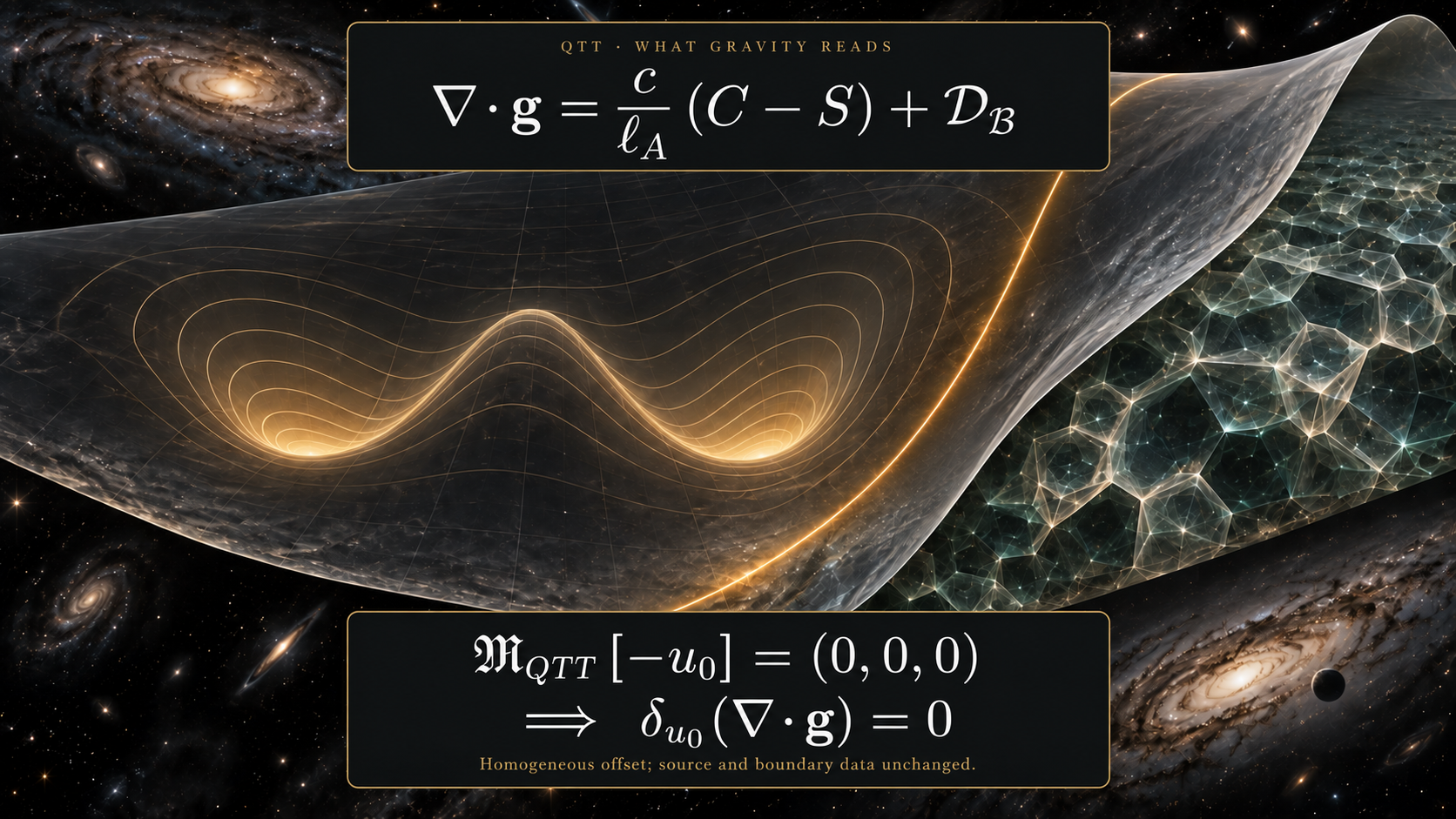
The Universe That Humans Invented · Essay 11First, decide what is supposed to decay
Imagine being told that empty space could change its mind. Somewhere beyond the visible galaxies, a tiny bubble forms. Inside it, the familiar arrangement of fields has changed. The bubble expands, and the chemistry that makes stars, planets and people possible may no longer work inside it.
That is the frightening version of false-vacuum decay.
My objection begins before the bubble. What physical object is being called the vacuum? Which properties have been measured, and which belong to a mathematical description extended far beyond the measurements?
Quantum Traction Theory answers the first question differently. In Artian's Universe, the underlying reality is organized into finite, addressed capacity. Empty of ordinary matter does not mean empty of physical structure. Matter persists through an endurance process, while creation and physical differences contribute to the source ledger. A smooth field is a description that must be connected to that substrate; it does not acquire authority over the substrate merely because we can draw its potential.
One concrete consequence is QTT's rule for a uniform change in the vacuum-energy baseline:
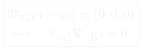
Here the three zeros mean that the change creates no new source, changes no endurance sink, and introduces no physical boundary or access difference. Under those conditions, changing the energy baseline does not create gravity in QTT. This is a source-law result within the framework, not a cancellation adjusted to the observed vacuum density. Its premises and proof are printed in the vacuum-capacity paper, section 6.
That is a substantial disagreement about what vacuum energy means physically. Whether it also rules out a transition between two different vacuum states is a further question. The history makes clear why the two should not be confused.
The Universe That Humans Invented · Essay 11How an ordinary idea acquired a cosmic consequence
A state can be stable against a small disturbance without being the lowest-energy state available. Think of a ball resting in a shallow hollow while a deeper hollow lies on the other side of a hill. The ball is locally settled. There is still somewhere lower to go.
Physicists call that metastability. The everyday analogy is useful, although a quantum field is not literally a ball, and tunnelling is not an object secretly climbing over the hill.
The early theory grew out of the study of phase changes and nucleation: how a small region of a new phase appears and grows inside an old one. J. S. Langer developed an influential statistical treatment in the 1960s. In 1974, Igor Kobzarev, Lev Okun and Mikhail Voloshin examined bubbles in a metastable vacuum; the English translation appeared in 1975. These were attempts to understand a defined physical mechanism, not announcements that the universe was about to end. Langer; Kobzarev, Okun and Voloshin.
In 1977, Sidney Coleman developed the semiclassical field-theory calculation. A second paper, with Curtis Callan, supplied the leading quantum prefactor. The memorable result has the form

Read it as a decay probability per unit time and volume. The quantity B is an action difference for the relevant tunnelling configuration; A supplies the prefactor. Once the action, initial state and approximation are specified, these quantities are calculated. They are not automatically arbitrary knobs.
Coleman's question was conditional: given a field theory with an appropriate higher-energy local minimum, how does it escape? His calculation did not establish that our universe occupies such a minimum. Coleman; Callan and Coleman.
Gravity entered explicitly in Coleman and Frank De Luccia's 1980 work. It can change whether a decay channel exists and how strongly it is suppressed. In 1981, Alan Guth's original inflation proposal used a metastable vacuum to drive accelerated expansion. The same paper identified a serious difficulty in completing the transition. False-vacuum decay was therefore part of an evolving research programme, with failures and restrictions visible in the original work. Coleman and De Luccia; Guth.
The Universe That Humans Invented · Essay 11What the Higgs discovery did, and did not, establish
The discovery announced at CERN on 4 July 2012 gave this old question a new public life. A Higgs-like particle had been observed near 125 GeV. Its mass, together with information about the top quark and other interactions, sharpened calculations of the Higgs potential. CERN's announcement.
The crucial step is extrapolation. Physicists determine the Standard Model's parameters from measurements and evolve them to much higher energies. Under particular assumptions about what physics continues to apply there, the effective Higgs potential can permit metastability. Widely studied parameter choices give a lifetime vastly longer than the age of the universe. This is not a measured expiry date. Buttazzo and colleagues; precision vacuum-stability analysis.
A measurement around one minimum does not map every remote region of a potential. Nor does observing the Higgs establish that the Standard Model, unmodified, describes every energy up to the gravitational endpoint. Top-mass interpretation, strong-coupling uncertainty, high-energy interactions and cosmological conditions matter to the inference.
This does not make extrapolation illegitimate. Science needs extrapolation. It means that the assumptions must travel with the conclusion. The technical literature usually carries them much more carefully than the frightening summary does.
The Standard Model calculation also deserves accurate accounting. Measured Higgs and top inputs are genuine empirical inputs, not proof that someone fitted a cosmic disaster. Conversely, their precision cannot turn an untested high-energy continuation into a direct observation.
The Universe That Humans Invented · Essay 11The vacuum in Artian's Universe
The QTT word "address" means a distinguishable place in the theory's underlying account of physical existence. It is not a claim that the universe runs on a human computer. "Capacity" means that an address has bounded physical resources. "Endurance" means that the persistence of matter is an ongoing source process, rather than a passive object placed into an independently existing container.
The relevant axioms have specific jobs. A2 supplies endurance consumption. A3 supplies creation. A6 bounds capacity. A7 requires the completed bundle to satisfy its closure rule. Together they change the admissible source objects. They are not four separate observations proving that choice of ontology.
The vacuum-capacity paper expresses the Newtonian-limit source rule as

C is the creation contribution and S the endurance sink in that paper's normalization. The length in the denominator is Artian's Ruler. The final term carries physical boundary, modular and access differences. In plain language, gravity reads an imbalance or a physical difference. It does not read homogeneous fullness merely because someone assigned that fullness an absolute energy density.
The distinction is ontological and mathematical. QTT does not put a gigantic constant into the conventional gravitational source and tune another gigantic constant against it. For the declared common-mode class, the source map annihilates the offset before it becomes a gravitational contribution.
This result concerns the role of an additive constant. It does not say that every spatially uniform physical state has zero gravitational effect, or that a real transition between phases is just a change in bookkeeping. The source paper makes those conditions explicit.
The Universe That Humans Invented · Essay 11The Higgs is still there
QTT does not make the CERN signal disappear. The book reads the Higgs particle as a neutral radial excitation of an electroweak capacity structure, called the scalar lock. The familiar low-energy mass relations remain part of its laboratory description. What changes is the source interpretation.
The book also gives a source-cycle restriction on which contributions can enter the Higgs sector. Its hierarchy argument excludes the specified non-closed Planck-capacity obstruction from the legal scalar source. That is a distinct claim from merely stopping an integral at a finite energy. The main book, pp. 969-970 and 983 onward, supplies the construction and its meaning.
These results challenge the picture of an independently fundamental, space-filling Higgs medium whose extrapolated potential can simply be identified with the substrate of everything.
But a Higgs mass or a positive local stiffness answers a local question. A statement about every allowed configuration and every possible transition is global. A stable floor under one measured vibration does not, by itself, prove that no other valley exists.
The Universe That Humans Invented · Essay 11The distinction that decides the argument
Here is the part that must survive even the most hostile reading.
Raising or lowering the entire energy landscape by the same amount does not change the difference between two valleys:
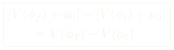
This is why QTT's homogeneous-offset theorem cannot be renamed a universal no-decay theorem. In the usual nongravitational tunnelling calculation, the common shift already cancels from the relevant action difference. A genuine bubble contains a changing configuration and an interface. It is not a uniform relabelling of the energy zero.
QTT's own vacuum paper explicitly retains Higgs excitations, bubble walls, condensate transitions and phase-interface differences as objects needing a separate source calculation. It would contradict that paper to claim that its common-mode result had already forbidden them all.
Finite capacity alone cannot complete the argument either. Finite quantum systems can support metastability and transitions. This is not a speculative loophole: a mathematical theory of metastability in finite-dimensional many-body systems has been developed, and discrete atomic models are used to study vacuum-decay analogues. Those models are not observations of cosmic Higgs-vacuum decay, but they rule out the shortcut "finite means unable to tunnel." Yin, Surace and Lucas; Darbha and colleagues.
The other tempting shortcut is information conservation. Unitary evolution preserves the complete quantum state while still allowing a subsystem, or a prepared metastable configuration, to change. Preserving information and preserving the present vacuum are different requirements.
The Universe That Humans Invented · Essay 11What QTT actually debunks
QTT exposes an unjustified identification: the vacuum of a chosen effective field theory is not automatically the physical substrate of the universe.
Its source construction gives that objection content. A completed capacity background, a particle excitation, a common energy offset and a phase boundary have different roles. QTT's homogeneous-offset theorem changes the gravitational source assignment for the first class without erasing the others.
Consequently, a continuum Higgs-vacuum decay rate cannot simply be pasted into Artian's Universe. One must first identify the two proposed source states, derive their allowed dynamics, and establish the map from those source states to the laboratory fields. The QTT source restrictions might remove a channel, alter it, or allow an effective decay process. That conclusion has to come from the construction.
The reverse caution matters just as much. Disagreeing with the source ontology does not refute Coleman's conditional mathematics. An effective theory can predict a real process even when its variables are not fundamental. The question is whether its assumptions and range of validity cover that process.
So the claim I reject is that an extrapolated field potential has already established a physical death sentence for our universe. QTT offers a different source model and a reason to reopen that identification. It has not, through the vacuum-offset theorem, measured a zero cosmic decay rate.
The Universe That Humans Invented · Essay 11What a decisive QTT result would look like
There is a clean mathematical target for a stronger conclusion.
Let P_vac select the proposed stable vacuum sector, and let U(t) be the evolution derived from the physical source law. Exact protection would require
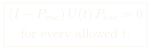
The symbols say something simple: evolution never takes an initially protected vacuum state into an unprotected state. Its escape probability is then zero. In a finite closed system, a sufficient way to establish this is to derive a Hamiltonian that commutes with the specified projector.
This is a general mathematical criterion, not a newly proved QTT vacuum theorem. Its physical content depends on deriving the projector and dynamics independently. Defining "vacuum" as an invariant space after the calculation would not prove that our observed vacuum occupies it. Nor would choosing the whole state space as the protected sector answer anything.
To apply the criterion, QTT must identify the actual electroweak source state, check all permitted transition channels and physical couplings, and show that the laboratory vacuum belongs to the protected sector. If instead it derives a nonzero transition amplitude, it must calculate the rate and state the domain where it applies.
That gives the proposal a clear way to fail: an allowed lower-energy configuration with a nonzero coupling out of the claimed protected sector defeats an exact no-decay theorem for that sector. It does not need a cosmic catastrophe to expose a mathematical mistake.
The Universe That Humans Invented · Essay 11A potential is a proposal about nature
False-vacuum decay is serious physics. Its history contains careful calculations, specified assumptions, and unresolved questions. The claim that our universe has been shown to face it is much stronger than those calculations establish.
QTT's contribution is to ask what the vacuum is made of before treating an effective landscape as the final description of reality. Its finite source ledger and homogeneous-shift theorem make that challenge precise. They also tell us where the next proof belongs.
I want that proof, not a comforting slogan. A universe should not be sentenced by an extrapolation. It should not be declared indestructible by changing the name of its vacuum either.
The Universe That Humans Invented · Essay 11Maps and further reading
- Two Universes: the source-ontology comparison used in this essay.
- Lexicon: vacuum capacity, endurance current, and pixellate: the QTT terms in context.
- Derivation Atlas, Observatory, and Blog Map: constructions, empirical rows, and related essays.
- Vacuum Capacity, Endurance-Current Gravity, and the De-Gravitating Bulk: the source-map dependency, particularly section 6 and the Higgs common-mode example in section 6.9. This is the author's theoretical construction, not independent experimental evidence.
- Cosmological-constant ledger family: the separate vacuum-amplitude and dynamical-selection problem. It should not be substituted for an electroweak decay calculation.
- The Prediction That Was Never Retracted and The Knob: earlier essays on Higgs naturalness and the accounting of empirical inputs.
Book pages
Quantum Traction Theory: Main Book v10.01, stable concept DOI. Direct reading anchors: p. 213, UEL and vacuum-energy relations; p. 219, A2 endurance; pp. 969-970, Higgs source-cycle restriction; p. 983, Higgs radial-mode interpretation. The PDF links locate the cited edition; the concept DOI identifies the book family.