The Paper That Started With a Silly Question
What must physically happen for a stone to keep existing? QTT's endurance law connects that question to mass, energy and gravity.
A few days ago, I asked my LinkedIn network what sounded like a pretty silly question:
What must physically happen for something to continue existing, even when its energy is unchanged and nobody is observing it?
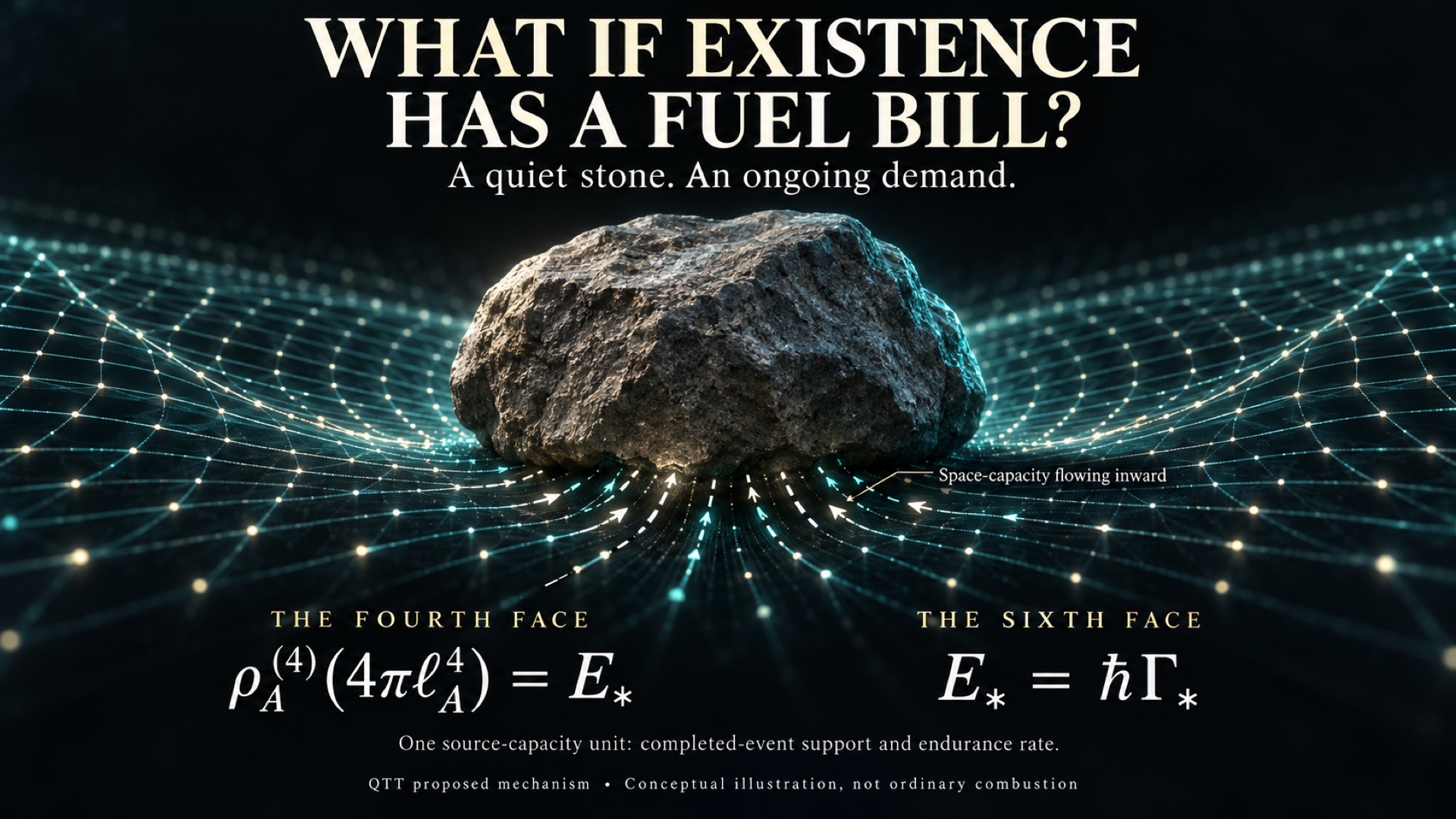
Take a stone. Put it somewhere quiet. Leave it alone. Tomorrow, it is still there. What, physically, had to happen during the night for that to be possible?
The conventional answer is: nothing extra. A stable object does not need an external energy supply just to remain an object. Quantum mechanics already describes its time evolution, including the phase of a stationary energy state. That phase can change while its measurable properties stay unchanged. There is no separate endurance mechanism in that description. The standard Hamiltonian account is explicit about the evolution once the Hamiltonian and state are supplied; that calculation does not itself construct the endurance mechanism proposed here.
My question goes underneath that account. Does continuing to exist come for free at the most fundamental level, or is persistence itself the result of a physical process?
That question led me to isolate something already present in QTT's source equations. It now has its own paper: The Sixth Face of the Unified Equilibrium Law.
Field Notes · The Sixth Face of UELA law of existence
I know how that sounds. A law of existence? Why would a stone need one? We are accustomed to asking what makes something move, decay or change. We rarely ask what makes it persist. Yet persistence is also something nature does. Whether it is fundamental or produced by a deeper mechanism is a legitimate physical question.
Quantum Traction Theory proposes a specific answer. Matter has an ongoing requirement for support from a finite underlying physical structure. QTT calls this its Law of Endurance, or A2. An object can have the same rest energy from one moment to the next while that source-level requirement continues.
I know how unorthodox this claim is. But in QTT, the stone really does consume something to continue existing. Put provocatively, its fuel is space-time as we know it. More precisely, it consumes inactive substrate support from which QTT constructs the familiar space-time description. A2 assigns that consumption to continued existence, even when nobody is watching.
So yes, in this theory the stone has a fuel requirement. "Burning" is an analogy for that consumption, not a claim of chemical combustion. The support is spent on sustaining the object; it is not added to the stone as extra stored energy or automatically released as heat. A quiet stone therefore need not reveal the process through warming or weight loss. QTT connects its gravitational field to that continuing demand. The microscopic separation of endurance throughput from ordinary heat channels remains a further physical question.
The compact result is:

Read it as: rest energy equals a fixed unit of action multiplied by the object's endurance rate. The unfamiliar symbol, Γ_A2, means the amount of A2 support allocated per unit of source time. It does not mean how often a detector clicks or how quickly the object decays.
Here is why the coefficient is fixed. QTT measures an object's allocated capacity by the Artian-mass count B=M/m_A. Its source rules assign E_rest=BE_* and Γ_A2=B/t̃_A, with E_*t̃_A=ℏ. The same allocation determines both quantities. There is no extra coefficient to adjust between them.
Field Notes · The Sixth Face of UELThe strange object in the fourth face
This is where the fourth face of the UEL enters. It contains the strange mathematical object I keep returning to:

Here, ℓ_A is Artian's Ruler. The fourth power does not describe an ordinary ball of space. It describes QTT's four-dimensional support for one completed event: its spatial support capacity, 4πℓ_A^3, together with one completion stride, ℓ_A. The completed-event capacity paper gives the construction. The quantity ρ_A^(4) assigns energy per unit of that four-capacity; it is not an ordinary fuel's energy per litre.
The connection to the sixth face is exact within the source rules:

The fourth face describes the completed-event support and its energy valuation. The sixth expresses the endurance requirement per unit of source time. A2 supplies the consumption law connecting this accounting to persistence. The equation alone would not establish that anything is consumed; the physical claim belongs to the source mechanism.
Field Notes · The Sixth Face of UELIt looks familiar. That is where the question gets interesting
The third face of the UEL uses the familiar quantum relation E=ℏω. Here, ω describes angular phase evolution: the changing angle used in quantum interference calculations. The sixth face uses E_rest=ℏΓ_A2, where the rate belongs to the proposed endurance process.
One describes phase. The other assigns a physical source requirement to continued existence. At the reference scale, their rates have the same numerical value. They are not two independent estimates of energy.
Changing a letter would achieve nothing. The physical content comes from defining endurance through A2's capacity and inward-flux rules, before using it in the energy equation. QTT proposes that phase and endurance are connected readings of the same underlying capacity. That is a much more specific claim than saying that everything vibrates.
Field Notes · The Sixth Face of UELWhy I take this seriously: endurance leads to gravity
The reason I pursue this idea is not simply that the equation looks attractive. The same endurance law is used in QTT's derivation of the Newtonian gravitational field.
Imagine surrounding an isolated, spherical object with an invisible measuring surface. In QTT, the object's endurance requirement appears as an inward source current through that surface. Enlarge the surface without adding more matter inside it, and the total enclosed requirement stays the same. Double the radius, and the spherical area becomes four times larger. The inward current per unit area therefore becomes four times smaller.
That is the inverse-square pattern. The remaining step matters just as much: QTT's shared-capacity endpoint rule fixes how this speed-like current maps to acceleration per source tick. Geometry alone does not supply that physical identification. Together, the stated rules give the Newtonian gravitational law and its coupling:

Here, ℓ_A is Artian's Ruler, QTT's source length scale. Once that ruler and the stated source rules are supplied, G_A is fixed rather than introduced as a second independent source constant. A numerical prediction also needs the ruler's independent construction; that is addressed separately in the Newton-constant paper.
This is the connection I find striking. Within QTT, the rest energy an object possesses and the gravitational field it sources are tied to the same endurance requirement. The stone does not have to change its energy, send a message, or wait for someone to look at it. Its continued existence is already part of the proposed gravitational accounting.
Field Notes · The Sixth Face of UELArtian mass, with the Planck-mass form as an output
The mass unit in this argument is Artian mass. Starting from the source energy and ruler gives
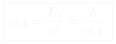
Combine that with the gravitational coupling above and the familiar expression emerges:

That is the Planck-mass form, reached as an output of the QTT source relations. The order matters: Artian's Ruler sets the energy and mass units, and the endurance construction supplies G_A. We have not first taken measured G, calculated a Planck mass, and then called the algebra a new prediction. Identifying the source coupling with laboratory G gives the conventional Planck mass; an independent numerical comparison still needs the independently constructed ruler.
For the stone, B=M/m_A counts how much of that mass capacity it carries. This is a source counting unit, not a claim that ordinary objects must come in indivisible Planck-mass lumps.
Field Notes · The Sixth Face of UELAnd at the other end: Einstein's field equations
Does the argument stop at Newton? The A2 Einstein-field paper takes the next step. It asks how a large collection of finite endurance events appears when described through a smooth, large-scale gravitational field.
Within its specified metric limit, the result is
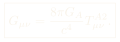
In ordinary language, the left side describes spacetime curvature. The right side describes the matter and energy sourcing it, now read through the endurance ledger. The same G_A fixed in the Newtonian construction fixes the strength of this relation.
That is a substantial consequence, but it has a precise starting point. The theorem requires a local, coordinate-independent metric description, consistent transfer of energy-momentum conservation, the stated second-order response, and no surviving leading preferred-clock contribution. It also requires the specified source-to-gravity normalization and compatible evolution constraints. Within that class, Einstein's field equation follows. Showing that every allowed finite QTT source necessarily enters that class is a further problem.
So the connection is not "write the sixth face and all of general relativity appears automatically." It is a source chain: endurance demand, gravitational current, Newtonian normalization, and then Einstein dynamics in the declared large-scale metric limit. The familiar Einstein form is the output of that conditional reconstruction. The distinctive QTT proposal is the physical source underneath it.
Field Notes · The Sixth Face of UELWhat the new paper actually establishes
The sixth-face paper makes this connection explicit and proves its consequences within the stated QTT source class. It carries the relation beyond a single number to the operators that describe possible energy and endurance values. Their allowed values, averages and variances are linked exactly. It also derives the corresponding expression in terms of inward flux through a closed surface.
The counting units are explicit. One full Artian mass unit requires one space-quantum of support per source tick, equivalent to 24 pixellate units in QTT's geometry. Express the rate in those smaller units and the formula becomes E_rest=(ℏ/24)Γ_pix. The physical allocation has not changed; only the unit used to count it has.
This belongs to a wider reconstruction. Companion work develops quantum phase and coherent evolution from completed-event rules under its declared physical conditions. The transport paper carries that argument. The sixth face adds the explicit endurance reading to the common energy structure.
QTT remains a proposed theory. These mathematical consequences do not, by themselves, show that nature uses its underlying mechanism. That requires a physical measurement of endurance or its flux which does not obtain the answer by dividing the measured energy by ℏ. The new paper states that distinction and supplies reproducible calculation checks.
Field Notes · The Sixth Face of UELThe stone is still there
What began as a question about an unobserved object ended at a connection between rest energy, phase and gravity. I did not invent the underlying endurance law in response to a LinkedIn post. The question made me recognise a consequence that deserved to be stated on its own.
We usually ask what gravity makes matter do. QTT also asks what matter must physically require in order to remain matter, and whether gravity follows from that requirement. If that account is right, the stone's gravitational field is connected to the very process that sustains it. That is why I think the silly question was worth asking.