What Is This Strange Mathematical Object? Why Has Physics Never Seen It Before?
A four-capacity that is neither a hypersphere nor a tesseract, and the QTT source route from one completed event to energy, mass, gravity, and cosmic creation
%7D%3D%5Cleft%7C%5Cmathcal%20O_3%5E%2B%5Cright%7C%5C%2CV_%7B%5Cmathrm%7Bpix%7D%7D%5C%2C%5Cell_A%3D24%5Cleft(%5Cfrac%7B%5Cpi%7D%7B6%7D%5Cell_A%5E3%5Cright)%5Cell_A%3D4%5Cpi%5Cell_A%5E4&bg=101b30&fg=f5f0e5&s=1&c=20201002)
Not a hypersphere and not a tesseract. It is QTT's typed product of one diameter-ball capacity normalization, the complete finite proper-frame fibre, and one Reality-Dimension closure stride, then read through energy, mass, frequency, endurance gravity, and the creation ledger.
I have trained my AIs to criticize me.
Not to manufacture a polite objection and then surrender after two paragraphs. Not to praise the ambition, repeat my own words back to me, and quietly avoid the load-bearing equation. I want them to find the place where a physicist will stop reading, put a finger on the page, and say: What exactly is this object?
This morning, one of them did exactly that.
The object was
%7D%3D4%5Cpi%5Cell_A%5E4%0A%7D&bg=101b30&fg=f5f0e5&s=1&c=20201002)
which QTT calls the completed four-capacity of one legal source event. I also call it the Atom of Reality.
This object is the unfamiliar face of a larger identity:
%7D%5CDelta%20V_A%5E%7B(4)%7D.%0A%7D&bg=101b30&fg=f5f0e5&s=1&c=20201002)
The mass and frequency faces are familiar. The fourth face is QTT-exclusive. It says that the same finite endpoint can be read as the funded capacity of one completed physical event. The novelty is not a rearrangement of the conventional Planck identities. It is the construction of the new source object %7D&bg=0a1424&fg=f5f0e5&s=0&c=20201002)

%7D&bg=0a1424&fg=f5f0e5&s=0&c=20201002)
If you have never read QTT before, here is the whole idea in ordinary language. QTT does not treat space and time as an empty stage that already exists before physics begins. It asks what finite physical support must be completed before one event can exist, carry energy, endure from one tick to the next, and be available to observation. QTT constructs the smallest such support as the equation above.
Five terms will appear throughout this article:
- QTT means Quantum Traction Theory, a finite-ledger substrate framework.
- Artian's Ruler,
, is the framework's smallest legal source stride. It is defined inside Artian Geometry before it is compared with the textbook Planck length.
- A pixellate is one no-preferred-axis spatial capacity member, normalized by the diameter-ball support
. It is a counting unit, not a tiny material ball that a microscope could photograph.
- A space quantum,
, is one complete finite proper-frame capacity packet. Its 24 members form a discrete orientation fibre; they are not 24 occupied balls superposed in ordinary space.
- The Reality Dimension is the non-translational spine through which an addressed event is closed. Its one-event stride is
.
Put those pieces together and the unfamiliar object becomes readable:
%7D%7D_%7B%5Ctext%7Bone%20completed%20event%7D%7D%0A%3D%0A%5Cunderbrace%7BV_%7B%5Cmathrm%7BSQ%7D%7D%7D_%7B%5Ctext%7Bclosed%20spatial%20capacity%7D%7D%0A%5Cunderbrace%7B%5CDelta%20w_A%7D_%7B%5Ctext%7Bone%20closure-spine%20stride%7D%7D.%0A%7D&bg=101b30&fg=f5f0e5&s=1&c=20201002)
The exact typed support is
%7D%0A%3D%0A%5Cmu_3%5Cotimes%5C%23_%7B%5Cmathcal%20O_3%5E%2B%7D%5Cotimes%5Cmu_1%2C%0A%7D&bg=101b30&fg=f5f0e5&s=1&c=20201002)
where 
%3D%5Cell_A&bg=0a1424&fg=f5f0e5&s=0&c=20201002)
Everything below explains why the first factor is 
My AI looked at the superscript &bg=0a1424&fg=f5f0e5&s=0&c=20201002)
It started with a Euclidean four-ball of radius
%0A%3D%0A%5Cfrac%7B%5Cpi%5E2%7D%7B2%7D%5Cell_A%5E4%0A%5Capprox%0A4.9348%5Cell_A%5E4.&bg=101b30&fg=f5f0e5&s=1&c=20201002)
That was not it.
It checked the boundary of that ball, the three-sphere:
%0A%3D%0A2%5Cpi%5E2%5Cell_A%5E3.&bg=101b30&fg=f5f0e5&s=1&c=20201002)
Wrong power of length, wrong coefficient, wrong object.
It checked the four-volume inside a causal cone, using 


Still not it.
It checked what happens when the ordinary spherical shell 

Again, the 
Then the AI said, in effect:
I have tried the standard objects. None of them gives a bare. Tell me what
That criticism was useful. More than useful, actually. Every calculation in it was pointing to the same conclusion:

The AI had not disproved the equation. It had proved that the noun "four-volume" was not enough.
So let us name the object properly and build it from the beginning.
The mistake hidden inside one familiar word
When a physicist sees %7D&bg=0a1424&fg=f5f0e5&s=0&c=20201002)
The Atom of Reality is none of these.
The multiplication is elementary. The QTT-exclusive result is the typed physical object it constructs: a rotationally closed spatial-capacity packet carried through one non-translational closure-spine stride, with its surface, energy, gravity, entropy, and creation relations tied to the same packet. No standard four-ball, tesseract, causal-cone volume, or textbook Planck-density identity supplies that object.
It is a product of two differently typed factors:
%7D%0A%3A%3D%0AV_%7B%5Cmathrm%7BSQ%7D%7D%5C%2C%5CDelta%20w_A.%0A%7D&bg=101b30&fg=f5f0e5&s=1&c=20201002)
The first factor, 

Therefore the superscript &bg=0a1424&fg=f5f0e5&s=0&c=20201002)
That distinction is the whole doorway.
Step one: Artian's Ruler is not an invisible cube
QTT begins with Artian's Ruler,

and quietly renaming it. The constructor order matters. The geometric object must be defined before the later gravitational comparison is allowed.
A conventional cube of side 
The minimal rotationally closed member is the sphere of diameter
%5E3%0A%3D%0A%5Cfrac%7B%5Cpi%7D%7B6%7D%5Cell_A%5E3.%0A%7D&bg=101b30&fg=f5f0e5&s=1&c=20201002)
QTT calls this member a pixellate.
That does not mean the substrate is filled with tiny visible marbles. The sphere supplies the normalization of one no-preferred-axis capacity member. It tells us how one local member is counted, not what a microscope would photograph.
The factor 
%5E3%0A%3D%0A%5Cfrac%7B%5Cpi%7D%7B6%7D.&bg=101b30&fg=f5f0e5&s=1&c=20201002)
Nothing has been fitted. Nothing has been borrowed from 
Step two: one member is not a completed space quantum
One diameter-ball support fixes the local normalization, but it has not yet closed the orientation ledger of a three-rail spatial frame.
The proper signed-permutation frame set has exactly 24 members:

In A5-X, those 24 proper orientations are not treated as 24 solid balls piled on top of each other in ordinary space. That would be nonsense as an occupied-volume calculation. They are 24 members of one finite orientation-capacity orbit. The measure being summed is a capacity ledger over legal orientations, not the volume of the geometric union of overlapping spheres.
The completed spatial capacity is therefore
%5C%5C%0A%26%3D4%5Cpi%5Cell_A%5E3.%0A%5Cend%7Baligned%7D%0A%7D&bg=101b30&fg=f5f0e5&s=1&c=20201002)
Now the

Standard geometry also has the separate solid-angle identity

This is a numerical cross-lock, not an alternative derivation and not an identification of a finite frame fibre with continuous Haar measure. The solid-angle identity is standard geometry. The 24-member count is standard finite-group theory. The QTT-native step is their typed use: one diameter-ball capacity normalization is counted over the complete finite proper-frame fibre and then carried through one address stride. Once that constructor is fixed, the arithmetic is exact.
This is why
Why exactly 24, rather than 12 or 48?
This is the place where a serious critic should press.
Once the arithmetic is visible, three nearby symmetry counts appear immediately. The proper tetrahedral rotation group has 12 members. The proper octahedral rotation group has 24. The full signed-permutation group, including reflections, has 48. If QTT merely looked at those three numbers and selected the middle one because it produced
That is not the constructor.
Begin with the object A5-X actually declares: three mutually orthogonal signed address rails,

The legal transformations must preserve unit length, orthogonality, and the complete signed rail set. They are therefore signed permutation matrices. A4 supplies proper real-rotor evolution, so the orientation class must also be preserved. The resulting automorphism group is
%0A%3D%0A%5Cleft%5C%7B%0AM%5Cin%5Cmathrm%7BMat%7D_3(%5Cmathbb%20Z)%3A%0AM%5E%7B%5Cmathsf%20T%7DM%3DI%2C%5C%20%5Cdet%20M%3D%2B1%0A%5Cright%5C%7D%0A%3DSO(3%2C%5Cmathbb%20Z).%0A%7D&bg=101b30&fg=f5f0e5&s=1&c=20201002)
There are 

%5Cright%7C%0A%3D3!%5C%2C2%5E%7B3-1%7D%0A%3D24.%0A%7D&bg=101b30&fg=f5f0e5&s=1&c=20201002)
This is not a decision to build the substrate from cubes instead of tetrahedra. The proper octahedral group is the familiar geometric picture of the complete proper signed-permutation action on three orthogonal rails. The rails come first. The group name comes afterward.
Why not 48? Because the other 24 signed permutations have determinant 

%0A%3De%5E%7B%5Cmathrm%7Btr%7DA%7D%0A%3D1.%0A%7D&bg=101b30&fg=f5f0e5&s=1&c=20201002)
A proper A4 rotor beginning at the identity cannot drift continuously into the determinant-
Why not 12? The tetrahedral group is an index-two subgroup of the legal 24-member frame group. It preserves one tetrahedral parity subset and omits twelve compensated rail permutations that remain legal for the three-rail object. Selecting that subgroup would require an extra binary choice between two dual tetrahedral subsets. No such selector exists in the declared source packet. It would privilege a hidden parity class, exactly what complete orientation closure forbids.
| Candidate packet | Count | What happens |
|---|---|---|
| Proper tetrahedral subgroup | 12 | Selects one tetrahedral parity subset and leaves twelve legal signed-rail transformations uncounted. |
| Complete proper three-rail frame | 24 | Includes every signed rail permutation with determinant  , once and with equal capacity. , once and with equal capacity. |
| Full signed-permutation group | 48 | Adds determinant- reflections and doubles the packet with a parity-conjugate sector. |
The selection statement can therefore be written compactly:
%3DSO(3%2C%5Cmathbb%20Z)%2C%0A%5Cqquad%0A%7CSO(3%2C%5Cmathbb%20Z)%7C%3D24.%0A%5Cend%7Bgathered%7D%0A%7D&bg=101b30&fg=f5f0e5&s=1&c=20201002)
There is still a physical question for nature: does the substrate instantiate this complete three-rail source packet? That is a real empirical burden. But 12, 24, and 48 are not interchangeable survivors of the same premises. They describe different constructor classes.
Step three: the Reality Dimension is a spine, not another road
We now have

but we still do not have one completed event.
QTT's source ontology is not an ordinary 3+1 spacetime with a decorative extra label. The current book describes a 1+3+1 source reading: one Reality-Dimension spine, three spatial laboratory readouts, and one clock/time readout.
The Reality Dimension participates in how physical events are addressed. Its distinctive job is closure. It is where an addressed event is closed.
It is not another translational direction beside 


One legal completed event carries one spine thickness:

The completed event measure is therefore the product
%7D%0A%26%3DV_%7B%5Cmathrm%7BSQ%7D%7D%5CDelta%20w_A%5C%5C%0A%26%3D%5Cleft(4%5Cpi%5Cell_A%5E3%5Cright)%5Cell_A%5C%5C%0A%26%3D4%5Cpi%5Cell_A%5E4.%0A%5Cend%7Baligned%7D%0A%7D&bg=101b30&fg=f5f0e5&s=1&c=20201002)
Equivalently, the measure is evaluated on
%7D(%5Cmathscr%20E_A)%0A%3D24%5Cleft(%5Cfrac%7B%5Cpi%7D%7B6%7D%5Cell_A%5E3%5Cright)%5Cell_A.%0A%7D&bg=101b30&fg=f5f0e5&s=1&c=20201002)
The per-member and completed-event quantities must not be conflated:
%7D%0A%3D%5Cfrac%7B%5Cpi%7D%7B6%7D%5Cell_A%5E4%2C%0A%5Cqquad%0A%5CDelta%20V_A%5E%7B(4)%7D%0A%3D24%5C%2C%5Cdelta%20V_%7B%7B%5Crm%20pix%7D%2CA%7D%5E%7B(4)%7D%0A%3D4%5Cpi%5Cell_A%5E4.%0A%7D&bg=101b30&fg=f5f0e5&s=1&c=20201002)
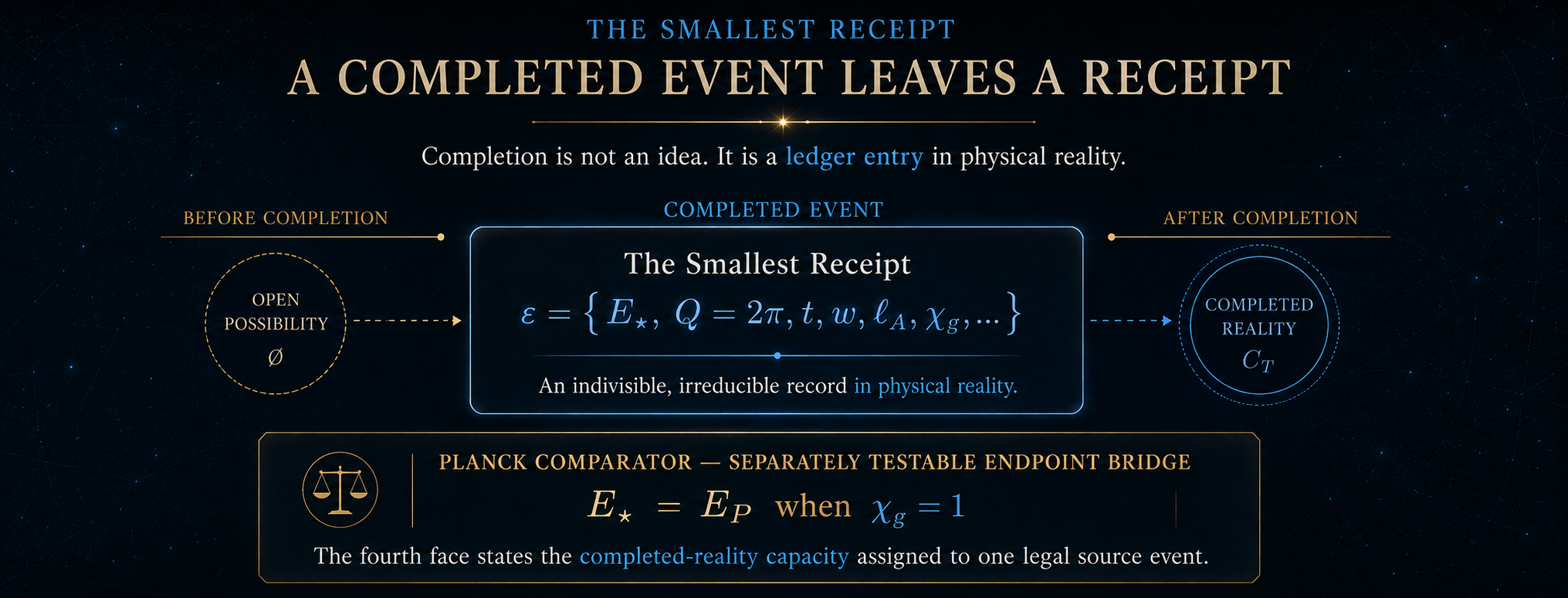
That is the object.
It is a rotationally closed 3D capacity quantum carried through one completed Reality-Dimension spine stride.
It is the Atom of Reality.
Why the coefficient does not change
My AI's most important observation was that every standard route from
That is correct.
If we integrate a shell, the radial integration introduces a denominator. If we move from 


QTT performs none of those operations.
It does not integrate the 3D capacity radially into a larger homogeneous dimension. It does not replace the two-sphere of directions by a three-sphere of directions. It does not ask four interchangeable Euclidean axes to enclose a body.
It takes an already closed spatial capacity measure and carries that complete measure through one discrete closure stride:
%7D%0A%3D%0A%5Cmu_%7B%5Cmathrm%7BSQ%7D%7D%5E%7B(3)%7D%5Cotimes%5Cmu_w%5E%7B(1)%7D.&bg=101b30&fg=f5f0e5&s=1&c=20201002)
For one event,
%7D%3D4%5Cpi%5Cell_A%5E3%2C%0A%5Cqquad%0A%5Cmu_w%5E%7B(1)%7D%3D%5Cell_A.&bg=101b30&fg=f5f0e5&s=1&c=20201002)
There is no new radial integral, so there is no division by three. There is no fourth Euclidean angular integration, so there is no new factor of 
The coefficient is not a failed four-ball coefficient. It is a completed three-orientation coefficient carried by a product measure.
Put the objects side by side
The quickest way to see the issue is to stop calling all of them merely "four-volumes."
| Object | Construction | Measure | What its directions mean |
|---|---|---|---|
| Tesseract | four Cartesian edges of length |  | four translational Euclidean axes |
| Euclidean 4-ball | all points with  | %5Cell_A%5E4&bg=0a1424&fg=f5f0e5&s=0&c=20201002) | four homogeneous Euclidean directions |
| Truncated causal cone | spatial 3-balls integrated through  | %5Cell_A%5E4&bg=0a1424&fg=f5f0e5&s=0&c=20201002) | one time coordinate plus changing spatial radius |
| QTT completed event | 24-orientation spatial capacity  one spine stride one spine stride | | three spatial capacity rails plus one non-translational closure spine |
These coefficients disagree because the objects disagree.
Calling the QTT object a four-ball would be wrong. Calling it a tesseract would be wrong. Calling it the interior of a light cone would be wrong. Calling it simply "a four-volume" without its constructor invites all three mistakes.
The precise name should therefore travel with the equation:
%7D%3D4%5Cpi%5Cell_A%5E4.%0A%7D&bg=101b30&fg=f5f0e5&s=1&c=20201002)
And the human name is Atom of Reality.
Why physics has not seen it before
The answer is not that mathematicians somehow missed an easy four-dimensional formula. They did not. The standard formulas my AI listed are correct.
Physics has not used this object as a fundamental completed-event measure because standard theories ask a different first question.
General relativity begins with a differentiable spacetime manifold and a metric. Quantum field theory places fields or operator-valued distributions on an already available spacetime. Lattice theories replace the continuum with coordinate sites and links, but the lattice is still the arena in which the dynamics are computed. In each case, the geometry or coordinate support exists before a particular event closes.
QTT reverses that explanatory order.
There is important neighboring work, but it is not this constructor. Quantum-gravity and information-theoretic literature already contains Planck-scale cells, causal regions, discrete events, and bounds on operations inside a four-volume. For example, Seth Lloyd's quantum geometric limit relates event counts in a four-volume to Planck-scale geometric bounds. It does not construct
%5Cell_A%0A%3D4%5Cpi%5Cell_A%5E4%0A%7D&bg=101b30&fg=f5f0e5&s=1&c=20201002)
as one completed source event, nor place that event measure as a fourth face of energy.
The novelty boundary is precise. Standard geometry owns the diameter-ball coefficient
It asks what an event must complete before it is legal to enter the physical ledger at all. The address is not an empty box waiting for reality to arrive. The completed event earns its address by closing its dial, capacity, orientation, and modular bundle.
That is why the object is unfamiliar. It lives before the usual textbook question.
Textbooks ask:
What is the volume of a region in the geometry?
QTT asks:
What finite support must close before one event counts as physically completed?
Once those questions are separated, the strange coefficient stops looking like a defective hypersphere. It becomes a receipt for a different kind of construction.
The same event leaves more than one receipt
The construction does not end at
Begin with the completed event and remove one Reality-Dimension spine thickness and one surface-normal thickness, each equal to
%7D%7D%7B%5Cell_A%5E2%7D%0A%3D%0A4%5Cpi%5Cell_A%5E2.%0A%7D&bg=101b30&fg=f5f0e5&s=1&c=20201002)
A regular orientable boundary has exactly two coorientations,

A7 gives those two sides physical meaning as the visible incidence and its same-universe hidden completion. They are distinct typed sectors of one completed boundary, so their capacities add rather than average:

The minimal surface member is the diameter disk associated with one Artian ruler,
%5E2%0A%3D%0A%5Cfrac%7B%5Cpi%7D%7B4%7D%5Cell_A%5E2.%0A%7D&bg=101b30&fg=f5f0e5&s=1&c=20201002)
Now the apparently separate number 32 is a quotient, not another selected symmetry count:
%5Cell_A%5E2%7D%0A%3D32.%0A%7D&bg=101b30&fg=f5f0e5&s=1&c=20201002)
This is the A5-X Surface-Capacity Uniqueness chain developed in the horizon and information paper. Its source is independent of the group-cardinality calculation: one completed four-capacity, two normalized thickness quotients, and the two coorientations of a regular orientable boundary.
The event and surface receipts also obey a central invariant,
%7D.%0A%7D&bg=101b30&fg=f5f0e5&s=1&c=20201002)
Check it directly:

while
%7D%0A%3D%0A16%5Cpi%5Cleft(4%5Cpi%5Cell_A%5E4%5Cright)%0A%3D%0A64%5Cpi%5E2%5Cell_A%5E4.&bg=101b30&fg=f5f0e5&s=1&c=20201002)
The event can therefore be counted through several linked ledgers:
%7D%7D%7B4%5Cpi%5Cell_A%5E4%7D%0A%3D%0A%5Cfrac%7BQ_%5CSigma%5E2%7D%7B16%5Cpi%5CDelta%20V_A%5E%7B(4)%7D%7D.%0A%5Cend%7Baligned%7D%0A%7D&bg=101b30&fg=f5f0e5&s=1&c=20201002)
One completed address is simultaneously one 
This is much more constrained than writing 

More than closure: the source of energy, mass, and gravity
The Atom of Reality already does far more than name event closure. In QTT it is the source unit that shows how gravity works and where the mass-energy of the universe comes from: not matter poured into an empty container, but completed space-time-reality capacity itself.
That sentence needs to be unpacked carefully, because QTT is making a very different claim from the familiar phrase "energy stored in space."
In the textbook picture, spacetime is usually the arena. Matter and fields occupy that arena, energy is assigned to them, and gravity is represented by the geometry responding to stress-energy. QTT keeps the successful laboratory equations, but it reverses the source order. Space, time, and reality are not passive background ingredients. A physical event exists only after a finite packet of spatial capacity, clock support, address, orientation, and modular closure has completed.
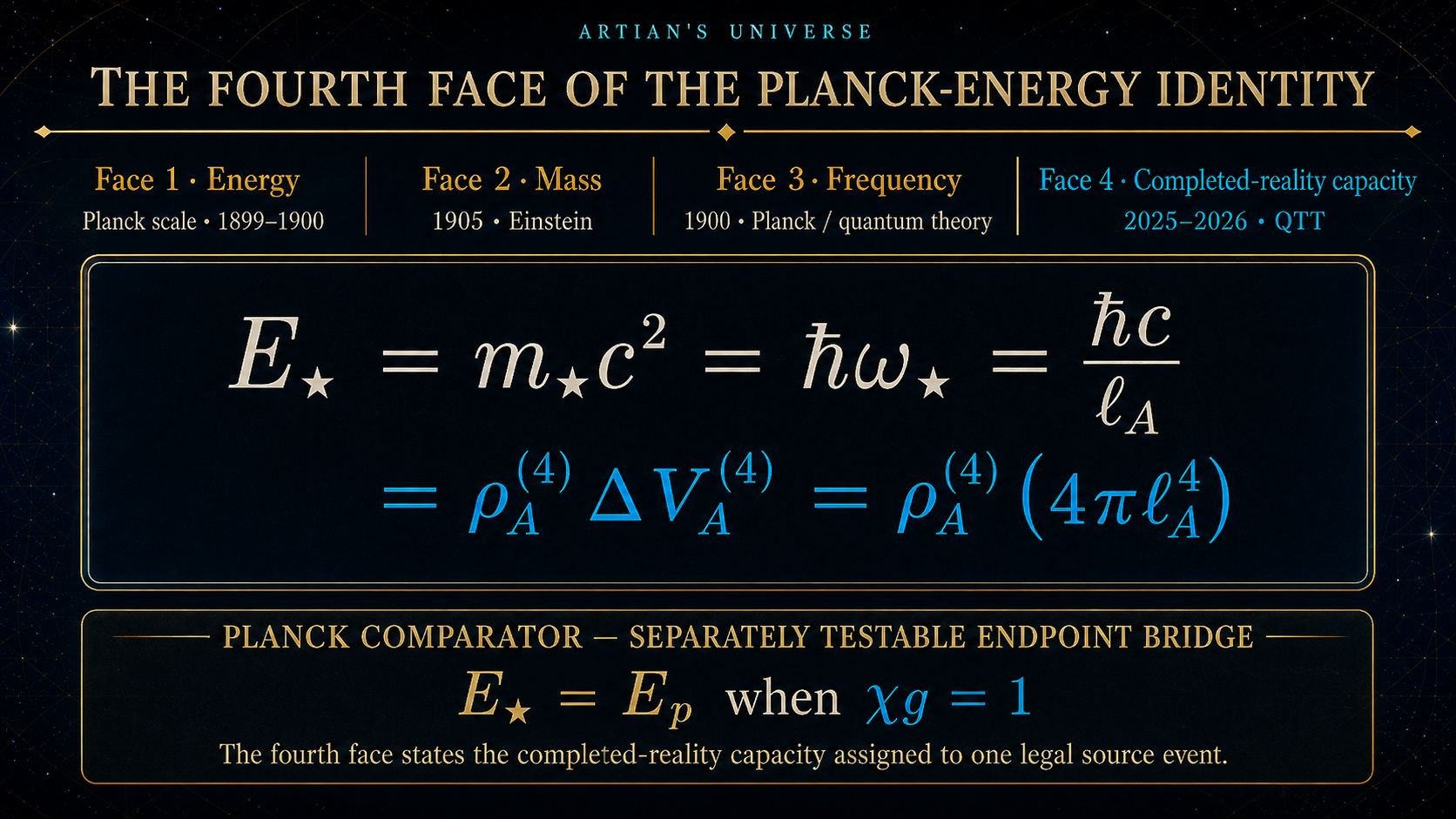
The fourth face of the Unified Equilibrium Law states the energy carried by that completed packet:
%7D%5CDelta%20V_A%5E%7B(4)%7D%0A%3D%0A%5Crho_A%5E%7B(4)%7D%5Cleft(4%5Cpi%5Cell_A%5E4%5Cright).%0A%7D&bg=101b30&fg=f5f0e5&s=1&c=20201002)
Here
It is also not a coefficient chosen afterward to make the fourth face equal the other three. The geometric constructor has already fixed
%7D%3D4%5Cpi%5Cell_A%5E4.%0A%7D&bg=101b30&fg=f5f0e5&s=1&c=20201002)
The source clock and capacity rail independently give

Only then is the event four-density read from those two already fixed quantities:
%7D%0A%3D%5Cfrac%7BE_%5Cstar%7D%7B%5CDelta%20V_A%5E%7B(4)%7D%7D%0A%3D%5Cfrac%7B%5Chbar%20c%7D%7B4%5Cpi%5Cell_A%5E5%7D.%0A%7D&bg=101b30&fg=f5f0e5&s=1&c=20201002)
So the fourth face closes without fitting a density:
%7D%5CDelta%20V_A%5E%7B(4)%7D%0A%3D%5Cleft(%5Cfrac%7B%5Chbar%20c%7D%7B4%5Cpi%5Cell_A%5E5%7D%5Cright)%0A%5Cleft(4%5Cpi%5Cell_A%5E4%5Cright)%0A%3D%5Cfrac%7B%5Chbar%20c%7D%7B%5Cell_A%7D%0A%3DE_%5Cstar.%0A%7D&bg=101b30&fg=f5f0e5&s=1&c=20201002)
Changing
The constructor order matters:
%7D%3D4%5Cpi%5Cell_A%5E4%2C%5C%5C%0A%5Ctext%7Bsource%20clock%20and%20A6--A7%20capacity%7D%0A%26%5Clongrightarrow%20E_%5Cstar%3D%5Cfrac%7B%5Chbar%20c%7D%7B%5Cell_A%7D%2C%5C%5C%0A%5Cleft(%5CDelta%20V_A%5E%7B(4)%7D%2CE_%5Cstar%5Cright)%0A%26%5Clongrightarrow%20%5Crho_A%5E%7B(4)%7D%3D%5Cfrac%7B%5Chbar%20c%7D%7B4%5Cpi%5Cell_A%5E5%7D.%0A%5Cend%7Baligned%7D%0A%7D&bg=101b30&fg=f5f0e5&s=1&c=20201002)
Only after this source construction is complete does the laboratory endpoint question enter. In the endpoint-faithful gravity branch,

That empirical bridge is separate from the existence of the fourth-face object. Starting instead from 
The same endpoint has the familiar mass and frequency readings:
%7D%5Cleft(4%5Cpi%5Cell_A%5E4%5Cright).%0A%7D&bg=101b30&fg=f5f0e5&s=1&c=20201002)
This is why the fourth face is not another equation placed beside 
For a ledger containing 
%7D%5CDelta%20V_A%5E%7B(4)%7D.%0A%7D&bg=101b30&fg=f5f0e5&s=1&c=20201002)
In plain language, QTT does not begin with a universe full of mass-energy and then ask how spacetime reacts. It begins with completed packets of space-time-reality support. What the laboratory calls energy is the capacity face of those packets. What it calls mass is their endurance cost: the continuing draw required for a completed physical bundle to remain present from one source tick to the next.
Gravity then reads the same packet through its two-sided surface ledger. A5-X gives

The Law of Endurance turns the continuing support draw of mass into an outward endurance current. Its weak-field readout has Newton's form, with

The surface and gravity forms are the same source normalization written two ways:

That is the coefficient multiplying stress-energy in the Einstein-field shadow:

The ontological chain is therefore direct:

This is what it means to say that the fourth object shows how gravity works. Gravity is not added to the Atom of Reality as an unrelated coupling. It is the large-scale surface response of the finite support that completed mass-energy keeps drawing in order to endure.
A3, the Law of Creation, carries the same ontology into cosmology. On the declared fixed-origin branch, with 

%0A%3D48%5Cpi%20B%5Cell_A%5E3N_T(N_T%2B1).%0A%7D&bg=101b30&fg=f5f0e5&s=1&c=20201002)
The universe is therefore not described as a fixed container that later receives matter. Its space-time-reality ledger grows through completed source events, while mass-energy is the funded capacity and endurance reading of those events. The Atom of Reality is the smallest receipt in that construction.
For a newcomer, the shortest possible summary is this:
A tesseract tells us how much coordinate room a four-dimensional cube encloses. A four-ball tells us how much coordinate room a four-dimensional sphere encloses. The Atom of Reality tells QTT how much finite physical support one completed event must earn before energy, mass, time, and gravity can have a common source.
What the AI was right to demand
The AI was right about one editorial failure: a graphic that prints only
%7D%3D4%5Cpi%5Cell_A%5E4&bg=101b30&fg=f5f0e5&s=1&c=20201002)
and labels it "four-volume" has not given a new reader enough information. A physicist will reasonably test it as a Euclidean four-body and reject it in under a minute.
The fix is not to tell the physicist that QTT uses a "different format" and ask for trust. The fix is to print the type signature:
![\displaystyle \boxed{
\Delta V_A^{(4)}
=
\underbrace{\left[
\left|\mathcal O_3^+\right|\cdot\frac{4\pi}{3}
\left(\frac{\ell_A}{2}\right)^3
\right]}_{\text{rotationally closed 3D capacity}}
\underbrace{\left[\ell_A\right]}_{\text{one Reality-Dimension spine stride}}.
}](https://s0.wp.com/latex.php?latex=%5Cdisplaystyle%20%5Cboxed%7B%0A%5CDelta%20V_A%5E%7B(4)%7D%0A%3D%0A%5Cunderbrace%7B%5Cleft%5B%0A%5Cleft%7C%5Cmathcal%20O_3%5E%2B%5Cright%7C%5Ccdot%5Cfrac%7B4%5Cpi%7D%7B3%7D%0A%5Cleft(%5Cfrac%7B%5Cell_A%7D%7B2%7D%5Cright)%5E3%0A%5Cright%5D%7D_%7B%5Ctext%7Brotationally%20closed%203D%20capacity%7D%7D%0A%5Cunderbrace%7B%5Cleft%5B%5Cell_A%5Cright%5D%7D_%7B%5Ctext%7Bone%20Reality-Dimension%20spine%20stride%7D%7D.%0A%7D&bg=101b30&fg=f5f0e5&s=1&c=20201002)
with 
Now there is something to check.
A critic can question whether nature uses the complete three-rail source packet at all. That is the correct empirical burden. But a 12-member tetrahedral subset and a 48-member reflection-doubled packet are not uneliminated alternatives inside that same constructor: the first inserts a hidden parity selector, while the second changes proper orientation into a proper-plus-improper object. A critic can also test whether the independently constructed surface ledger and four-capacity stay locked by %7D&bg=0a1424&fg=f5f0e5&s=0&c=20201002)
What a critic can no longer do is replace the object by a four-ball, calculate
Is it merely a definition?
Every theory has definitions. The scientific question is what the definition forces once it is made.
If 
The object is therefore not defended by saying, "I define it this way, so it is true." It is exposed by saying, "This is the constructor; here are the consequences that must remain mutually consistent; here are the routes by which nature can refuse it."
The current source status is exact inside A5-X:
%7D%3D4%5Cpi%5Cell_A%5E4.&bg=101b30&fg=f5f0e5&s=1&c=20201002)
Its empirical selection belongs to the connected tests and metrology bridges. The Fourth-Face Talbot-Lau preregistration is one prospective access test of the completed-event framework. It does not put an Atom of Reality under a microscope; it asks whether a frozen completed-event source law leaves the predicted nonconstant laboratory shape after ordinary interferometer physics is fixed.
The Artian's Ruler framework asks a different question: whether the absolute scale can be constructed without using
This is how an unfamiliar object enters physics properly. First define it. Then derive what else must move with it. Then give nature a clean way to say no.
What happened in the conversation
My AI began by assuming the object belonged to a known family. That assumption was reasonable because my label was too compressed.
It tested the family thoroughly:
- not a Euclidean four-ball;
- not a three-sphere boundary;
- not a causal-cone interior;
- not an integrated spherical shell;
- not a tesseract.
Then it refused to accept "QTT is different" as an answer. Good.
That refusal forced the missing definition into the open:

Once that sentence is printed, the coefficient becomes transparent:

The conversation did not weaken the object. It removed an ambiguity that made the object look like something it never claimed to be.
That is why I train my AIs to criticize me. Agreement is cheap. A useful critic finds the noun I forgot to define.
This morning, the AI did not find
Neither did I.
That was not the end of the equation. It was the first clear sign that the comparison had been aimed at the wrong object.
Reading anchors
- QTT Main Book, stable concept DOI: A5-X noncircular address-ruler construction on pp. 55-58; Reality-Dimension spine discussion on pp. 77-82; UEL fourth-face construction on pp. 158-160; readable Law of Endurance and gravity bridge on pp. 198-205; creation-ledger construction beginning on p. 243.
- Artian's Completed-Event Four-Capacity Theorem: the standalone owner theorem for the typed product measure
, its one-member firewall, and the downstream fourth-face role.
- Lexicon: Artian Geometry
- Lexicon: Artian's Ruler
- Lexicon: Pixellate
- Lexicon: Space Quantum
- Two Universes: source geometry
- Metering the Planck Length without big G using Artian Geometery Anchors
- Artian Capacity Endpoint Without G
- The Artian Keystone Audit
- Artian A2 Endurance and the Einstein-Field Infrared Theorem
- The Creation Ledger
- Fourth-Face Talbot-Lau Completed-Event Preregistration
- Seth Lloyd, The quantum geometric limit: adjacent four-volume/event-counting work, not the QTT completed-event constructor.
Where the Atom of Reality, endurance, and creation ledgers live
- pp. 55–58: the A5-X noncircular address-ruler construction.
- pp. 77–82: the Reality Dimension spine and completed-event closure.
- pp. 198–205: the Law of Endurance and the gravity bridge.
- p. 243 onward: the Creation Ledger and cumulative source-volume law.
Continue through the Blog Map, the Artian's Ruler paper family, the Derivation Atlas, and the Lexicon entries for Artian's Ruler, Reality Dimension, and space quantum.