
Speed of Light for All Local Observers
The ontological cleaning: the same measured c, protected for different reasons.
Metric GR and the Artian/QTT model agree on the local vacuum light-speed readout. This note separates that agreement from the source stories beneath it, then identifies the few declared windows where the stories become experimentally different.
Separation: 7.6120467489% · target frozen before primary data · no fitted parameter in R
One thing I never liked about the standard metric story of relativity — and never hid, even in the 2019 video sessions — is its ontological treatment of the observer of light. Not the mathematics. The mathematics is magnificent, and the Artian/QTT model keeps its tested local shadow. What I could not accept was the source story told about what time is.
On 15 July I deposited a sealed dual-clock Sagnac preregistration; the reader-facing field note followed on 16 July. The test made some readers uncomfortable, including me. This post is the reason behind it: the two ontologies, side by side, with the domain in which they are operationally identical and the windows in which they are not.
1 · The trap in the question
Everyone looks for the difference in the wrong place. “If QTT has an absolute source clock, surely some moving observer must measure a different light speed.” No. In the domains compared here, both constructions give every local inertial observer the same c. The difference is not the local number. It is the reason the number survives.
Metric GR protects local light-speed invariance kinematically through its Lorentzian metric and local Lorentz symmetry. The Artian/QTT model must earn the same readout while carrying an absolute source ordering. Its current radiative Lorentz-stability theorem excludes preferred-frame kinetic operators in the declared local matter/gauge domain and supplies an anisotropic negative control. The control gives the exact loop response α/(12π), so the calculation is sensitive to a preferred tensor when one is actually inserted.
Metric GR says the local value is invariant because local spacetime is Lorentzian. The Artian/QTT model says the same readout survives because its declared local ledger cannot construct a preferred-frame tensor. The ontology lives in the reasons and in the tests outside their shared protected domain.
2 · The ontology table
| Standard metric GR + ordinary QM reading | Artian/QTT model | |
|---|---|---|
| Time | A coordinate and proper-time structure on a Lorentzian spacetime; no frame-independent global present is supplied by the metric alone. | A source-order counter. Completed address events are ordered before laboratory clock readout; the source clock is not promoted to a local preferred-frame vector. |
| Space and duration | Aspects of one metric spacetime structure. | Readout aspects of one completed address measure, with the source four-cell written as ΔV4 = 4πℓA4. |
| “Now” | No invariant simultaneity slice follows from ordinary local Lorentz symmetry. | Quantized Now is membership in a completed w-address tick. It is a source statement, not a light-clock synchronization convention. |
| Persistence | Rest energy is a state property; standard theory does not add a separate per-tick existence-work ledger. | Reality-work is throughput: Etick = Mc2 per substrate tick, with existence-work power Mc2/t̃A. |
| What c is | The local null-cone conversion fixed by the Lorentzian metric structure. | The source ruler-to-tick ratio c = ℓA/t̃A, inherited by every lawful local readout channel. |
| A boost | A Lorentz transformation between local inertial frames. | A re-slicing of the readout in which the moving channel completes a different proper-time count while preserving its internal ℓ/t ratio. |
| Twin aging | Different worldlines accumulate different proper times. | Different address paths accumulate different numbers of endurance transactions; the low-regime readout recovers the same proper-time difference. |
| Lorentz symmetry | Fundamental to the local metric description. | Exact in the declared local readout domain; the all-orders matter/gauge corollary is conditional on the no-local-spurion boundary. |
| Source object | Lorentzian metric geometry and local quantum fields in the operational baseline used here. | A finite ledger of completed events, modular capacity, and source-to-readout access maps. |
3 · Why a source clock can still yield one local c
This is the part people assume must break. In the Artian ledger, c is not first introduced as the speed of an object through an external stage. Rods, clocks, photons, and observers inherit the same completed-address ruler and tick. A local measurement of c therefore compares two aspects of the same lawful readout unit.
Time dilation remains real: different channels accumulate different proper-time or address counts. But the ruler-to-tick ratio internal to each qualified local channel stays the same. This is not yet an empirical victory over GR; inside the protected local domain it is an alternative constructor for the same observed result.
4 · The epistemic table: what can be known
| Standard metric GR + ordinary QM reading | Artian/QTT model | |
|---|---|---|
| Status of local c-invariance | Built into local Lorentzian metric kinematics. | A scoped tensor-exclusion theorem in the declared local matter/gauge sector, plus an exact α/(12π) anisotropic control. |
| Can local tangent data read source order? | The operational theory supplies no preferred source order to read. | Not through a local preferred-frame coupling in the declared domain. The source clock remains a scalar ordering unless a separate, qualified access channel is constructed. |
| Shared protected domain | Ordinary local rods, clocks, light propagation, and matter/gauge observables within the theorem's printed assumptions. Agreement here is expected; it is not evidence that the source ontologies are identical. | |
| Distant simultaneity | No invariant simultaneity convention follows from local Lorentz symmetry alone. | A source address order is posited, but ordinary tangent readout cannot promote it into a local clock synchronization signal. |
| Scientific cost | Fewer source objects; no deeper ledger is needed for the local metric account. | More source structure. It earns scientific standing only where that structure fixes a predeclared observable outside the shared local domain. |
5 · The windows where the ontologies split
The corpus organizes the discriminators into three families: counts, closures, and costs. Some rows below are prospective tests; others are retrospective or structural audits. The status column is part of the claim.
| Observable | Standard baseline | Artian/QTT target | Status |
|---|---|---|---|
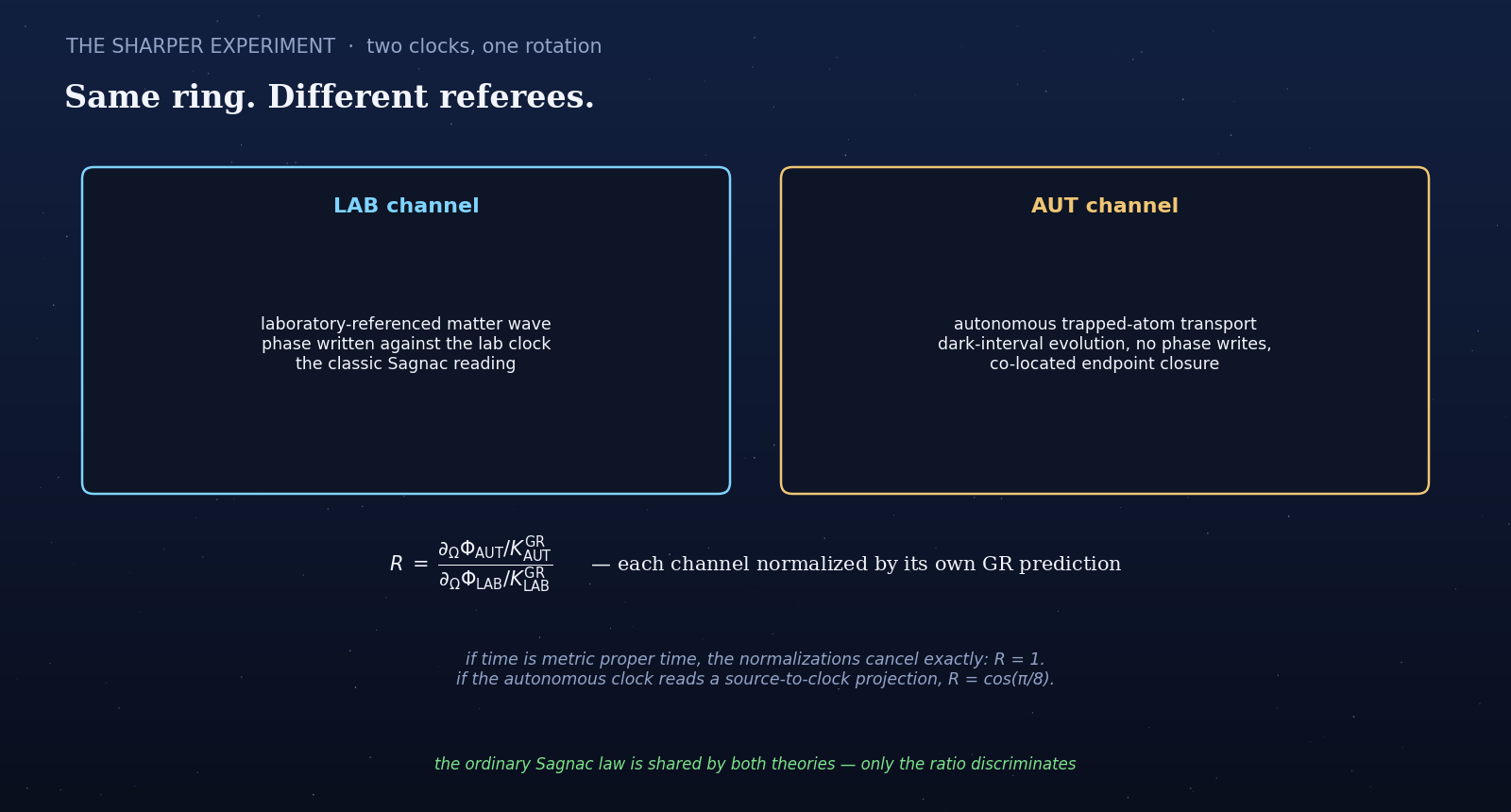
| Qualified dual-clock Sagnac ratio R | R = 1 for the metric proper-time hypothesis after each channel is normalized by its own GR apparatus response. | R = cos(π/8) = 0.9238795325… for the seven-gate-qualified QTT-A1 autonomous channel. | Preregistered 15 July 2026. Protocol closed; qualified hardware and primary data pending. Gate failure = no verdict. |
| Planck-mass coherent-superposition ceiling | Standard QM has no intrinsic mass-only ceiling at mP; practical loss of visibility is assigned to environmental and apparatus decoherence. | For one coherent address bundle, Mcoherent < mP ≈ 21.76 μg. A verified coherent spatial superposition at or above mP would falsify this QTT ceiling. | Long-range prediction. Environmental decoherence and classical-mixture alternatives must be excluded. |
| Cosmic-age clock bridge | A model-dependent FLRW age is inferred in the chosen cosmological fit. | T0ABC = 15.40 Gyr and t0lab = 15.40 cos(7π/48) = 13.81184 Gyr. | Exact internal projection; retrospective comparator (+0.65σ using the stated Planck age row), not a prospective clock measurement. |
| Cosmological-constant source amplitude | Λ is a parameter of the effective cosmological model; the observed small vacuum scale is not selected by GR alone. | The current ledger reduces ρΛ/ρP = ε/(12π), then proves that conservation, reachability, convergence, and a capacity bound do not uniquely select positive ε. | Reduction and non-uniqueness theorems closed; microscopic exchange-ratio derivation pending. No solved positive amplitude is claimed. |
| Galaxy acceleration knee | No unique acceleration constant follows from GR without an additional matter or modified-dynamics model. | a0τ(T) = c/(2πT), with the laboratory floor a0,labfloor = a0τ/cos(π/8). The χΛ source-kernel closure remains separate. | Renewal-ledger rail printed; source-kernel and full empirical adjudication remain open. |
6 · Why I published the uncomfortable test
The dual-clock Sagnac protocol places two channels on one rotating ring, fixes the normalized ratio, requires seven qualification gates, and freezes a blind decision rule. Several people asked why I would publish the configuration under which a printed QTT clock-projection claim can fail in public.
The reason goes back to 2019. I did not reject the standard metric ontology because it was strange. I rejected the habit of allowing an ontology to remain insulated from a price. If the Artian/QTT model claims a source order behind laboratory clocks while proving that ordinary local preferred-frame tests cannot read it, then it owes physics a lawful access window: a number, a protocol, and a date.
The target cos(π/8) was not fitted to a ring. Its upstream paper identifies the same half-angle with the standard T-gate magic-state overlap and the symmetric CHSH optimum; ρ = 2π cos(π/8) also enters the separately published neutrino-ratio rail. Those algebraic recurrences are provenance, not Sagnac evidence. The ring remains the prospective test of this particular physical clock-projection claim.
In 2019 I argued about the ontology. In 2026 I priced one part of it: 7.6120467489%, frozen before primary data. If a qualified ring reads 1, the printed QTT-A1 projection target is falsified. If it reads cos(π/8) while all seven gates hold and the controls close, the metric hypothesis for that channel is contradicted. If it reads neither, the two-point model fails. A gate failure produces no theory verdict.
7 · The honesty ledger
The local matter/gauge Lorentz tensor exclusion and the α/(12π) anisotropic control, within the printed no-spurion domain.
The clock as completed-address source order, with proper time and laboratory time treated as access readouts.
Qualified dual-clock hardware and primary data; Planck-mass coherent superposition; source-kernel closures for the vacuum and acceleration rows.
No completed Sagnac observation, no empirical proof of absolute source order, no closed gravity-loop theorem, and no derived positive cosmological-constant source amplitude.
Nothing here asks a reader to accept an ontology on authority. The local agreement is deliberately preserved; the departures carry their own status labels. The universe remains the only referee. The purpose of the preregistration is to hand it a whistle without first deciding which side should win.
— Ali
Open the exact source records
Read around the clock and the test
Move from argument to ledger
Where this note sits in the main volume
QTT Main Book v10.01, stable concept DOI 10.5281/zenodo.17527179.
- A1, source clock, and source/readout distinction: pp. 47–52 and 49–66.
- Local two-clock and Lorentz readout: pp. 169–172 and 216.
- Sagnac, clock projection, and reference conventions: pp. 554–573.
- Capacity regulator and local matter/gauge field-theory domain: pp. 680–684.