When a Simple Test Reaches the Deepest Layer of a “Smooth” Universe
Why Talbot–Lau scientists should care about a velocity barcode that must move
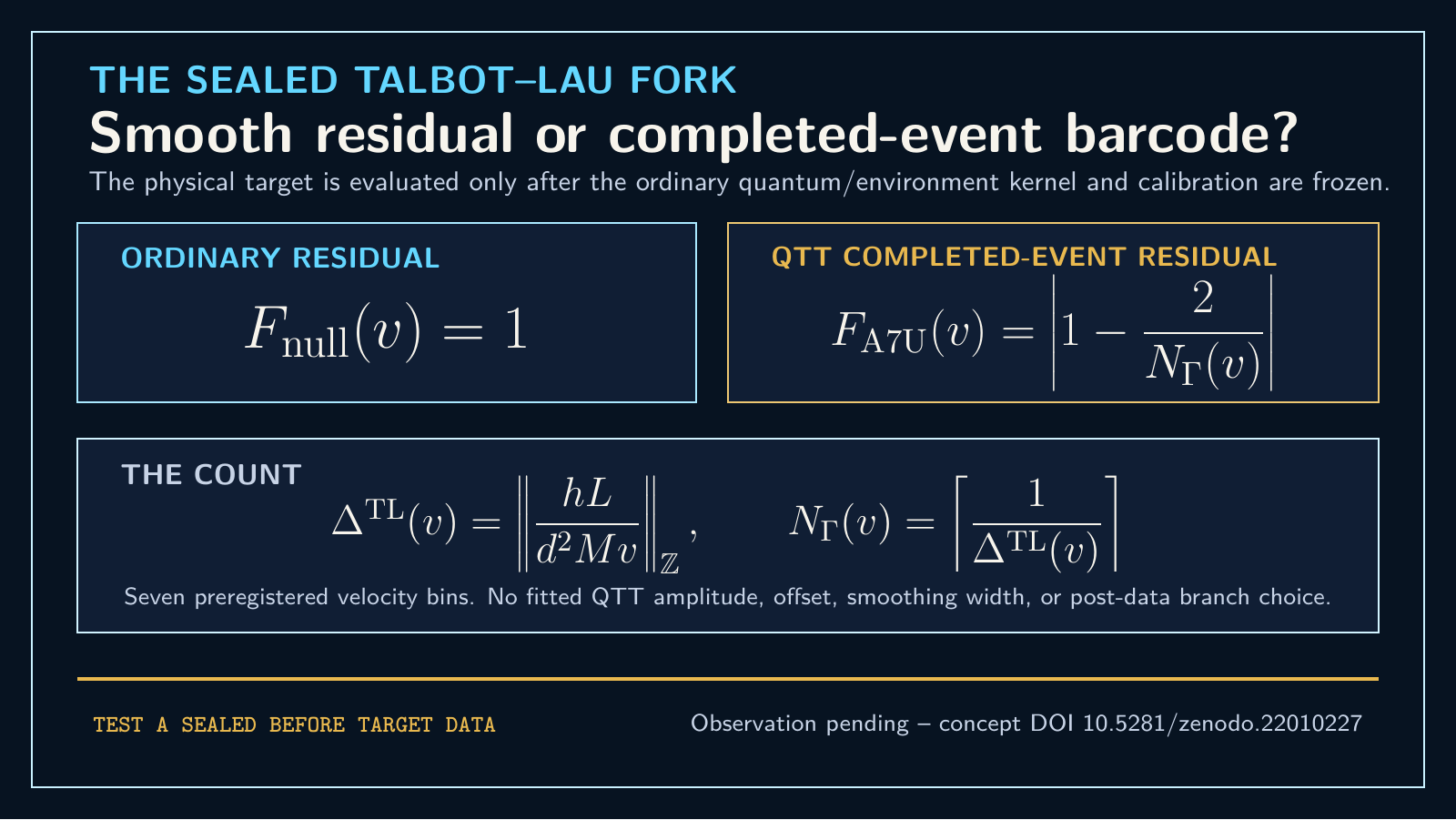
%3D1%2C%5Cqquad%20F_%7B%5Crm%20A7U%7D(v)%3D%5Cleft%7C1-%5Cfrac%7B2%7D%7BN_%5CGamma(v)%7D%5Cright%7C&bg=101b30&fg=f5f0e5&s=1&c=20201002)
One qualified residual is smooth. The other carries a frozen integer fingerprint. Test B then asks whether every feature moves to the new velocity coordinate fixed before target-bearing data are opened.
![\displaystyle \boxed{
\begin{aligned}
\text{ordinary residual:}\qquad &F(v)=1,\\[2mm]
\text{QTT completed-event residual:}\qquad
&F(v)=\left|1-\frac{2}{N_\Gamma(v)}\right|,\\[1mm]
&N_\Gamma(v)=
\left\lceil
\frac{1}{\left\|\dfrac{hL}{d^2 Mv}\right\|_{\mathbb Z}}
\right\rceil .
\end{aligned}}](https://s0.wp.com/latex.php?latex=%5Cdisplaystyle%20%5Cboxed%7B%0A%5Cbegin%7Baligned%7D%0A%5Ctext%7Bordinary%20residual%3A%7D%5Cqquad%20%26F(v)%3D1%2C%5C%5C%5B2mm%5D%0A%5Ctext%7BQTT%20completed-event%20residual%3A%7D%5Cqquad%0A%26F(v)%3D%5Cleft%7C1-%5Cfrac%7B2%7D%7BN_%5CGamma(v)%7D%5Cright%7C%2C%5C%5C%5B1mm%5D%0A%26N_%5CGamma(v)%3D%0A%5Cleft%5Clceil%0A%5Cfrac%7B1%7D%7B%5Cleft%5C%7C%5Cdfrac%7BhL%7D%7Bd%5E2%20Mv%7D%5Cright%5C%7C_%7B%5Cmathbb%20Z%7D%7D%0A%5Cright%5Crceil%20.%0A%5Cend%7Baligned%7D%7D&bg=101b30&fg=f5f0e5&s=1&c=20201002)
That is the fork.
After ordinary quantum interference, known environmental effects, detector response, and physical calibration have been carried through the apparatus model, does the remaining visibility contain no extra structure? That is the first line: %3D1&bg=0a1424&fg=f5f0e5&s=0&c=20201002)
Or does it carry a discrete count tied to completion of the Talbot phase? That is the second line. For the preregistered first-harmonic branch, its shape is fixed before the QTT-sensitive residuals are opened. At exact whole-turn closure, the frozen convention is 

The two possibilities do not differ by a fitted QTT amplitude, a movable velocity offset, or a branch chosen after seeing the data. More importantly, QTT says that if the shape is real, every feature must move to a new velocity address when the mass or geometry is changed.
This is how a machine on a laboratory table can reach a question about the deepest layer of physical description.
A large object behaving like a wave
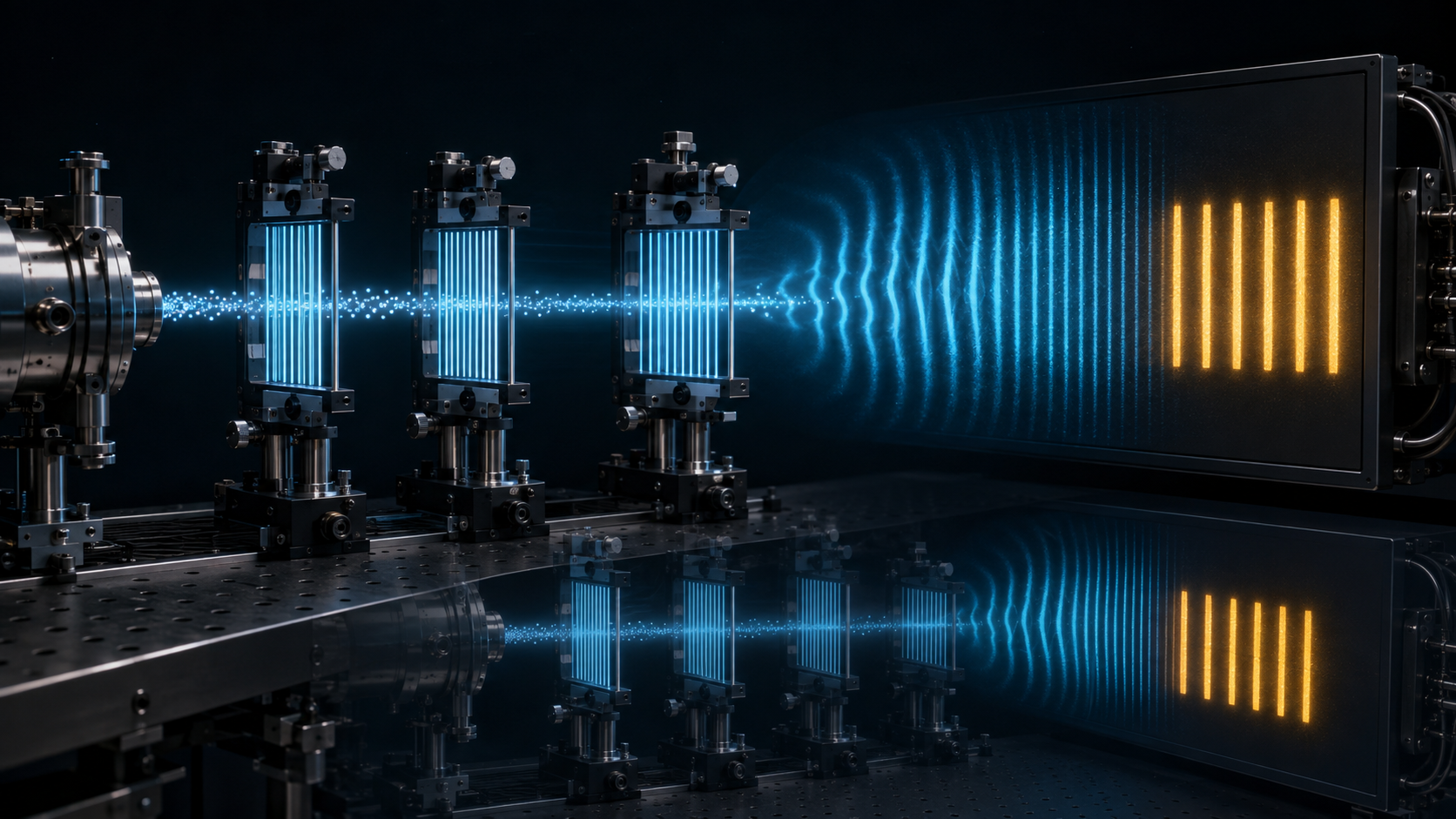
A Talbot–Lau interferometer sends a particle beam through three periodic gratings. The first prepares coherence. The second transforms the matter wave. The third scans the pattern that arrives. The result is an interference fringe: the particles cross the instrument in a state that cannot be replaced by one classical trajectory.
This is no longer a thought experiment confined to atoms. In January 2026, Sebastian Pedalino and colleagues reported interference from sodium nanoparticles containing more than 7,000 atoms and exceeding 170,000 daltons. Their MUSCLE instrument uses three ultraviolet standing-wave gratings separated by 


It does not execute the sealed QTT test retroactively. The public archive lacks the prospective event-level velocity row, frozen seven-bin covariance, complete complex-kernel certificate, and blind activation packet required for a theory verdict. The published quantum and classical contrast curves also share a fitted global factor of 
This is exactly why the new target is nonconstant and why its movement matters. A free global scale can absorb a constant. It cannot quietly reproduce a frozen seven-bin fingerprint and then carry that fingerprint to the independently calculated address of a second configuration.
What is being counted?
Imagine the Talbot phase as a hand going around a clock face while a particle crosses the interferometer. It may finish exactly on a whole turn or stop a little before or after one.
The dimensionless phase coordinate is
%3D%5Cfrac%7BhL%7D%7Bd%5E2Mv%7D.&bg=101b30&fg=f5f0e5&s=1&c=20201002)
Its distance from the nearest integer is
%3D%5Cleft%5C%7C%5Cfrac%7BhL%7D%7Bd%5E2Mv%7D%5Cright%5C%7C_%7B%5Cmathbb%20Z%7D.&bg=101b30&fg=f5f0e5&s=1&c=20201002)
The double bars with the 
%3D%5Cleft%5Clceil%5Cfrac%7B1%7D%7B%5CDelta%5E%7B%5Crm%20TL%7D(v)%7D%5Cright%5Crceil.&bg=101b30&fg=f5f0e5&s=1&c=20201002)
If the phase is 


%3D%5Cleft%7C1-%5Cfrac%7B2%7D%7BN_%5CGamma(v)%7D%5Cright%7C.&bg=101b30&fg=f5f0e5&s=1&c=20201002)
As velocity changes, the phase changes. The nearest-integer gap changes. The integer count changes. QTT therefore prints a particular stepwise barcode across velocity.
Ordinary quantum mechanics already owns a rich Talbot–Lau pattern. The test does not rename that familiar pattern QTT. Nor does it compare a bare source-only barcode with raw data. The registered factor is inserted inside the independently calibrated physical prediction:

Here 


“Smooth” is also deliberately narrow here. It means that the qualified residual contains no additional A7U factor. A qualified null rejects this QTT branch in this channel. It does not prove every possible continuum ontology.
Test A: is the barcode there?
Test A divides the admitted velocity range into seven predetermined bins. Before any QTT-sensitive residual is opened, the laboratory must freeze the mass distribution, grating geometry and alignment, event-level velocity or time-of-flight response, bin migration, complex ordinary Talbot/environment kernel, detector model, physical nuisance basis, covariance, operating point, harmonic extraction, and the exact QTT target.
The design must also prove in advance that the projected separation between the QTT target and the ordinary null is at least five standard deviations:

If the apparatus or chosen operating point cannot meet that gate, the run is ineligible. It returns no theory verdict. That is not an escape route after the result; the eligibility decision is made before target-bearing data are opened.
Once activated, the data face two frozen alternatives. The null says the residual multiplier is one. QTT says the seven bins carry its specified nonconstant physical shape. There is no fitted QTT amplitude, no movable offset, no smoothing width, and no search through integer branches after looking at the result.
One configuration, however, leaves an uncomfortable possibility: an apparatus effect could accidentally resemble part of the shape. That is why Test B exists.
Test B: does the barcode move to its new address?
Run the interferometer in configuration 

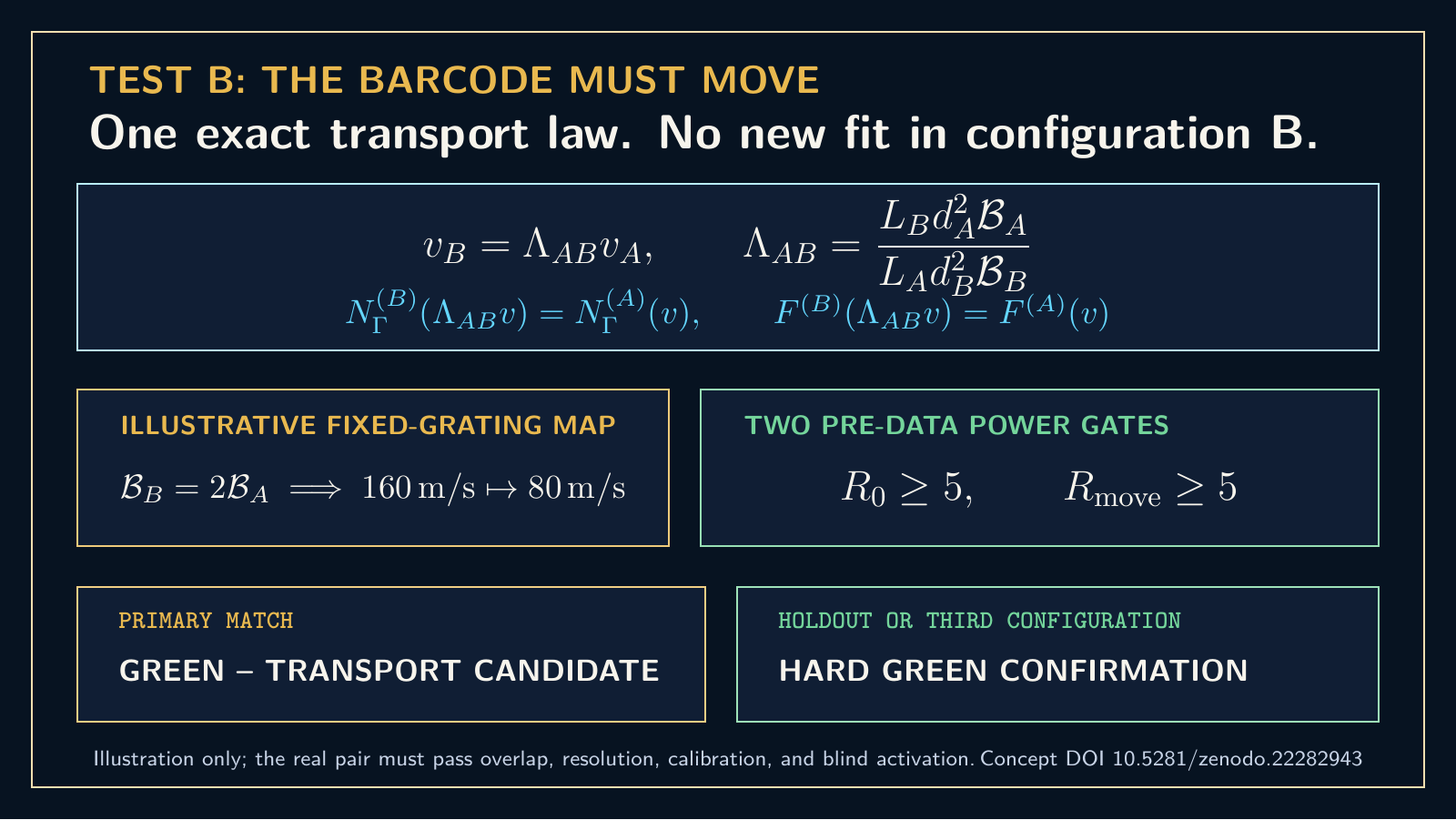
QTT closes the transport law before the pair is activated:

Here 
The transport theorem is exact:
%7D(%5CLambda_%7BAB%7Dv)%3DN_%7B%5CGamma%7D%5E%7B(A)%7D(v)%2C%0A%5Cqquad%0AF%5E%7B(B)%7D(%5CLambda_%7BAB%7Dv)%3DF%5E%7B(A)%7D(v).&bg=101b30&fg=f5f0e5&s=1&c=20201002)
For a simple illustration, keep the gratings fixed and take configuration 

Test B demands two separate five-sigma design gates:

The first separates the transported QTT target from the ordinary null. The second separates it from a particularly dangerous rival: the same source-shaped feature refusing to move and staying at the old laboratory velocity. The selected configuration must also move at least one registered closure locus by five calibrated velocity-resolution units.
This is the heart of the test. A detector feature may stay at the same laboratory velocity. A laser artifact may track laser power. A mass or velocity error must remain inside its calibrated covariance. The QTT feature must move with the frozen completed-event transport law.
The experiment is not asking whether there is an unexplained bump. It is asking whether nature carries a movable integer fingerprint.
What every result means
| Result | Registered meaning |
|---|---|
| A gate fails before target data are opened | INELIGIBLE — NO THEORY VERDICT. The instrument did not become a valid test. |
| The ordinary null survives and the A7U target fails | RED — NULL CONSISTENT. The registered completed-event branch is rejected in this channel. |
| A nonmoving source-shaped feature survives | RED — NONTRANSPORTING SHAPE. The feature is not the registered migration law. |
| The frozen shape appears and moves correctly in the primary two-configuration packet | GREEN — TRANSPORT CANDIDATE. The first prospective match has occurred. |
| The same decision survives a sequestered holdout or preregistered third configuration or species | HARD GREEN. The confirmatory transport criterion is met. |
| A reproducible third shape appears | Neither registered alternative owns it. It becomes a new experimental problem. |
That status ladder matters. A first match would be scientifically striking, but the protocol refuses to call its own discovery confirmed before the independent confirmation gate is crossed.
Why Talbot–Lau scientists should care
No experimental group needs to accept QTT’s ontology before running this test.
The proposition stands on its own: take a frontier matter-wave instrument, freeze everything already known to affect it, and compare the ordinary residual with a predetermined discrete physical target. Then change one controlled configuration and ask whether the entire feature packet travels to its precomputed address.
The test is attractive for four reasons.
First, the QTT prediction is unusually rigid. It has no target-fitted amplitude, velocity shift, smoothing width, or post-data branch choice.
Second, transport is harder to fake than a one-run anomaly. A successful result needs the correct physical shape and the correct movement.
Third, the experimental class already exists. This is not merely a firmware change: a valid run needs prospective event-level velocity logging, a second calibrated configuration, blind activation, complete complex kernels, and a joint fourteen-component covariance. But it does not require inventing a new branch of interferometry.
Fourth, every eligible outcome is publishable. The experiment either rejects the branch, produces a prospectively matched transported candidate, or exposes a third reproducible structure that neither side was allowed to claim in advance.
The connection to the Fourth Face
QTT begins deeper than the interferometer. Its Fourth Face assigns a finite completed-reality capacity to one legal source event:
%7D%5Cleft(4%5Cpi%5Cell_A%5E4%5Cright).%7D&bg=101b30&fg=f5f0e5&s=1&c=20201002)
The Talbot–Lau test does not claim to place 
A transported match would therefore establish something narrower and cleaner than “the whole theory is proven.” It would be prospective, zero-target-fit evidence for the registered A7U completed-event migration law. A stronger identification with the Access-Law projector requires its own frozen camera/intertwiner certificate. Direct Fourth-Face metrology remains a separate experiment.
That separation does not shrink the result. It tells an experimentalist exactly what this apparatus can decide.
A manageable intervention with a very large question
Many tests of foundational physics ask for a new accelerator, a rare astronomical event, or sensitivity far beyond present technology. This one asks an existing class of matter-wave instrument to preserve more information about particles it already knows how to interfere.
Seven velocity bins. Two calibrated configurations. One frozen physical barcode. One exact law for where it must move.
The logic is simple because neither side is allowed to negotiate with the answer afterward.
Talbot–Lau scientists have already built instruments that ask how far quantum interference can be carried into the macroscopic world. The same instruments can now ask whether the ordinary pattern is the entire story, or whether completed reality leaves a count beneath it.
No belief is required. Certify the apparatus. Keep the analysis blind. Let the barcode move, or let it fail.
Scientific anchors
- Fourth-Face Talbot–Lau Completed-Event Preregistration — Test A.
- Two-Configuration Talbot–Lau Completed-Event Transport Preregistration — Test B.
- A7U Molecular Visibility Transport.
- A7U source framework.
- Pedalino et al., *Probing quantum mechanics with nanoparticle matter-wave interferometry*, Nature 649, 866–870 (2026).
- Pedalino et al., public experimental data and analysis archive.
- Quantum Traction Theory: Main Book.
Author note: QTT is speculative physics unless and until its deposited tests return their registered green results. This article distinguishes the closed source theorem, the sealed experimental protocol, and the still-pending observation.
Where the source and laboratory bridge live
- pp. 114 and 117–124: matter-wave visibility and the finite access gap.
- pp. 263–266 and 353: A7U distributed bundles and access-relative purity.
- pp. 428–438: laboratory visibility transport and calibration separation.
- pp. 1247–1255: A7U source ontology, observables, and falsifiers.
Continue through the Blog Map, the Test A paper family, the Test B paper family, the Observatory, and the A7U visibility entry.