 Quantum Traction
Field NotesField Notes
FOUNDATIONS / REALITY DIMENSION
The Reality Dimension: A Spine You Cannot Walk Along
Why QTT puts a real internal phase structure behind the space we see.
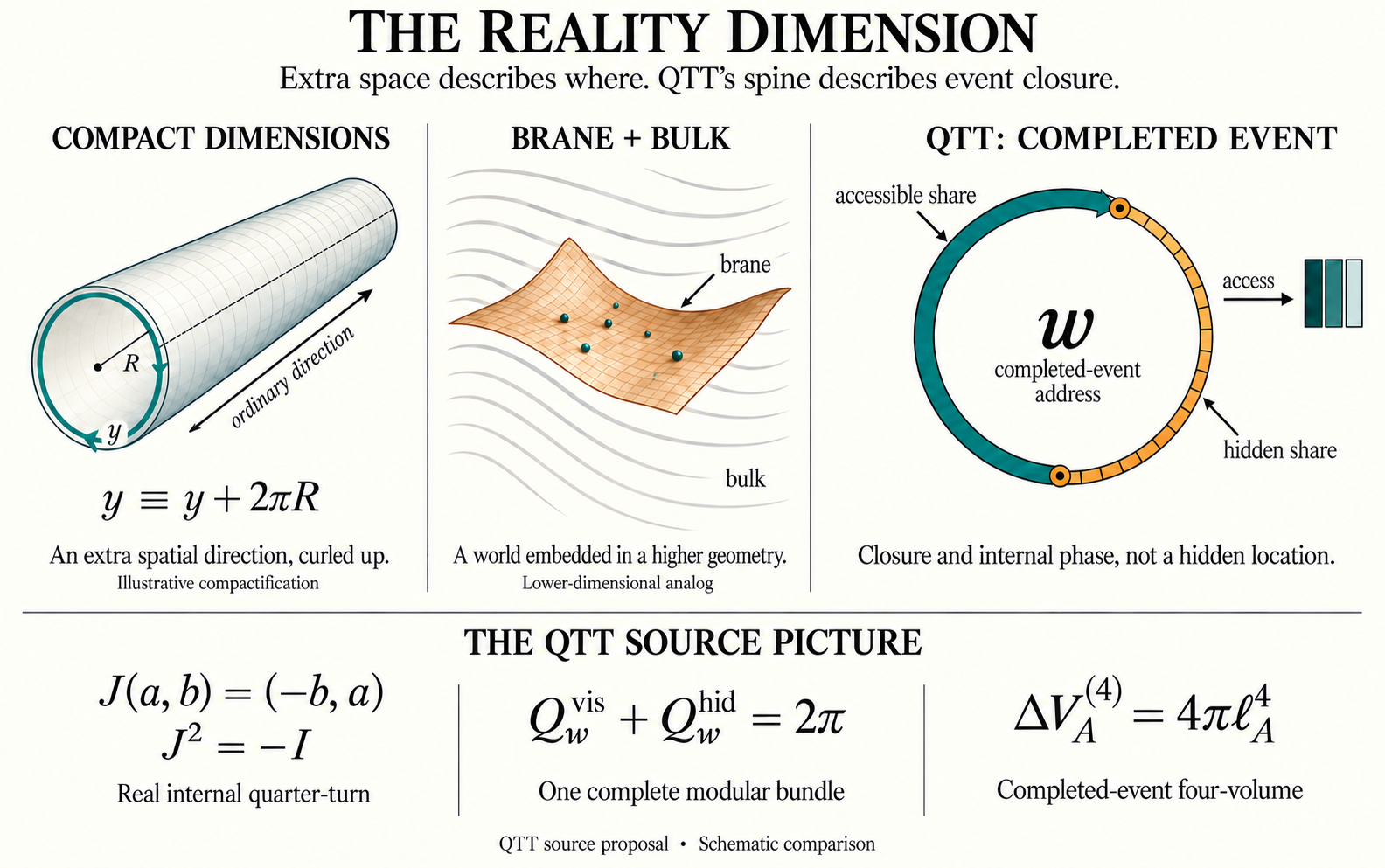
Imagine changing something about an object without moving it, tilting it, or turning any of its visible parts. Later, when you compare it with another object, the difference becomes measurable.
Quantum phase already gives physics situations of this kind. A relative phase can change an interference pattern even when the final spatial paths are unchanged. Position alone does not tell you everything needed to predict the result.
Quantum Traction Theory asks a physical question behind that mathematics: what carries the phase, and what makes the object carrying it a complete physical event?
My proposed answer is the Reality Dimension. I call it a spine dimension because its job is to organize internal rotation and completed existence, rather than provide another direction to travel through.
Three different roles for additional structure. The compact loop is a spatial direction; the brane is an extended object in a surrounding geometry; QTT's ring represents a completed modular bundle. Its colored shares are illustrative, not a measured split. The ring is not a spatial tunnel, and the readout bars do not depict a predicted experimental curve.
The Coin That Started the Question
When I was seven, during the Iran-Iraq war, my childhood friend and I would take shelter in the basement my father had built in our house in Isfahan. One of our games was spinning a coin on the floor.
At speed, the coin could look almost spherical. As it slowed, the apparent sphere became a wobbling coin again. I would put a finger against it to find out what was really there. The motion stopped. The coin was still a coin.
The object had kept its identity. What my eyes could read from its motion had changed.
That memory appears in the main book's section, "The Reality Dimension: not another higher dimension". It supplies an intuition, not a quantum experiment. Ordinary motion and visual averaging explain the coin. Touching it is not a demonstration of quantum measurement.
The useful question it left me with was this: how much of an object's appearance belongs to the object itself, and how much belongs to the way it becomes accessible?
What Does "Spine" Mean?
A spatial coordinate answers a question such as: how far left, forward, or upward?
QTT's spine answers a different question: which completed event carries this internal state, and how does an interaction access it?
Here, "completed" has a technical meaning. An event satisfies the theory's closure and capacity rules. It does not mean that a human has looked at it, that consciousness has created it, or that its whole future is finished.
The book makes a particularly important refinement: a physical address is the identity of a completed event, not an empty little box that existed before anything happened. The address belongs to the event. It is not a new postcode somewhere behind ordinary space.
Three symbols keep the picture straight:
| Symbol | Plain meaning |
|---|---|
| The completed-event address: which event-support we are talking about. | |
| The phase on its internal dial: where the internal state sits in a cycle. | |
| The operation that makes a quarter-turn in a real internal two-component description. |
These are different jobs. An address is not an angle. An internal angle is not another spatial coordinate. And the quarter-turn of this mathematical dial must not be confused with every physical rotation or clock angle used elsewhere in QTT.
"Spine dimension" names this organizing structure. It does not, by itself, assert an extra independent coordinate of the kind used to count the dimensions of spacetime.
The Equation You Can Understand by Turning an Arrow
Take a pair of real numbers, . Picture them as the horizontal and vertical components of an arrow on a sheet of paper.
A quarter-turn sends that pair to :
Apply the turn twice and the arrow points in the opposite direction. Apply it four times and it comes back. The symbol means "leave the pair unchanged," so means "reverse both components."
This is exactly the arithmetic performed by multiplication by on the complex number .
That observation makes the word "imaginary" much less mysterious. A negative square is perfectly natural for an operation on a real plane: it describes two quarter-turns. Nothing has to travel into imaginary space.
The real-pair description is mathematically equivalent to the familiar complex description. On its own, replacing the letter with changes no prediction. QTT's substantive proposal is that the internal structure belongs to physical event-support, and that its closure, composition and coupling to an observer can be specified by source rules.
That is where the physics has to enter.
What Makes the Event Complete?
In QTT, a completed address carries a full modular bundle. "Modular" means that the internal description closes cyclically, like a dial returning around a circle.
The book writes the bundle balance as
The 's here are dimensionless modular-capacity weights, not ordinary electric charges or probabilities. The total represents a completed bundle. Changing access can redistribute what is visible and hidden while leaving that total intact.
An instrument therefore need not read the whole bundle to register a physical effect. It reads the part to which its interaction couples. "Hidden" describes that access relation; it does not mean a second copy of the object in an invisible room.
This is also why the theory calls the structure a Reality Dimension. Its central object is the completed event from which a laboratory description is obtained. Reality is being organized around event completion and finite access, not defined by human perception.
The proposal connects several parts of QTT. A1 supplies the clock framework; A4 supplies the internal real rotor; A5-X identifies completed-event addresses and shared support; A6 bounds capacity per address; A7 supplies the complete modular bundle. This article explains their connection. The detailed constructions are developed in the book and the completed-event transport paper.
Is This the Fourth Dimension of Spacetime?
No. Time already has a role in spacetime, and the Reality Dimension does not replace it.
Nor does the word "four" in QTT's completed-event capacity imply four spatial directions. The related source equation is
Here is Artian's Ruler. The quantity is QTT's proposed elementary four-volume capacity, with the temporal interval expressed in length units. It is an event-scale measure, not a road extending away from the laboratory. The coefficient is part of the QTT source construction; it is not the usual geometric formula for the volume of a four-dimensional ball.
The spine, the internal dial and the four-volume are related parts of the theory, but they are not interchangeable names for the same mathematical object. The spine organizes closure; the dial describes internal phase; the four-volume assigns capacity to a completed event.
How This Differs from Other "Dimensions"
Physics uses the word "dimension" for several quite different things. Confusing them makes almost any new proposal sound stranger than it is.
The useful comparison is not simply how many dimensions a theory has. It is what those dimensions do. Some provide additional space. Others describe possible states. Others organize relationships from which spacetime may emerge.
| Structure | A picture a newcomer can use | What distinguishes QTT's spine |
|---|---|---|
| Ordinary space and time | Three spatial coordinates tell you where; time supplies the temporal part of an event's description. | The spine identifies completed support and organizes its internal closure. It is not another laboratory position or a replacement for time. |
| Kaluza-Klein compact dimensions | A very thin hose looks like a line from far away. Up close, there is another direction around its circumference. | A compact circle is still extra space, with a physical size. QTT's modular circle has a dimensionless closure weight, not an extra spatial circumference. |
| String-theory compact dimensions | Extra spatial directions form a compact geometry. In familiar ten-dimensional superstring compactifications, six spatial dimensions are compact while four spacetime dimensions remain large. Their shapes and fields affect the lower-dimensional physics. | QTT's spine is not a tiny Calabi-Yau space housing string modes. It specifies completed-event support, a real internal rotor and capacity closure. Compactification review. |
| M-theory's higher-dimensional setting | An eleven-dimensional description in appropriate limits, with extended objects such as membranes and five-branes. | A QTT event is not defined by its location in an eleven-dimensional arena or by being an extended brane. Witten. |
| Branes and the surrounding bulk | Imagine a sheet inside a larger room. A brane is the extended sheet-like object; the bulk is the surrounding spacetime. In some models, matter is confined to the brane while gravity propagates in the bulk. | The spine is neither a sheet nor the space outside one. Its "hidden share" is inaccessible modular support, not matter stored outside our brane. ADD, Randall-Sundrum. |
| Holographic bulk/boundary descriptions | In examples such as AdS/CFT, a theory with a gravitational bulk is related to a lower-dimensional boundary theory. | QTT's visible/hidden bundle split is not automatically a holographic duality. It is an access-and-closure construction with its own rules. Maldacena. |
| Configuration and phase spaces | A map of all possible arrangements, supplemented by momenta in phase space. Its many axes need not be extra physical directions. | The spine proposes physical completed-event support, rather than merely adding coordinates to a system's state map. |
| Quantum Hilbert space | A space of quantum states, including their superpositions. Its dimension counts independent state directions, not extra streets in the universe. | QTT asks how a physical source constructs and carries that structure. The new real-cycle theorem addresses part of this question. |
| Internal gauge fibers | An internal structure associated with each spacetime point, such as phase conventions and their transport. | This is the closest structural comparison. QTT attaches its rotor to completed addresses and combines it with finite-capacity closure and access rules. An internal circle by itself is not the novelty. |
| Loop quantum gravity | Quantum geometry described through structures such as spin networks, with discrete area and volume spectra. No extra spatial direction is required. | QTT's distinctive object is the completed modular bundle and its specified rotor/capacity/access relations, not discreteness alone. Rovelli and Smolin. |
| Causal sets | Discrete elements related by a causal order; a smooth spacetime is an approximation to that structure. | Event-based or discrete foundations already have precedents. QTT adds its particular internal rotation, modular closure and completed-capacity assignment. Surya. |
| QTT Reality Dimension | A non-translational spine organizing the internal state and closure of completed physical events. | Its defining combination is completed-address identity, a real -rotor, a full modular bundle, finite per-address capacity and a specified access/readout relation. |
These rows compare mathematical roles and physical proposals, not their experimental standing. "Internal" also has different meanings: a compact internal space in a string model can still be extra spatial geometry, whereas an internal phase need not be a spatial coordinate at all.
Tiny Space Is Still Space
For a simple compact spatial circle, a coordinate is periodically identified:
Here is a radius with units of length. Going once around covers a spatial circumference. Making that circle too small to see does not change its mathematical role into event closure. Extra spatial dimensions in Kaluza-Klein theories remain part of an extended spacetime construction. Duff's review explains that history.
Compare QTT's statement:
There is no length on either side. This is a dimensionless modular-capacity balance. It introduces no compactification radius for the spine. Artian's Ruler still sets the source scale elsewhere in the theory; the claim is not that every physical scale has disappeared.
Two equations can contain and represent very different physical objects. The same circle mathematics does not make a spatial circumference and a completed modular bundle the same thing.
A Brane Is an Object, Not a Type of Coordinate
The sheet-in-a-room picture is an analogy with the dimensions reduced so we can draw it. A physical three-brane has three spatial directions and a time history. It is not literally a two-dimensional sheet. The bulk can contain additional spatial directions, and what is confined or allowed to propagate depends on the model.
QTT does not use "spine" for a surrounding bulk. Nor does it explain an inaccessible share of an event by placing that share on the other side of a membrane. The distinction is about which degrees of freedom participate in a given readout.
Where the Novelty Actually Sits
The gauge-fiber comparison matters more than a picture of a tesseract. Standard gauge theory already has internal phase structure that is not an extra room. It also distinguishes a physical comparison from a change of descriptive convention: merely relabeling a phase need not change anything observable. QTT must preserve that distinction. An absolute dial label is not automatically a measurable quantity. Tong's gauge-theory lectures give the conventional account.
QTT's proposed new physical object is the completed event that carries a real internal rotor, closes a finite modular bundle and participates through a defined access relation. Its address names that completion. The related four-volume specifies its source capacity. These pieces must work together, not simply coexist as new labels.
That is a specific, QTT-native proposal with a mathematical burden: construct the rotor, establish its closure and composition, then connect the source to a laboratory readout. Neither "another hidden dimension" nor "just a circle" describes that program adequately. Demonstrating historical priority for every part would require more than a comparison table; the defensible novelty claim is about this particular source construction and its consequences.
Earlier Rotors Deserve Their Place
A rotor is a mathematical way to describe a rotation. Quaternions and geometric algebra already do this with extraordinary efficiency. Earlier physics also gave geometric interpretations to structures conventionally written with complex numbers.
David Hestenes, in particular, explicitly interpreted the imaginary unit in the real spacetime-algebra form of the Dirac equation as a generator of rotation in a plane. It would be historically wrong to present " can have a geometric meaning" as a QTT invention. Hestenes, Gauge Gravity and Electroweak Theory.
The comparison is therefore quite specific:
- A mechanical rotor describes a body changing orientation in space.
- A quaternion or geometric-algebra rotor supplies an algebraic representation of rotation.
- QTT's spine proposal assigns internal phase to completed physical event-support and connects it to finite capacity and access.
Hestenes already went beyond a convenient notation toward a physical interpretation. QTT's claimed contribution must therefore rest on its particular completed-event mechanism and its consequences, not on the general idea that rotations can explain complex arithmetic.
What the New J Construction Adds
The recent frame-cycle work asks a sharper question than "can we draw as a turn?"
Can a real source model produce the structure that behaves like , without placing a complex number in the starting equations?
Start with three labels that cycle in a chosen direction. Call a forward step . Two steps, , go the other way around the three-cycle; three steps return to the start.
Assign a real value to each label. Separate the common average from the differences around the cycle. Those differences have zero sum. Although there are three entries, only two can vary independently.
On that zero-sum sector, the construction gives
In ordinary language: compare forward with backward, and normalize the comparison. The result has exactly the quarter-turn structure used by complex arithmetic. The follows from the cycle algebra; it is not adjusted to fit an experiment.
Notice the distinction: the original cycle has three steps, while the constructed acts as a quarter-turn on the differences. We have not called a 120-degree turn a 90-degree turn. They are different operations.
The average has not mysteriously disappeared, either. It is kept separately. On the full space the exact equation is , where selects the zero-sum differences. The simpler holds on that selected sector.
This is a definite construction under declared rules. It starts from a directed cycle, real linear profiles, a counting metric and a specified distinction between baseline and contrast. Showing that a physical source must realize those rules is a separate scientific obligation. The result is stronger than changing a symbol, without pretending the premises have vanished.
The manuscript also addresses composition. Under an additional rule identifying equivalent joined histories, the two local structures combine through
You do not need tensor algebra to see the question this answers: how can two internal systems form a joint system with a compatible complex structure? The theorem supplies a precise rule, including its normalization and extension to several systems. This is a projector, distinct from the modular-capacity weights above.
The construction uses established mathematics of finite cycles and tensor products. Its research contribution is the explicit source-history setup, the joining rule, and the consequences proved from them. The published v2.0 verifier has been rerun: all 185 exact checks passed, comprising the original 97 algebraic checks and 88 additional finite-witness and record-certificate checks. Those are mathematical checks, not 185 observations of nature.
What Would Change in Our Picture of Physics?
If this source interpretation is physically realized, three familiar subjects acquire a connected explanation.
Phase would have a specified carrier. We would still calculate interference, but the internal state being compared would belong to completed event-support rather than remain only a component in an abstract state description.
A joint quantum system would have an explicit construction. The question would become which event histories can be joined, what equivalences that joining respects, and how the resulting shared structure determines the allowed comparisons.
Observation would be an interaction with finite access. An apparatus would read a defined part of a physical bundle. Changing the coupling or accessible support could change the readout while preserving the complete bundle. A consciousness-based explanation is unnecessary.
Spin, helicity and electromagnetic phase are further applications of the corpus's source program, but they require their own representation and transport results. One circular dial alone is not a derivation of all three.
The distinctive ambition is to connect the carrier, composition and observation through the same completed-event ontology. A familiar equation reached by that route can be an explanatory achievement even when its numerical prediction agrees with ordinary quantum theory. A new empirical distinction requires an additional, independently qualified prediction.
What Would Make It More Than an Interpretation?
The physical test is whether the proposed source rules determine measurable behavior with independently established inputs.
A serious comparison must state the apparatus coupling, fix the prediction before examining the judged data, and count the fitted choices on both sides. Recovering a known interference pattern checks the construction. A blind, reproducible difference from the ordinary prediction could distinguish the physical models. Failure of a qualified, specific prediction would count against that prediction and its necessary premises.
QTT remains a proposed physical theory. The frame-cycle result is an exact conditional theorem; the universal physical identification is not established by its algebra alone. Keeping those statements separate lets us recognize the mathematical advance and ask the right experimental question.
For me, the attraction of the spine is that it asks for a physical account of something we normally calculate through abstract coordinates: the internal structure that carries phase and participates in an event.
The coin in the basement never became a sphere. But it taught me to distinguish an object from the picture available through a particular interaction. The Reality Dimension develops that question into a proposed source structure, with equations that can be checked and consequences that must eventually face the laboratory.
Reading Further
- Artian Geometry & Quantum Traction Theory, main book: "The Reality Dimension: not another higher dimension"; A4's internal circle and real rotor; A5-X's completed-address definition; A6 and A7's capacity and closure rules. Section names are used because page numbers change between editions.
- Completed-event transport and quantum coherence: the companion source-to-quantum construction.
- Complex Structure and Composition from Finite Real Source Histories: An Artian Frame-Cycle Construction, v2.0, 21 September 2026: the published frame-cycle paper, including the source-history construction discussed here, composition rules and finite-record certificates. Its source-history premises accompany the proofs.
- QTT Lexicon: Reality Dimension, completed address, internal dial and modular bundle.
- David Hestenes on real spacetime algebra, M. J. Duff on Kaluza-Klein theory, and David Tong on gauge theory: comparisons and prior mathematical context.
- Douglas and Kachru on string/M-theory compactification, Randall and Sundrum on a warped extra dimension, and Arkani-Hamed, Dimopoulos and Dvali on large extra dimensions: why compact geometry and brane/bulk models differ from the QTT spine.
- Rovelli and Smolin on quantum geometry and Surya on causal sets: precedents for discrete structures without added spatial directions.