Corrupted Culture in Modern Physics: “Shut Up and Calculate”
The Right Math and the Wrong Ontology
Imagine asking what a machine actually does and being handed a calculator. You run the numbers. They work beautifully. You ask again what is happening inside the machine.
“Why does that matter? You got the right answer.”
That response might be sufficient for finishing a calculation. I find it a deeply unsatisfactory ambition for physics. We are trying to understand a universe, not merely become efficient at predicting the next reading on an instrument.
A scientific culture damages itself when it treats questions about reality as an inconvenience to successful mathematics. That is the corruption I mean here: turning a useful working attitude into a rule about which questions deserve to exist.
The Universe That Humans Invented · Essay 14The instruction to stop
“Shut up and calculate” is usually associated with quantum mechanics. There is a small historical correction worth making: David Mermin used the phrase in 1989 and later discussed both its frequent attribution to Feynman and his own more nuanced view. It was not a commandment issued by nature. Mermin’s account
Calculation has earned its authority. Quantum theory gives us extraordinarily effective ways to describe atoms, light and interactions. Anyone proposing a deeper account inherits the obligation to reproduce those successes.
But a correct prediction does not automatically certify every physical story attached to it. An equation can tell us what an instrument will register while leaving open what exists between preparation and measurement.
This is where ontology enters. The word sounds more intimidating than the question. Ontology asks what is physically there. What changes? What carries the interaction? Which things belong to the universe, and which belong to our description of it?
There are physicists who take these questions seriously. Entire courses and research programmes study quantum foundations, measurement and the relationship between a system and its environment. My criticism is directed at the habit of dismissing such questions, wherever it appears, rather than at an imaginary profession in which nobody thinks. Cambridge’s quantum-mechanics course
The Universe That Humans Invented · Essay 14A starting point
Consider one of the basic rules of quantum mechanics. A perfectly isolated system evolves in a way that preserves the mathematical norm of its state. Physicists call this unitary evolution. In an ordinary textbook formulation, it is a postulate: a starting law from which calculations proceed. Preskill’s lecture notes state it explicitly under “Axiom 4. Dynamics.” Caltech, p. 6
There is nothing dishonest about a postulate. Every framework needs starting points. The problem begins when a starting point is treated as a completed explanation.
We can ask what physical organisation would make that rule follow. What would the underlying process have to preserve? What would an incomplete description leave out? Could the familiar quantum equation be the visible account of a more basic process?
Those are scientific questions when we make them precise enough to calculate and check. Calling them philosophy does not answer them.
The Universe That Humans Invented · Essay 14My mission
This was my mission in developing Quantum Traction Theory: to find the right ontology, and through it to examine what we may have misunderstood about our universe.
I wanted to look underneath the objects we had learned to manipulate so confidently. A coordinate is useful. That does not settle whether nature is made of coordinates. A probability is useful. That does not, by itself, tell us everything about the physical process producing the outcomes.
In QTT, I call the proposed source account Artian’s Universe. It asks what finite physical structure is present, what sustains it, how it changes, and what a particular interaction allows us to read. The distinction between the source and our access to it matters throughout the framework. The proposal has to earn that distinction through mathematics and physical tests; giving it a name is only the beginning.
The Universe That Humans Invented · Essay 14One concrete example
The recent Completed-Event Transport and Quantum Coherence paper develops a specific version of this question. Within its declared source construction, it obtains:

You do not need to decode every letter to understand the statement. For the specified capacity-preserving source process, the coherent capacity missing from the part we retain is exactly the capacity transported into its complement. Here G measures that capacity; it is not Newton’s gravitational constant.
When nothing leaks out of the retained sector, and the source preserves the required phase structure, unitary quantum evolution follows. The construction starts from explicit real record rules and derives the corresponding amplitude map.
There is a particularly clear example on pages 77–78. After the first contact, the selected mode has none of its original coherent amplitude. After the second, it returns completely. The complementary mode carried it in between. If we permanently discard that mode after the first contact, we calculate a different process.
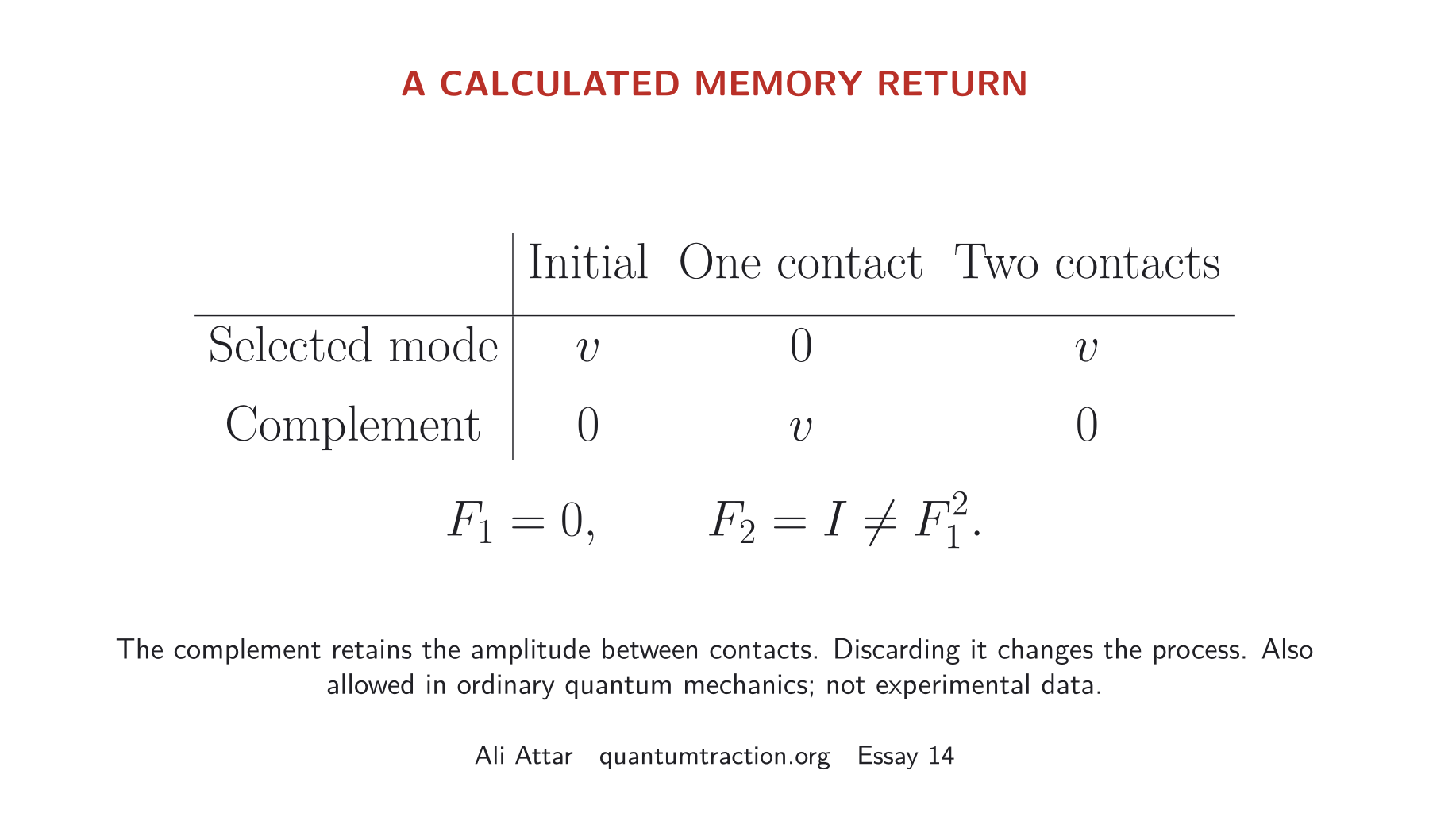
Ordinary quantum mechanics also permits this kind of memory return. The claim is not that textbooks cannot calculate it. The QTT contribution here is the explicit source construction and the conditions under which its quantum description follows. The theorem is exact in that class; identifying which physical systems realise all its conditions remains a separate obligation.
That distinction is important to me. I cannot criticise someone else for confusing a successful description with reality, then declare my own source picture physically established merely because its equations are consistent.
The Universe That Humans Invented · Essay 14Keep asking
The ambition should be to make an assumption explainable. Sometimes we succeed. Sometimes a proposed explanation quietly contains the assumption it promised to replace. Discovering that is useful too, provided we admit it and continue working.
A better ontology must do more than sound satisfying. It should specify a mechanism, account for the established results, constrain what can happen, and expose where an observation could prove it wrong. Renaming a mystery does none of those things.
The phrase “the universe that humans invented” describes the danger I keep returning to: we build a mathematical representation, become fluent in it, and gradually forget which parts were established by observation and which parts we supplied. Familiarity starts passing for necessity.
The right mathematics deserves to survive a better physical explanation. It may turn out to describe exactly the same observations while acquiring a different meaning. That possibility should interest physics, not embarrass it.
I will calculate. I also want to know what the calculation is about. Finding that physical account was my mission when I began QTT, and it remains the work.
The Universe That Humans Invented · Essay 14An invitation to disagree
I would welcome responses from the following ten writers and researchers. Their positions differ, sometimes sharply. Each has challenged some aspect of calculation without explanation, neglected foundations, or the methodology of theoretical physics. These links give their own arguments; the invitation does not imply that any of them endorses QTT or this essay.
- Sean Carroll: what should a theory explain beyond a successful prediction?
- Sabine Hossenfelder: which methodological habits obstruct progress?
- Lee Smolin: what would it mean to complete the quantum description?
- Tim Maudlin: which physical assumptions are hidden in the formalism?
- Adam Becker: what can the history of quantum foundations teach us about dismissing questions?
- Jim Baggott: where should the boundary between physical explanation and speculation be drawn?
- Philip Ball: how can quantum explanation become clearer without becoming misleading?
- Carlo Rovelli: what does physics lose when it dismisses philosophy?
- David Deutsch: how much explanatory content must a physical theory carry?
- John Horgan: when does competence in calculation leave comprehension behind?
My question to all ten is the same: does this finite-source construction add a physical explanation, and which independently checkable step would you challenge first?