The Universe That Humans Invented
How physics settled on smooth spacetime, and why a century of success has not settled the question.
When I was in high school and began learning about quantum physics, something bothered me. We were being introduced to a universe that refused to behave like the everyday world. Energy came in discrete amounts in familiar bound systems. Light arrived in individual detection events. Measurement had become a problem serious enough to divide the people who built the theory.
Yet underneath the calculations, space and time usually continued as before. Between any two positions, another position. Between any two times, another time. Keep dividing. The mathematical stage never runs out.
Why did the quantum revolution transform what happens on the stage without settling what the stage is made of?
That question has stayed with me. Sometimes an assumption becomes so familiar that we stop noticing how much of our picture rests on it.
The Universe That Humans Invented · Essay 13The assumption beneath the revolution
Modern quantum mechanics took shape in 1925-1926. Maxwell's electromagnetic theory is older: his major field paper appeared in 1865. We are looking at roughly a century of modern quantum mechanics and more than a century and a half of electromagnetic field theory. Quantum history; Maxwell's original paper.
In their familiar continuum formulations, these theories use fields or wavefunctions defined over continuously variable coordinates. General relativity makes spacetime geometry dynamical, but still describes it through a smooth manifold and metric. Quantum field theory quantizes fields without, by that step alone, making the underlying spacetime discrete.
There is no mathematical contradiction here. Discrete energy levels can arise in a continuous space. Counting photons does not prove that distance comes in indivisible pieces. But neither does a successful calculation on continuous coordinates prove that nature contains an actual continuum at every scale.
Consider the familiar Schrodinger equation:

Its derivatives describe changes across arbitrarily small mathematical intervals. The equation predicts evolution after its state, mass, potential and boundary conditions have been specified. It does not independently establish that its continuous coordinates remain physically meaningful through unlimited subdivision.
That is a substantial unanswered question, not an objection to using the equation.
The Universe That Humans Invented · Essay 13Maxwell gave us a clue about asking deeper questions
Maxwell's work connected electricity, magnetism and light. In modern SI notation, the vacuum wave speed obeys

The numerical treatment of these constants depends on the unit convention. Maxwell's achievement was much more than converting units: the field equations connected electromagnetic propagation to light. They supplied a physical unification, not merely a numerical resemblance. Maxwell, 1865.
There is a lesson here. A relationship between quantities previously treated separately can expose a deeper structure. But an equality must earn that interpretation. We have to show the mechanism, identify the independent inputs and establish what follows that was not inserted at the beginning.
The same demand should apply when we ask where spacetime comes from. Writing the coordinates is the beginning of that investigation, not its completion.
The Universe That Humans Invented · Essay 13The car argument answers the wrong question
Imagine being told that a car might break down after 500,000 miles. You only need to drive a few miles today. Why worry?
As practical advice, that is reasonable. You do not need a complete microscopic theory of steel to drive to the shops. Likewise, an engineer does not need a final theory of quantum gravity before building a bridge.
But suppose your job is to understand the car: why it moves, what the engine does and why the machine eventually fails. The fact that today's short journey succeeds cannot answer those questions.
Physics has a precise version of the useful part of this argument. Effective field theory explains how reliable predictions can be made within a specified range of energies without knowing every detail at shorter distances. The calculation still declares its measured inputs, effective coefficients, approximations and error budget. That is controlled reasoning, not an embarrassment. Burgess, *Quantum Gravity in Everyday Life*.
The trouble starts when "we do not need the deeper answer for this calculation" becomes "the deeper answer does not matter." One statement concerns a particular task. The other abandons a scientific question.
The Universe That Humans Invented · Essay 13What we know about gravity, and what we still owe an explanation
General relativity does much more than attach the word "curvature" to falling objects. It supplies equations connecting spacetime geometry with energy, momentum and stress:

Those equations have physical content. Their use also requires a matter model, coupling constants, and initial or boundary data. They do not, by themselves, determine why the gravitational coupling has its measured value or establish whether the smooth metric is fundamental or an effective description.
We know a great deal about gravity's behavior. What remains unsettled is whether the geometry in the equations is the deepest physical structure, and how gravity and quantum phenomena fit into one account. That gap is enormous. Familiarity with the equations should not make it look small.
Calling that problem irrelevant because gravity is weak in a particular laboratory calculation misses its scale. It concerns the physical meaning of the stage on which the rest of the calculation takes place.
The Universe That Humans Invented · Essay 13Penrose asks the deeper question too
Roger Penrose gives this concern a sharper direction. In a published dialogue with Humitaka Sato, he says:
"It's the effect of gravity on quantum mechanics, not the effect of quantum mechanics on gravity."
He is proposing that gravity could matter to quantum-state reduction, the emergence of definite outcomes, rather than only to remote black holes or the early universe. That proposal is not established fact. But it directly challenges the idea that foundations matter only in exotic places. Penrose-Sato dialogue.
This is the kind of question I want kept alive. Perhaps the difficulty is not only how to add a quantum treatment to gravity. Perhaps some of the physical premises behind our quantum description also need explaining.
The Universe That Humans Invented · Essay 13The educational habit that worries me
I am concerned less with the age of physicists than with a habit of training. A student can become fluent in difficult calculations without becoming equally fluent in distinguishing a physical postulate from a mathematical convenience, or a fitted input from a prediction.
When a foundational question is answered only with "the calculation works," the question has not been answered. Repeated often enough, that response teaches students which questions are welcome.
There have always been physicists pushing back. Snyder published Quantized Space-Time in 1947. Bombelli, Lee, Meyer and Sorkin proposed a locally finite causal-set account in 1987. Their work matters, and a criticism of physics that erases it would be unfair. Snyder; Bombelli and colleagues.
My criticism concerns the distance between acknowledging that foundations are open and teaching the familiar picture as though the remaining work were only technical refinement. I find that complacency scandalous. The question deserves more than an optional footnote.
The Universe That Humans Invented · Essay 13What a replacement has to do
Putting pixels into a diagram does not explain spacetime. A discrete model must recover the phenomena that smooth theories describe, explain how ordinary geometry emerges, and survive tests of its own distinctive consequences. It must also account for observed symmetries rather than assume that discreteness makes every difficulty disappear.
That is the direction motivating my work on Quantum Traction Theory: begin with finite source structure and completed events, then ask how the familiar descriptions arise. In the recent frame-cycle construction, for example, real finite histories supply a complex structure and a composition rule under explicit premises. The question is what those premises explain physically, beyond representing familiar algebra. Source-history paper.
For QTT, the next demand is concrete: connect these source constructions to independently qualified laboratory observations. Keep track of what the mathematics has established and what the apparatus can test. A theorem establishes what follows from declared premises; observation assesses whether those premises describe nature. That is how an alternative earns physical authority.
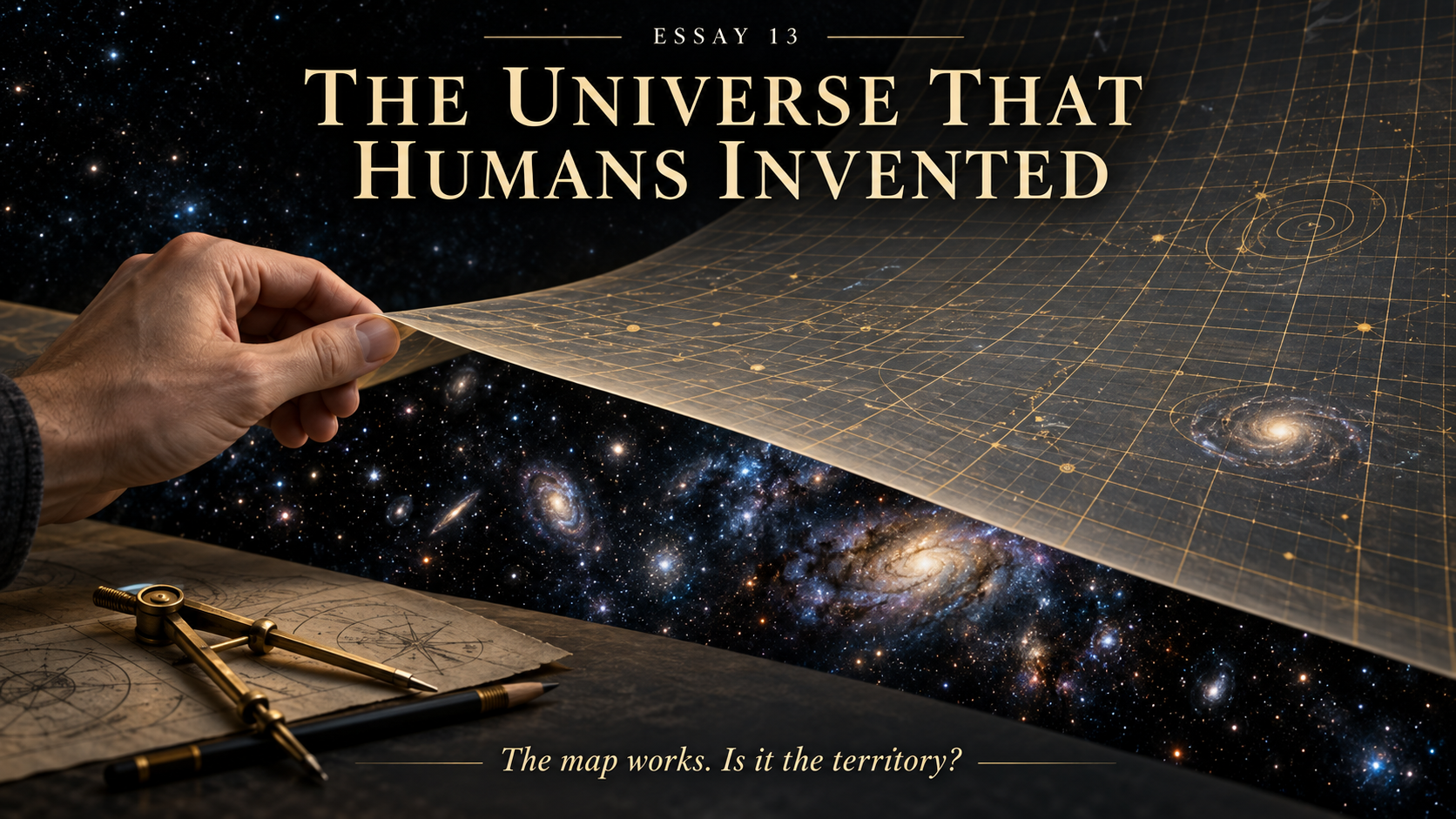
The universe humans invented is our representation of reality. We invented its coordinates, mathematical objects and explanatory language. Their remarkable usefulness gives us a reason to investigate them carefully, not permission to stop investigating.
I am not asking physics to discard a century of successful calculations. I am asking us to stop treating their success as a complete explanation of what the universe is made of.
We know how to calculate on smooth spacetime. We still need to find out whether that is how the universe is built.