The Part We See, the Whole That Exists
A story about the Law of Bundled Existence

Fixing the Universe Humans Invented · Essay 17The leaf at the window
A child stands beside a window, looking through a narrow gap in the curtain.
Outside, one green leaf moves in the sunlight. The branch is hidden. The trunk is hidden. The roots are far below the ground.
From where the child stands, there is only a leaf.
Then someone opens the curtain.
The leaf has not changed. But the child's picture of it has. What looked like a small, separate thing is now part of a tree.
This does not prove anything about particles. An electron is not a leaf attached to an invisible branch. But the story offers a useful question:
When we observe something, are we seeing a complete physical thing, or only the part of a larger whole that our window allows us to see?
The Law of Bundled Existence begins with that question.
It is the seventh principle, or A7, of Quantum Traction Theory, known as QTT. Its proposal is that, at the deepest level, an active unit of reality cannot exist as an unfinished fragment. The part available to observation and its unresolved physical complement must belong to one complete bundle. That bundle has a fixed total, not an amount chosen differently whenever a calculation becomes difficult.
In simple language:
What we can reach and what we cannot reach must together make one complete physical bundle.
The unseen part is not placed in another universe. It is not imaginary. Nor is it a mysterious store from which a scientist may borrow whatever is missing. A7 requires it to belong to this universe and to the same physical whole as the part being observed. "Hidden" describes the limits of our access, not a place outside reality.
The curtain belongs to the view. It does not divide the world into what exists and what does not.
Fixing the Universe Humans Invented · Essay 17One complete bundle
The book states the rule at each active address w, the source address of a completed physical event:
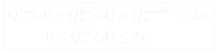
Here A is the declared access window. "Visible" means accessible through that window, not necessarily visible light. The two shares are shares of one dimensionless modular budget. The number 2π names one complete modular circle. It is not two pi joules, an extra particle mass, or an adjustable quantity of unseen energy.
This is a physical completion law. Giving a circle its usual normalization does not, by itself, prove that nature must organize existence into completed address bundles. A7 makes that restriction; its mathematical consequences and experimental tests must then be worked out. The source statement and the same-universe meaning of its complement are printed in Main Book pp. 263-264.
The equation counts the shares in the completed source ledger. It should not be read as an unrestricted rule that the ordinary quantum entropies of any two correlated parts simply add. The book gives its modular-relative-entropy representation with a declared reference and compatible product-splitting conditions on p. 263. Correlations and the access map still have to be accounted for.
Now imagine that the child closes the curtain again.
The branch disappears from sight. Has the leaf become independent of it?
Of course not.
A7 asks us to take a related distinction seriously in physics. What an instrument can measure must not automatically be mistaken for everything that physically belongs to the thing being measured.
Within QTT, changing the instrument can change which share of a bundle becomes accessible. It does not give nature permission to leave the underlying bundle incomplete. The visible share may change while the required total remains the same.
For two access windows applied to the same completed source bundle, subtracting their completion equations gives:

This balance describes a change of access, not physical creation or destruction inferred from opening a curtain. A detector can also interact with a source. Such an interaction needs its own dynamical account; the completion identity is not a substitute for it.
Completeness is a condition of existence, rather than a reward for being observed. A particle does not have to wait for a person to look at it before reality becomes whole.
Fixing the Universe Humans Invented · Essay 17Why a ceiling is not enough
But why should a rule like this be needed?
To understand its role, imagine designing a universe.
You decide that its most basic physical units have limits. No address may carry an unlimited amount. QTT assigns this job to another principle, A6: the capacity rule.
Yet a limit alone does not tell you what counts as a complete, existing unit. Saying that a container cannot hold more than a certain amount does not tell you whether nature permits it to be empty, partly filled, or full.
A7 adds the completion condition: an active bundle must be complete. What is visible need not fill the whole budget, but the visible and unresolved shares together must do so. A6 forbids excess; A7 forbids an unfinished active bundle.
Another QTT principle, the Law of Endurance, addresses how physical patterns continue from one fundamental moment to the next. In the theory's picture, persistence requires ongoing physical support. A7 identifies the completed bundle to which that continuing support belongs. These principles have different jobs: setting a limit, sustaining existence, and requiring completion. The book connects bundle completion to the A2 endurance count on pp. 265-266.
This is the sense in which bundled existence is necessary within QTT. Without it, the theory would lose its rule connecting an observed share to a complete underlying physical unit.
That is not the same as proving that no other theory could describe our universe. A principle can be essential to a proposed explanation before experiments establish that nature follows it.
In Artian's Universe, the completed source comes first. An instrument's representation is a readout of that source. The human-invented universe becomes a problem when we promote the edge of that representation into the edge of physical existence.
Fixing the Universe Humans Invented · Essay 17Complete does not mean accessible
The child at the window might now ask another question.
"If the whole is complete, why can we not always know everything about the part?"
Because completeness and accessibility are different things.
A book can contain a complete story even when only one page is open. Reading the page carefully does not make the rest of the book available.
Quantum physics has already taught scientists to distinguish the state of a whole from the state of one of its parts. An entangled larger system can have a pure state while a smaller part, considered alone, has a mixed state. In everyday language, a complete description of the whole does not necessarily become a complete, independent description of each piece. This is standard quantum mathematics, reviewed by the Horodeckis in *Quantum Entanglement*.
That result starts from a specified joint quantum state and a subsystem split. It does not supply QTT's physical completed-address budget or its source-side capacity count. Conversely, the equation "visible plus hidden equals the total" alone does not prove that every chosen split is entangled. QTT's strict mixedness result uses the completed pure bundle together with irreducibility across the declared incomplete access cut. Access that closes over the relevant complete sector can still yield a pure state.
A7 takes a further step at the source level.
It proposes that completion is a requirement placed on the underlying units of physical existence. The familiar world of separate objects is then what becomes accessible through particular observations, while the deeper physical account remains one of completed bundles.
In this picture, the uncertainty of a limited view need not mean that reality itself is unfinished.
That does not mean every measurement secretly reveals a value already written on a little hidden label. The completion rule alone does not establish such a claim. It says that the physical whole must be accounted for; further mathematics explains the outcomes of particular experiments.
The leaf and the curtain help us ask the question. They do not supply the quantum answer.
Fixing the Universe Humans Invented · Essay 17What the law adds
Here the story reaches its claim to something new.
It would be too much to say that QTT invented the idea that nothing is completely isolated. Earlier researchers made strong proposals about universal entanglement. Zeng-Bing Chen's *Universal Entanglement and an Information-Complete Quantum Theory*, first submitted on 28 July 2019, is one clear example. Its spacetime-matter proposal is a different construction. The broader idea that physical reality must be understood through relationships has a history that A7 should acknowledge, not erase.
A7's distinctive proposal is that each active underlying bundle must satisfy an exact completion rule, with a fixed total shared between what is accessible and what is not.
The important point is not the appearance of a familiar number. It is the physical restriction: an incomplete accessible share cannot be promoted into an independently complete source object merely because our equations describe that share conveniently.
Specific consequences of this restriction can be proved inside the framework. Whether nature obeys it is an experimental question. These are different judgments, and the essay keeps both in view.
The novelty claim can therefore be stated precisely:
QTT supplies a quantitative law of completed physical bundles, together with a finite source-capacity constructor. Its distinctive content is the restriction and the predictions that follow from that constructor, not the general observation that things are connected.
A new name would not be enough. A new interpretation would be interesting, but not decisive. The deeper achievement is a restriction that can be calculated and exposed to a test.
Fixing the Universe Humans Invented · Essay 17From the story to a test
Suppose an experiment gives scientists carefully limited access to a quantum system. Could A7 predict a small, unavoidable limit on how independent and pure that accessible part can appear? Could it predict how that limit changes when experimental access changes?
The A7U source paper now derives a finite-chamber result. For a declared chamber whose completed boundary-capacity slots are counted before observation, the source certificate gives:
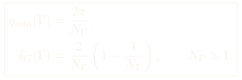
The integer NΓ counts completed A5-A6-A7 boundary-capacity slots in the certified chamber. It is not selected from the measured fringe contrast. The first expression is the smallest modular share in that finite certificate. The second is the corresponding two-sector purity defect. Larger certified counts give smaller defects. The excluded one-slot case has no nontrivial incomplete two-sector cut.
This is a derived source result under the paper's printed chamber and spectrum conditions. A7's completion identity alone does not supply that spectrum or a universal numerical floor for every possible instrument. In fact, strict mixedness alone allows defects that are arbitrarily small; the finite source certificate is the additional load-bearing step.
To test the result with matter waves, the source must pass through an actual instrument. The Molecular Visibility Transport framework builds that bridge using the relevant Fourier harmonics, source distribution, ordinary environmental decoherence, detector response, and covariance. A source purity defect, an access-projector weight, and a measured fringe visibility are distinct objects. Their equality cannot be assumed because all three are numbers between zero and one.
A constant loss of contrast can be absorbed into an unknown apparatus contrast. The discriminating target is a predeclared shape that changes with controlled settings and survives independently certified calibration directions. This is why the programme uses qualified blind tests, not merely a small unexplained visibility loss.
The current status is specific. The finite-chamber source gap is derived. Direct qualified observation of the floor remains pending. The public Pedalino power scan stresses the simplest saturated insertion under its nominal apparatus model; it does not contain the full calibration and covariance packet required for a theory verdict. That stressed diagnostic is retained in the transport paper, not counted as confirmation or erased as an inconvenience.
The prediction must come first. The relevant experimental conditions must be specified. Then the result must be allowed to disagree. For a qualified, independently frozen packet, an incompatible residual shape is a falsifier of that source-to-instrument branch. The chamber count or camera cannot be replaced after seeing the result.
A law earns our trust because it risks telling us something precise that could be wrong.
Fixing the Universe Humans Invented · Essay 17Opening the curtain
At the window, the child opens the curtain once more.
The leaf is still moving.
The larger view has not made it less real. Nor has discovering the tree made the leaf meaningless. It has simply changed what the child understands the leaf to be.
This is the possibility at the heart of bundled existence: the objects we observe may be real without being complete in isolation.
If A7 is right, the universe looks like a world of separate, accessible things because our encounters with its completed units are partial. Its completion rule connects the reality that exists with the limited reality that any particular experiment can reveal.
That possibility is bold enough to investigate. It does not need to be presented as a certainty.
The child once thought the edge of the curtain was the edge of the world.
A7 asks whether physics sometimes makes a similar mistake.
Our view may be partial. Existence, A7 proposes, is not.