What If the Physics Textbooks Disappeared?
Keep the measurements. Reconsider the physical story. A QTT source account of light, clocks and the π/8 angle.
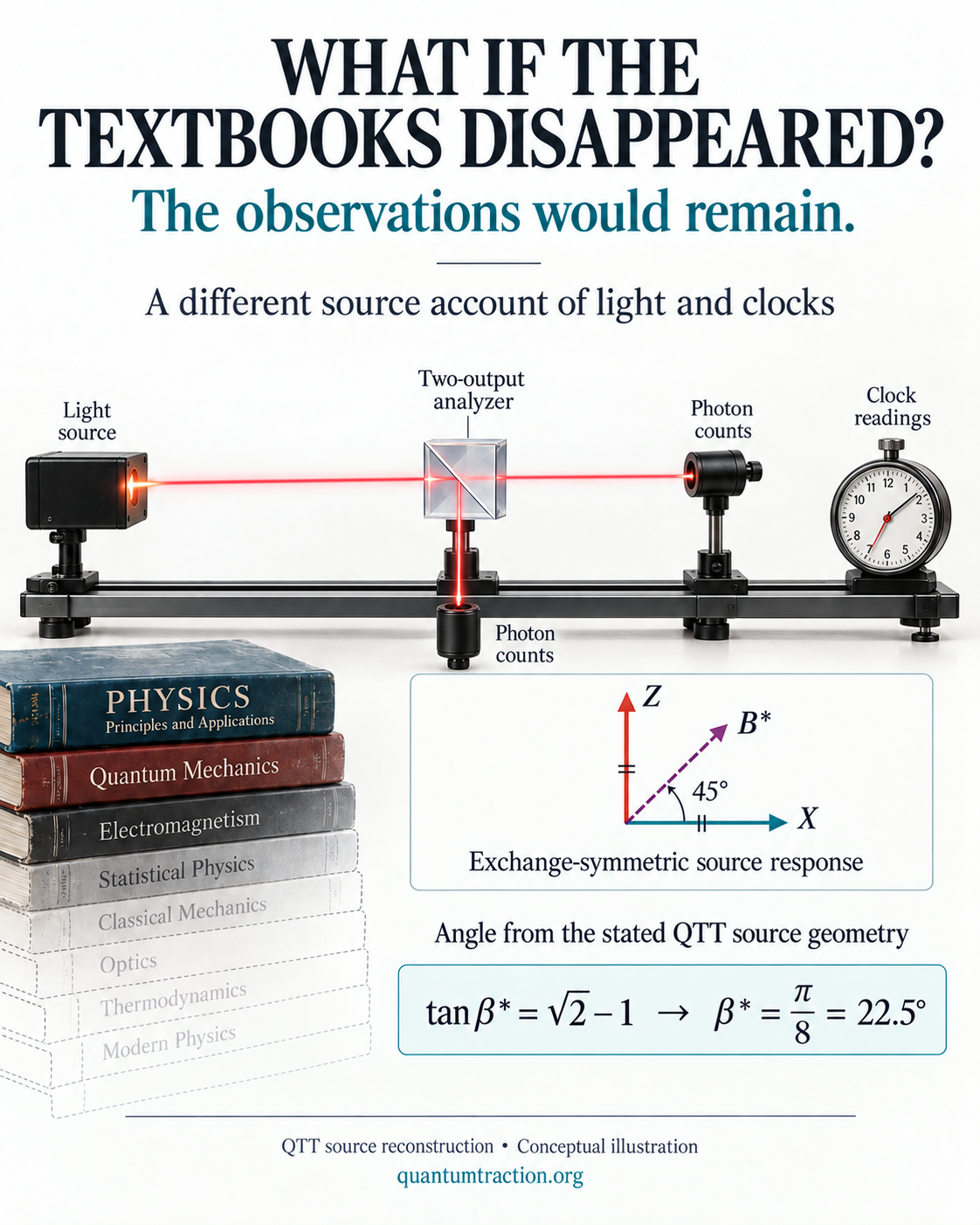
Have you ever asked yourself what would happen if we lost every physics textbook, but kept the experimental records?
We would still have the photon counts. The clock readings. The measurements.
Would we rebuild the same interpretation of the universe?
That question is behind my new paper.
Could a successful textbook explanation become a brake on theoretical imagination? I think it can, when we begin treating it as the only possible explanation.
So I tried a different starting point: Quantum Traction Theory, or QTT.
Start with completed physical events, an ordered source clock, finite capacity and a real internal phase structure. Then ask whether those ingredients can reconstruct familiar light and clock laws.
The chain in ordinary language
- Movement and internal clock activity share one source-rate budget. Within that source class, more movement means less internal clock activity. The familiar clock-slowing relation follows. Light is the branch with no private rest-clock activity.
A balanced two-channel source has a profile angle selected by its exchange symmetry:
π/8 = 22.5°.
That angle follows from the stated source construction rather than being adjusted to photon counts.
- A detector retains a fraction of the source profile’s capacity. With the specified sampling conditions, this gives the familiar polarization probabilities and the angular correlations of a neutral photon pair.
The paper connects those results through one declared source account. It also calculates the observer’s clock-and-ruler readout, rather than correcting the clock alone.
The observations do not choose the story alone
The important point is that an observation does not arrive with its interpretation attached.
The same optical law can be reached from different physical starting objects. Agreement with that law alone cannot tell us which objects are fundamental.
This is a mathematical reconstruction within stated QTT premises and readout conditions, not a report of a new experiment. Full proofs and reproducible calculations are openly available. A separate qualified clock test addresses the new source-to-detector bridge.
What would you insist on testing before accepting a different account of the same observations?
Read the paper: Can Light and Clock Behavior Be Reconstructed from Completed Events?