FIELD NOTES / GRAVITY / 24 OCTOBER 2026 / ALI ATTAR
A letter to Conrad Ranzan and the story of Gravity
A shared picture of the cost of existence, an earlier author I had not known, and the particular mathematical construction behind QTT.
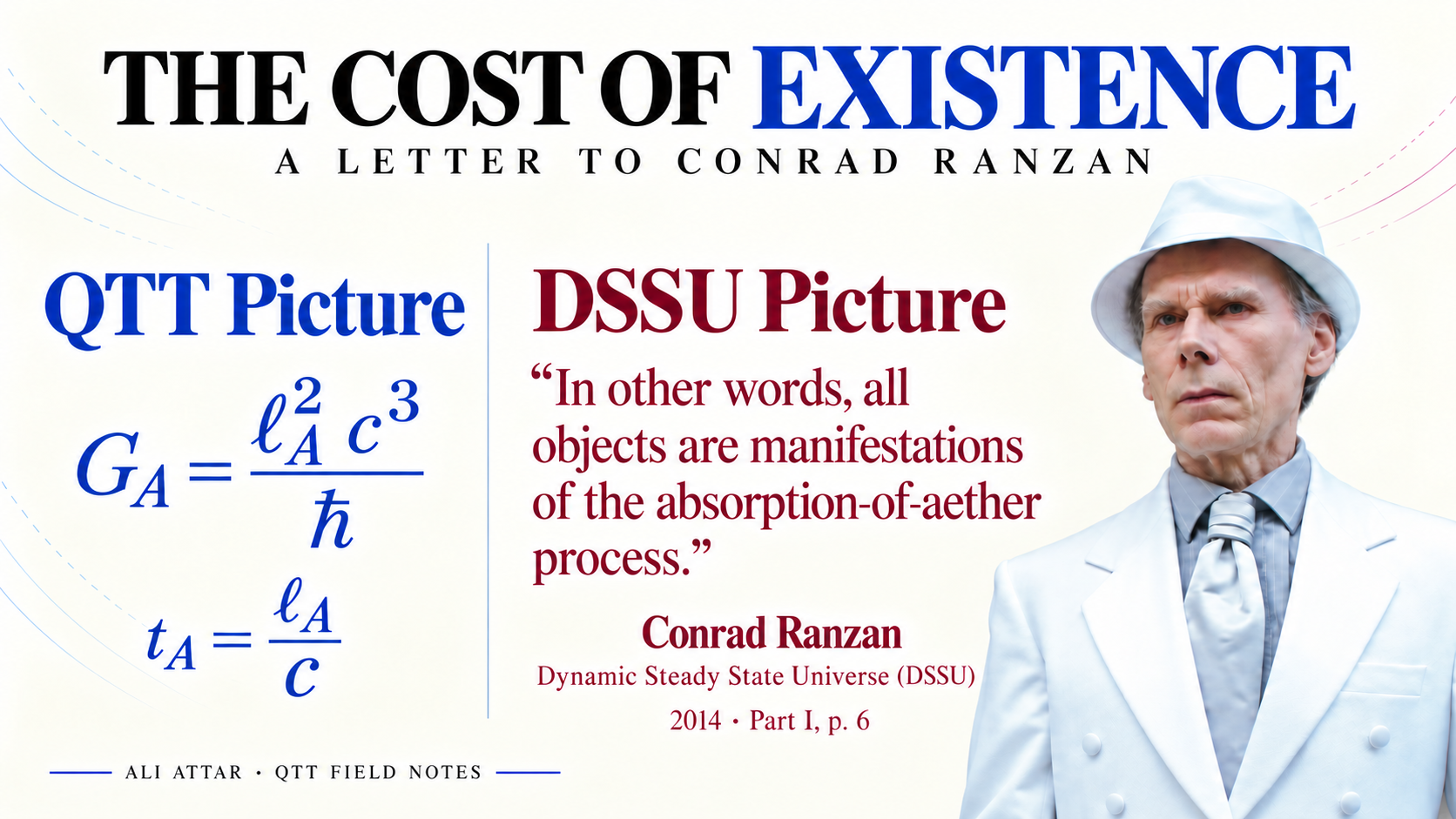
In other words, all objects are manifestations of the absorption-of-aether process.2014, Part I, p. 6. AI-assisted editorial illustration based on the supplied portrait.
This week, I had a shocking discovery through deep research with ChatGPT.
I found that one of QTT's axioms has closely related prior work written by Conrad Ranzan, published back in 2014.
I had mixed feelings:
- Someone is crazy enough and genuinely creative enough to have the same picture in their head about Gravity!
- QTT's novelty got partially hurt. But does it really matter? I am happy that someone thought about the same picture!
But what's the picture, and what are the exact words here? I'll keep it simple.
Newton described Gravity as a "Force" between bodies of matter. For me, his picture leaves two questions:
- His famous equation tells us how two bodies attract each other. A single body can still have a gravitational field. But what physical process gives that body its gravity in the first place, even when it is alone? The force law does not tell us that.
- Later, the Standard Model gave the electromagnetic, weak and strong interactions their quantum carriers. A graviton is the hypothetical carrier in a quantum description of gravity, but none has been individually detected. It leaves the quantum account of gravity unfinished.
Einstein pictures Gravity as curvature of spacetime. His theory takes us beyond Newton, but still leaves three open questions:
- It predicts singularities in black-hole interiors, where its classical description reaches its limits.
- We still need a complete account of how quantum matter and smooth, dynamical spacetime fit together! Einstein's original equation treats both geometry and matter classically, within a continuum description. Quantum mechanics provides a deeper description of matter and energy, but it does not by itself supply a complete quantum theory of spacetime or a universally accepted account of how quantum matter sources dynamical geometry.
- At galaxy scales, the gravity inferred from motion is often greater than the visible matter accounts for. The usual account adds dark matter. Its gravitational evidence is substantial, but no dark-matter particle has been conclusively identified. This is a reason to investigate the full picture, not by itself proof that Einstein's equation is broken.
Now, here is the question I wanted answered in a highschooler's language, without technical jargon:
What is physically happening when matter "curves" spacetime?
It's unbelievable, but modern physics doesn't have a settled microscopic answer for this underlying process!
Einstein's equations describe the relationship. I wanted a physical picture underneath that relationship. It may sound like a silly question, while to me it's the most fundamental question physics can ask.
Now I have found, by surprise, that Conrad Ranzan had already published a closely related answer in 2014. I had been working toward mine since 2019 without knowing his work. In his account, matter persists through continuing aether absorption. See his paper, especially Sections 5 and 6.
Here is the shared picture, in simple words:
In QTT, Matter/Energy needs to consume Space-Time-Reality capacity to continue existing. In Conrad's version, the continuing process is aether absorption.
This is what I have called the "Law of Existence". A continuing substrate cost of existence is a bizarre departure from the usual textbook picture. In QTT, it is expressed through A2, the Law of Endurance: the cost of existence.
My picture and Conrad's picture have some fundamental differences as well:
- I connect Energy, Mass, oscillation, completed-event capacity, modular charge and endurance rate through the six faces of the UEL. These are different readings of one source capacity, not six unrelated things that happen to have the same number. The fourth face connects the energy of a completed event to its geometrically constructed support. In my picture, Energy and Matter are active patterns supported by that capacity; A3, the Law of Creation, mints new completed capacity. The fifth face's modular charge is not an ordinary computer bit count. The fourth-face paper gives the precise construction.
- QTT gives this picture a specific mathematical structure. Its source gravitational coupling is
Here, is Artian's Ruler, the QTT source ruler, and its source tick. The A2 gravity paper states the conditions connecting that source construction to the measured gravitational response. Conrad's inflow velocity and QTT's endurance current are also different mathematical objects; sharing an inward-flow picture does not make the two theories identical.
The similarities and differences are clear enough for me to say this to Conrad: It's an honor to know your work! Even if it has only been a few days, and thanks to GPT deep research!
I think this is the right physical picture, Conrad.
In QTT, this picture connects the Planck-scale length, time and energy through one source construction. Where Artian's Ruler is fixed independently of measured , QTT can reconstruct its gravitational coupling from that ruler, rather than starting with to define the ruler.
Setting the ruler's size in metres still needs an independent physical anchor; the non-gravitational metrology paper develops that route.
I respect you, Conrad, more than Einstein, even if your picture has not been widely recognized by the scientific community. Deep down, I believe this is the better physical picture of Gravity for our universe! QTT gives my version a mathematical construction. That makes it explicit and checkable; the physical picture still has to stand up to observation.
Continue Reading
Define QTT. Start With a Shopping Cart.
The cost of continued existence and the common source count behind inertia and gravity.
The Paper That Started With a Silly Question
How the sixth UEL face links rest energy to the A2 endurance rate.
Why G Derives This Way in QTT
The source ruler, gravitational coupling and the distinction between a structural identity and numerical metrology.
Maps for this note: Blog Map / All Field Notes / A2 endurance / Two Universes / Corpus Tree / UEL derivation map.
Source Papers
- Prior work: Conrad Ranzan, The Fundamental Process of Energy, Part I (2014); Dynamic Aether Theory of Gravity (2025).
- QTT construction: completed-event four-capacity; modular-charge fifth face; endurance-rate sixth face; inertial mass and its three readouts; A2 field dynamics.
- Conventional comparisons: Newtonian fields; quantum fields on curved spacetime; black-hole singularities; dark-matter evidence and its unknown particle nature.