FIELD NOTES / FOUNDATIONS / 17 OCTOBER 2026 / ALI ATTAR
Define QTT. Start With a Shopping Cart.
A loaded cart needs a harder push. QTT starts one question earlier: what allows either cart to keep existing?
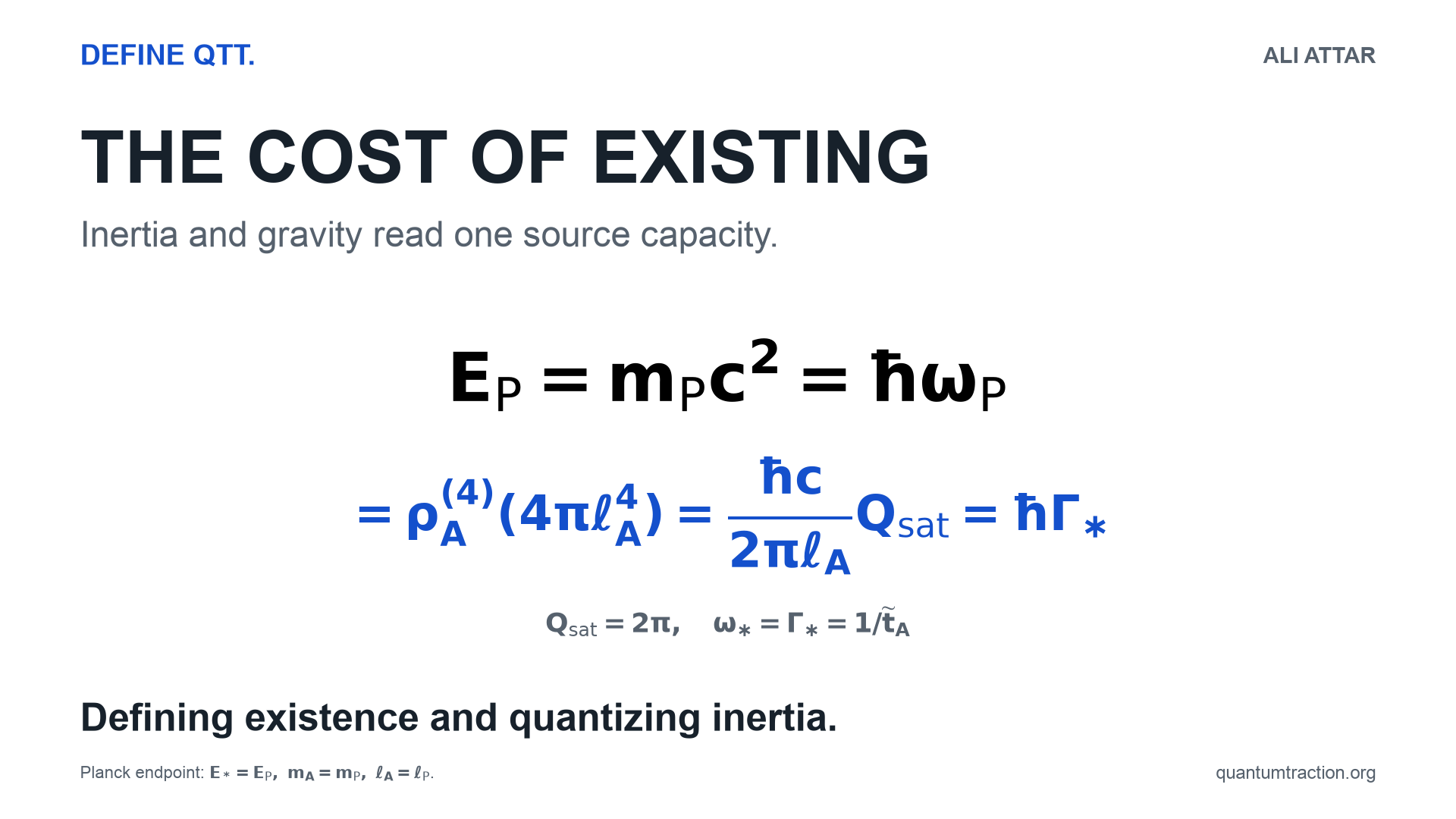
I got this question from one of the known physicists: "You didn't define QTT. Define it."
Ok. I have my happy and sunny Saturday in Paris. Let's do it. This is my entry point to QTT.
Imagine pushing an empty shopping cart, then pushing it after loading it. The loaded cart is harder to accelerate. Physicists call that inertia.
Now consider gravity. More mass means an object responds more strongly to a given gravitational field. It also produces a stronger gravitational field of its own.
These are three different questions:
- How difficult is the object to accelerate?
- How strongly does it respond to gravity?
- How much gravity does it produce?
QTT's construction says all three measure the same underlying physical capacity supporting the object's existence. One source quantity appears in three different experiments.
But to understand what I mean, we need to look at the cart before anybody pushes it.
It is standing there. Nothing seems to be happening.
In QTT, remaining a thing is already a physical activity.
Quantum Traction Theory begins with a finite structure of Reality-Space-Time. Matter, clocks and the geometry we measure are readouts of physical events in that structure. The microscopic units are not mathematical points with no size and unlimited capacity. They have finite capacity, and the continuation of an existing object requires support from them.
The Cost of Enduring
This is where A2, the Law of Endurance, enters.
A2 says that matter consumes inactive support capacity to continue existing. The book describes the smaller geometric units as pixellates. The formal consumption law counts completed support quanta.
More mass requires more support consumption. A loaded cart has a greater endurance demand than an empty cart, even while both stand still.
The compact equation is:
Here is the dimensionless Artian mass count, expressed in the theory's fundamental mass unit . The symbol is the fundamental source tick. The equation says that the support-consumption rate grows directly with the source mass count.
Twice the source count means twice the endurance demand.
This is support turnover in QTT's substrate. It is not a claim that the stationary cart burns ordinary fuel or must continuously become hotter. The framework distinguishes the capacity spent on continued existence from energy accumulating inside the cart as heat. A2: Law of Endurance.
That changes the starting question of mechanics.
Before asking what makes a thing move, QTT asks what allows it to remain a thing from one physical tick to the next.
The next step connects that question to gravity.
A2 gives the support demand a spatial current. Around an isolated, settled source, that current spreads across spherical shells. A sphere's area grows as the square of its radius. Consequently, the same total demand is distributed more thinly at greater distances.
The QTT construction maps that endurance current into the gravitational field. In its weak-field limit, the result is the familiar inverse-square law.
The geometrical spreading is familiar mathematics. The proposed physical source is the new ingredient: the field is read as the large-scale expression of the support required for matter to endure. The A2 field-dynamics paper gives the source law and the mapping into the gravitational description.
Three Readings, One Source
Now return to the shopping cart.
The inertia paper constructs a source-capacity operator and shows how its spectrum enters the object's rest energy and motion. From the source action, the same coefficient appears in resistance to acceleration and response to an external gravitational field. The A2 source construction supplies its gravitational-sourcing face.
The resulting relationship is:
Every term reads the same source count.
That is the part I want the physicist to examine. The argument is more substantial than writing three familiar masses beside one another. Their coefficients are extracted through distinct operations and connected to one source construction. The theorem states the finite source class and the low-speed, weak-field conditions under which those readings coincide. Artian Inertial Mass Operator and Three-Readout Spectral Equivalence Theorem.
What the Fall Rate Means
This also explains why I would be careful with the usual falling-object story.
Two objects can have very different support demands and still share the same leading free-fall acceleration in a common external field. The inertia and gravitational-response coefficients scale together. Their ratio cancels from that acceleration.
The same fall rate does not mean the same underlying physical activity.
The heavier object still consumes more support and produces a stronger gravitational field of its own. Treating it as a small test body means neglecting its effect on the surrounding field. That approximation should not erase the object's own endurance demand from the interpretation.
Experiments have tested composition-independent free fall with extraordinary precision. MICROSCOPE compared titanium and platinum test masses and found no violation at a sensitivity of a few parts in . That is a fact any proposed source account must respect. MICROSCOPE results.
QTT's additional claim concerns what that successful large-scale description represents underneath.
Newtonian mechanics relates forces to motion. General relativity relates free fall to spacetime geometry and universal coupling. QTT supplies a finite support-consumption account intended to underlie that geometry, and connects its source count to the coefficient governing inertia.
The equality of the masses is familiar physics. The A2 identification of their common source with the demand of continued existence is the distinctive QTT claim.
It also has consequences beyond a cart.
When an object's internal binding changes its total energy, the source construction requires the corresponding change to appear consistently in its inertia, its response to gravity and its gravitational sourcing. We cannot adjust one face independently to rescue the calculation.
And the smooth gravitational field is an average over finite support events. The framework describes how a finite detector region samples those events. Predicting the detailed fluctuations additionally requires the physical correlations between them. That supplies a concrete place to look beyond the smooth average, rather than assuming that greater consumption must make heavier test objects fall faster.
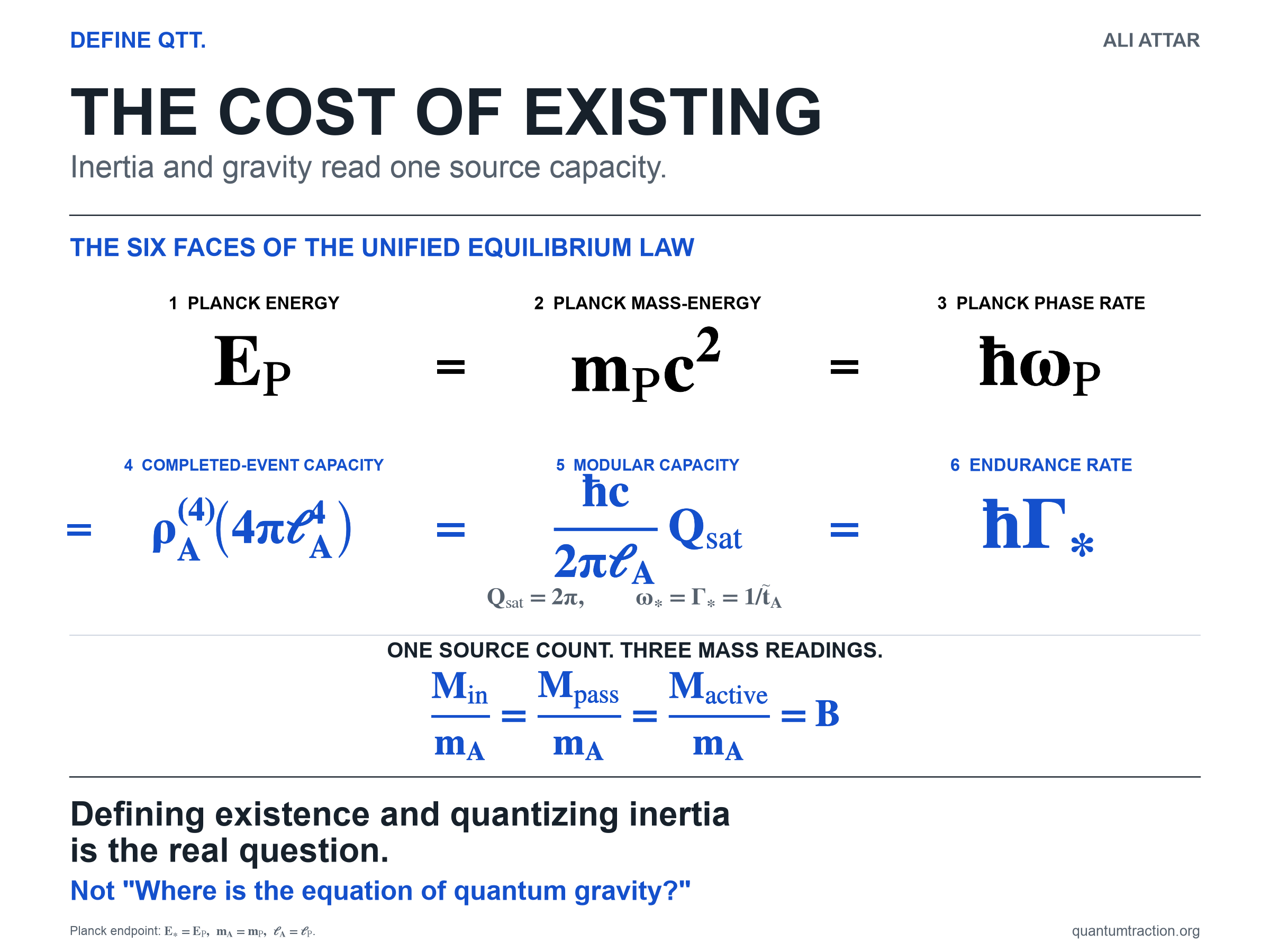
So, to the physicist who asked me to define QTT: this is where I would begin.
Take the cart seriously while it is standing still.
Ask what its mass means physically, what supports its continuation, and why that same content appears when we push it, weigh it or measure the gravity it produces.
QTT's answer begins with A2. Continued existence carries a physical support demand. In the derived regime, inertia and gravity are different measurements of that common source.
"Defining existence and quantizing inertia" is the real question. Not "Where is the equation of quantum gravity?"
Continue Reading
Reader maps: Blog Map / All Field Notes / A2 vocabulary / Two Universes / Corpus Tree / UEL derivation map.