FIELD NOTES / FOUNDATIONS / 17 OCTOBER 2026 / ALI ATTAR
A Nearly 350-Year-Old Burden of Proof
Physics has tested continuum equations. Has it established a universe that can be divided without end?
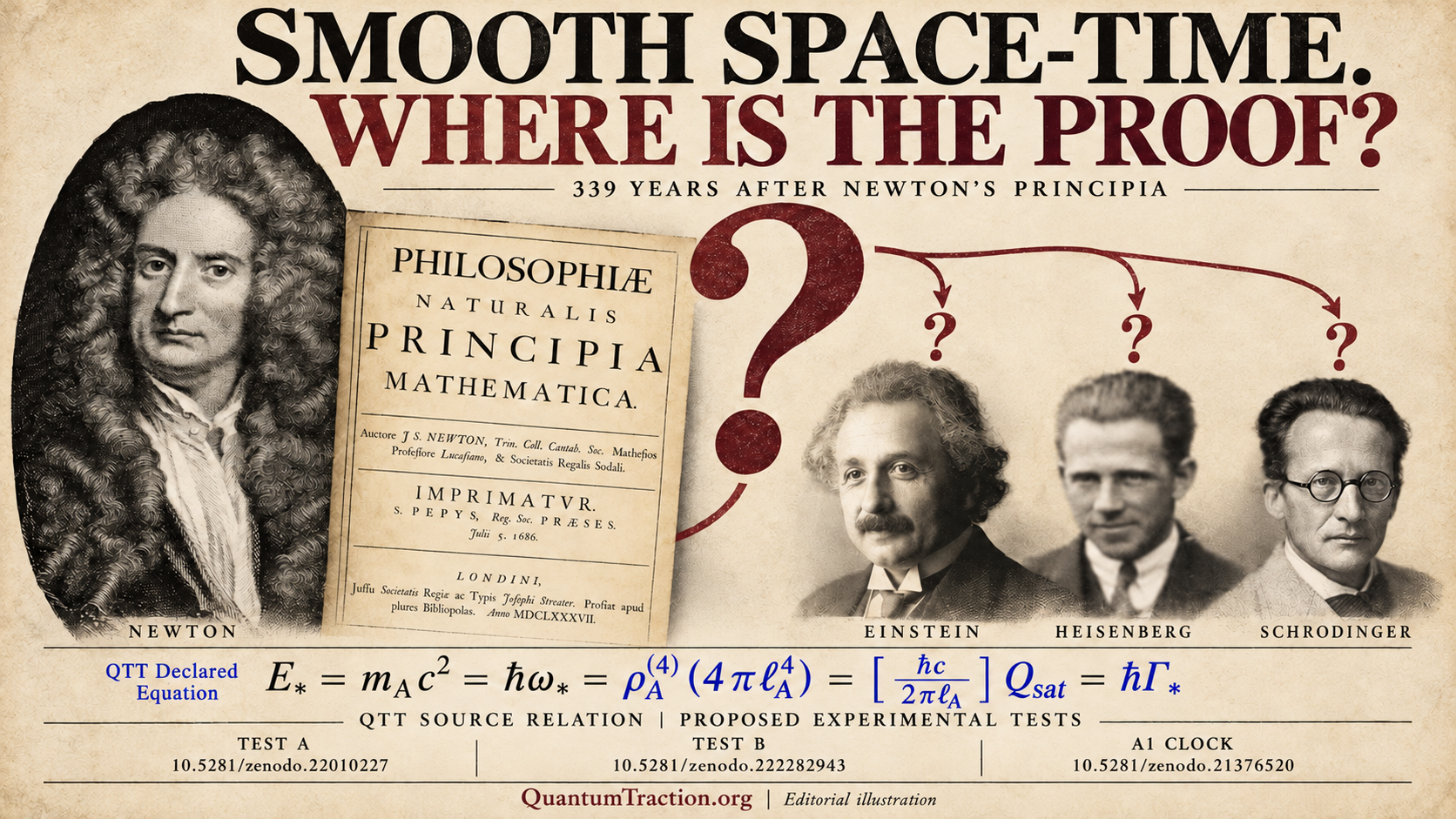
When Newton organized classical physics, its equations gave us an extraordinarily powerful way to calculate motion. They also carried a picture of the universe: three-dimensional space and a continuously flowing time, with no smallest physical interval built into the geometry.
The Principia appeared in 1687. That was 339 years ago.
Almost three and a half centuries later, I want to ask a question that should never have become uncomfortable: where is the evidence that the universe remains continuous and arbitrarily divisible, however far down we go?
We have evidence that continuum equations work over enormous tested ranges. Extending that success to infinite physical divisibility is another claim. We should stop treating the two as interchangeable.
The assumption inside the equations
Newton did discuss his foundations. His Principia explicitly describes absolute space and absolute time. It would be historically wrong to say that he never declared them. But describing a mathematical space does not establish that nature contains physically distinguishable locations between every pair of locations, without end. Newton's Scholium
Geometry allows us to keep dividing a line. Does the universe perform that division too? A mathematical operation is not automatically a physical operation.
Here is the burden of proof. If a theory treats a continuous substrate as the final account of reality, that physical claim needs evidence. Its age does not supply the evidence. Neither does its place in a textbook.
Einstein changed our account of clocks, rulers and simultaneity. His 1905 paper states its physical postulates and starts from operational measurements, rigid standards and Euclidean coordinates. Relativity was a major reconstruction, not a casual declaration that things are simply "like that." It nevertheless retained continuum descriptions. General relativity later made geometry dynamical while still using a spacetime manifold. Einstein's 1905 paper
Space and time did not become identical. They became parts of a common geometry with different physical roles. Continuous time was already present in classical physics. What survived these revolutions was the use of a continuum, not proof that no deeper physical structure exists.
Quantum physics made the question more urgent
Then nature confronted us with discrete spectral lines, quantized exchanges and individual detection events. Quantum mechanics transformed the rules for matter and light. Yet its familiar particle and field formulations could retain continuous spatial coordinates and continuous time.
That combination is mathematically possible. Quantized energy does not, by itself, prove quantized space. But it makes the question unavoidable: which parts of the continuum belong to nature, and which belong to the description we chose?
For me, the scientific failure begins when that question is treated as already settled. A successful calculation is not permission to declare its underlying picture of reality untouchable.
Max Planck's length and time scales matter here. They are serious physical scales, central to quantum-gravity research. Calling them decorations would miss that work. But writing down a natural unit does not establish an actual minimum distance, a physical tick, or a mechanism that completes an event. Those are additional physical claims. Hartle, Quantum Mechanics at the Planck Scale
The foundational problem is older than modern physics. In Artian's Universe, I discuss Zeno's challenge about motion and divisibility. It is a challenge, not experimental evidence for pixels. Riemann was more explicit about the physical question: in his 1854 lecture, he considered whether the reality underlying space might be discrete, and whether familiar geometry remains applicable at arbitrarily small scales. Riemann's lecture
The question was available. We still owe it an experimental answer.
The conversation that brought this back
My friend Asa Oldring recently sent me a message about asking Jim Al-Khalili for the evidence for "quantum Planck time." Asa wrote: "He says there is none!"
That exchange brings us directly to the question. Evidence that a Planck-scale unit is a fundamental tick must be produced. So must evidence for any proposed alternative. But an absence of evidence for discrete time does not establish continuous time all the way down.
I invite Professor Al-Khalili and anyone interested in this question to examine concrete competing predictions. Researchers already investigating non-continuum foundations have been asking related questions for years. They do not all propose the same structure, and discrete space does not automatically require discrete time.
My challenge is to the promotion of a useful continuum model into an unquestionable final ontology.
What QTT puts on the table
Quantum Traction Theory starts from a different proposed substrate: finite source capacity, an Absolute Background Clock and completed events. Its Unified Equilibrium Law connects six physical readings of one source energy scale:
Here,
In ordinary language, these are energy, mass, phase rate, completed-event four-capacity, modular capacity and endurance rate.
Artian's Ruler is QTT's source ruler. The Artian mass is its source mass unit. Reading them as laboratory Planck units uses the corpus's stated source-to-gravity identification. The equation above is written in source variables; it does not obtain its tick by silently inserting a measured gravitational constant.
The fourth face contains the QTT completed-event object . Its density is energy per fourth power of length, not an ordinary three-dimensional energy density. The fifth face reads the saturated modular capacity . The sixth assigns rest energy to the A2 endurance allocation rate. A stationary object is not thereby predicted to lose mass or release heat.
These are six linked readings of one source budget, not six independent measurements. Their scientific force comes from the stated source rules and the consequences that can be carried into an apparatus.
Put the difference into an experiment
I have registered specific tests of those consequences. An experimentalist does not have to accept QTT's interpretation to run them.
Test A asks whether a fixed additional visibility pattern appears in a Talbot-Lau matter-wave interferometer after the ordinary apparatus response is independently calibrated. It is a prediction of a specified extra shape, not permission to fit an arbitrary loss of interference. Test A preregistration
Test B goes further. Change the apparatus configuration and test whether the whole additional pattern moves according to the frozen transport prediction. Ordinary interference features move too, so movement alone is insufficient. The registered comparison concerns the particular additional pattern and its predicted migration. Test B preregistration
The A1 clock programme addresses a different source consequence. Its proposed qualified comparison distinguishes a normalized unit response from a mixed-reference response containing
Programming a 22.5-degree overlap into an optical control would not qualify as evidence for a source clock. The source-to-detector connection must be established independently. Clock, ruler and synchronization effects must also be treated consistently, so neither hypothesis is removed by the correction procedure. A1 clock preregistration
These are registered proposals with physical qualification requirements, not reports of completed confirmatory experiments. Their sharpness depends on meeting those requirements before looking at the test outcomes.
The six-face identity alone is not a detector prediction. Each test needs its specific physical bridge, calibrated inputs and enough sensitivity to separate the competing targets. Once those conditions are met, a result against the registered QTT branch counts against it. A matching result must survive controls and independent repetition.
The burden belongs on both sides
No finite experiment can certify infinite divisibility at every possible scale. Nor can one positive result establish every conceivable discrete universe. What an experiment can do is decide between specified predictions at a stated sensitivity.
That is enough to make progress.
State the continuum-based apparatus prediction. State the QTT prediction. Freeze the analysis. Publish the outcomes, including the inconvenient ones.
I am not asking the community to believe that space and time count because I have written an equation. I am asking it to test whether the physical counting rules behind that equation leave the registered consequences in real observations.
The continuum has earned its success as a model. Infinite physical divisibility has not been established by that success.
Nearly 350 years after Newton, the assumption is old enough to be tested without deference.
Burden of proof is on both sides.
Papers behind the equation
Related Field Notes
Maps for this note: Blog Map / All Field Notes / Corpus Tree / UEL vocabulary / UEL derivation map / Tests and observations