Logical Inconsistencies of Dark Matter
What goes wrong when a gravitational inference is treated as a material identification.
The Universe That Humans Invented · Essay 12Put gravity in the witness box
A galaxy does not hand us a sample of dark matter. It gives us light, spectra, gas emission, and motions. We measure those signals, apply a theory of gravity, estimate the ordinary matter, and ask whether the calculation agrees.
Often it does not. That discrepancy is real. The next sentence is where the argument can go wrong.
If Newtonian gravity and general relativity are protected from questioning, every unexplained gravitational effect must be assigned to something else. An invisible mass distribution becomes the answer before its physical identity has been established. The calculation may be useful and even highly predictive. But the force law was one of its premises, not a witness exempt from examination.
This essay concerns logical inconsistencies in that argument: treating an inference as a unique identification, demanding that a halo gravitate without demanding its response, or counting a reconstruction as a fresh prediction. It does not claim that every mathematical model containing dark matter is internally contradictory. Collisionless gravitating systems are perfectly coherent mathematical objects. Whether they describe the missing component of our universe is a physical question.
Newtonian gravity and GR must be allowed to be part of the problem. A discrepancy cannot decide its own cause merely because we have given the remainder a name.
Notice for students and researchers
QTT and Artian's Geometry remain speculative physics pending independent experimental validation of their distinctive claims. This essay separates observations, conventional model interpretations, and QTT source statements. A result within a framework is not, by itself, experimental confirmation of its premises.
The Universe That Humans Invented · Essay 12How a missing quantity became a substance
In the 1930s, Fritz Zwicky used the motions of galaxies in the Coma cluster to infer much more gravitating mass than its luminous contents suggested. Galaxy rotation studies, including Vera Rubin's work in the 1970s, made the discrepancy a central problem rather than an isolated curiosity. The historical sequence is summarized by Caltech and NASA.
The modern case is far larger than those early estimates. It includes galaxy dynamics, gravitational lensing, structure formation, and the cosmic microwave background. A serious objection has to face that whole collection.
Still, more evidence of a gravitational discrepancy does not automatically settle what produces it. The methodological choice remains: add a material component, change the gravitational dynamics, or derive a different physical source beneath the effective equations. Each choice must eventually predict the same measured quantities, with its assumptions and adjustable inputs exposed.
The Universe That Humans Invented · Essay 12A residual is not a particle identification
For an approximately circular galactic orbit, the acceleration required by the motion is the square of the circular speed divided by the radius. Compare it with the Newtonian acceleration calculated from ordinary stars and gas:

This is a comparison, not a discovery equation for a new substance. Inferring the circular speed already requires attention to inclination, distance, and noncircular motions. Estimating the baryonic field requires gas measurements and a conversion from starlight to stellar mass. Their uncertainties belong in the result. The radial-acceleration analysis makes the observed-versus-baryonic distinction explicit.
A halo reconstructed from a rotation curve can reproduce that curve. Of course it can: the curve helped determine the halo. The additional evidence comes when that construction predicts something it was not adjusted to reproduce.
This is not an objection to inference. An unseen object can be discovered through its consequences. It is an objection to spending the same observation twice: once to construct the proposed cause, then again as supposedly independent proof of it.
Lensing is an additional observable, but a lensing mass map is also a reconstruction through a gravitational theory. It cannot be dismissed as meaningless, and it cannot be presented as a photograph of a specific dark particle. Changing the theory requires calculating the light deflection, not merely announcing that Einstein might be wrong.
The Universe That Humans Invented · Essay 12Gravity must work in both directions
The intuitive objection is tempting. If dark matter attracts ordinary matter, ordinary matter must attract it. Why, then, does dark matter not collapse into stars or settle into a thin disk?
Because attraction alone does not remove orbital energy. Two bodies can attract each other and keep orbiting. A cloud can become gravitationally bound while retaining enough disordered motion to remain extended. Ordinary gas can collide and radiate away energy; the usual collisionless cold-dark-matter model lacks an efficient equivalent cooling channel.
Invisible does not mean unable to cool, either. A dark sector with its own dissipative interactions can behave differently. Double-disk models explicitly explore that possibility, and Gaia stellar-motion analyses constrain thin dark disks. Elastic self-scattering and energy-losing radiation are different mechanisms. We should not demand the predictions of one model from another.
The better objection concerns the halo's unavoidable gravitational response. A stellar bar is a rotating, elongated concentration of stars. It can transfer angular momentum to the surrounding halo through gravitational torques. Collisionless does not mean immune to that exchange. For an isolated bar-halo exchange, the accounting is

Gas, external torques, and structural evolution require their own terms in a full galaxy model. This equation isolates the mutual exchange; it does not pretend those other processes vanish.
Debattista and Sellwood showed that dense halos in their models could brake bars too strongly compared with observed fast bars. The relevant issue is the inner halo's density and orbital distribution, not simply how massive the outer halo is.
This remains a live, quantitative problem. A 2026 Auriga simulation study found faster bars in more baryon-dominated galaxies; those galaxies also lay above the observed stellar-mass–halo-mass relation. Getting a fast bar is not enough if the chosen galaxy then misses another independently measured relation.
The demand is straightforward: use the same galaxy and the same halo to predict its attraction and its braking. Do not replace the dense halo with a dynamically convenient one halfway through the explanation.
The Universe That Humans Invented · Essay 12The visible matter keeps knowing the answer
The most striking galaxy-scale observation is not just excess speed. It is the organization of the excess.
McGaugh, Lelli, and Schombert found a tight relation between the acceleration traced by rotation and that calculated from baryons, using 2,693 radial points in 153 galaxies. These are not 2,693 independent galaxies, and shared distance, inclination, and stellar-population uncertainties matter. The relation remains a substantial empirical regularity. In its low-acceleration limit,

Here the acceleration scale in the observational relation is empirically determined, about 1.2 times 10 to the minus 10 metres per second squared. The equation is not being presented as a new QTT prediction or as exact for every system. See the original study.
The visible distribution tells us a surprising amount about the effect attributed to the invisible distribution. Related clues include the baryonic Tully-Fisher relation in gas-rich galaxies and the correspondence between features in luminous matter and features in rotation curves discussed by Sancisi. These are connected observations, not three independent verdicts.
Dark matter and baryons interact gravitationally, so their correlation is not logically forbidden. The difficult part is deriving the normalization, small scatter, detailed departures, and environmental dependence from a specified formation model. Saying that the two components interact is the beginning of that calculation.
Nor is it true that simulations cannot produce the relation. A FIRE-2 study reproduced its broad behavior and identified distinctive hooks and bends. Those departures are particularly valuable: a frozen model can be tested on their presence, size, and frequency in new data. Its star-formation and feedback prescriptions must remain part of the input account, including which observations informed them.
The question is whether galaxy formation predicts the pattern or is flexible enough to reconstruct it. A withheld sample and the full distribution of residuals can distinguish those possibilities much better than an attractive plot through the mean trend.
The Universe That Humans Invented · Essay 12A repair must pay its energy bill
Dark-matter-only simulations often produce centrally concentrated halos. Some observed galaxies favor shallower central profiles. Stellar feedback is one proposed route between the two.
The mechanism is not that dark matter absorbs supernova light. Rapid movement of gas changes the gravitational potential and can transfer energy to collisionless orbits. Pontzen and Governato developed an analytical account and tested it against simulations. That is real dynamical work, not an empty label.
But "feedback" is not an unlimited account from which a halo may withdraw whatever energy a fit needs. For a mechanism powered by a specified supernova population, a necessary condition is

The right-hand side is the available explosion energy multiplied by the fraction that reaches the relevant restructuring process. The amount, location, and timing of the transfer all matter. Passing the inequality alone does not prove that the proposed core forms.
Penarrubia and colleagues examined the tension between making large cores and the low star-formation efficiency implied by dwarf-galaxy populations. Li and colleagues found that baryonic compression worsened radial-acceleration agreement in their semi-empirical halo models. Expansion must then counteract compression, not just be invoked in isolation.
The clean test uses independent stellar ages, star-formation histories, and gas constraints to bound the available energy. If a specified mechanism cannot pay for the required transformation, that mechanism fails. Adding another energy source is a revised model with new obligations, not evidence that the original explanation worked all along.
The Universe That Humans Invented · Essay 12Which dark matter survived the test?
Cold, warm, self-interacting, dissipative, and wave-like dark-matter models are not interchangeable. Their allowed structures and detection channels differ. Testing a particular interaction and finding nothing constrains that interaction and its parameter range; it does not exclude every possible invisible gravitating component.
There is an equal and opposite bookkeeping error. A failed candidate should not disappear into the phrase "dark matter remains viable," as though the candidate itself had survived. Keep the rejected mass ranges, cross-sections, and halo assumptions in the scientific record. Otherwise a research program's flexibility gets mistaken for a single theory's predictive accuracy.
The same applies to altered gravity and to QTT. A new field, interpolation function, access coefficient, or source term has to be specified before it can be tested. Moving an adjustable function from the matter side of an equation to the gravity side does not make it disappear.
As checked on 20 September 2026, the recent LZ announcement is a useful example of careful experimental language. The collaboration reported an interesting interaction in an extended WIMP search at 2.6-sigma significance, and did not claim a discovery. It is neither a confirmed identification of cosmological dark matter nor a result to conceal because it is inconvenient to a critique. The experiment is collecting more data. See Berkeley Lab's 1 September report.
If such a signal becomes independently reproducible, a proposed gravitational-only replacement must confront it. A criticism worth publishing needs an answer to what would change its author's mind.
The Universe That Humans Invented · Essay 12The evidence a critic cannot skip
The cosmic microwave background is a much stronger argument than fitting a separate halo to each rotation curve. Planck's cosmological analysis found that temperature, polarization, and lensing could be described consistently within a shared, spatially flat six-parameter base Lambda-CDM model. Its physical baryon and cold-dark-matter densities, acoustic scale, primordial amplitude and tilt, and reionization optical depth are inferred parameters. Foreground and calibration nuisance parameters are additional. They must be printed as inputs or fits, not advertised as numbers derived from first principles.
That accounting does not erase the cross-observable constraint. Thousands of spectral measurements are not freely adjustable once a small shared cosmological model and its nuisance treatment have been fixed. An alternative owes an equally explicit calculation with its own freedoms counted.
The Bullet Cluster observations add a spatial separation: most ordinary baryonic mass is in hot gas, while the lensing peaks lie nearer the galaxies. A collisionless unseen component provides a physical explanation under the standard gravitational model. The data are not merely a second drawing of a rotation curve. Lens reconstruction, source geometry, gas modeling, and merger assumptions still belong in the account; an alternative has to predict the offsets and amplitudes, not call them artifacts by preference.
It is also wrong to dismiss all gravity alternatives by saying that none can address cosmological spectra. Skordis and Zlosnik constructed a relativistic modified-gravity theory agreeing with microwave-background and matter spectra on linear scales. It introduces additional fields and a specified dynamical construction. That is not bare MOND solving every cluster problem, nor a license to omit its parameter and stability analysis. It demonstrates that the competing hypothesis must be calculated rather than ruled out by vocabulary.
The Universe That Humans Invented · Essay 12Where QTT changes the question
QTT puts the physical source of gravity ahead of the inferred mass map. In Artian's Universe, persistence is an active finite-capacity process. A2, the Law of Endurance, assigns a continuing substrate demand to a completed mass bundle. A3 supplies creation. The source equation distinguishes those two processes and physical boundary or access differences:
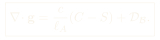
Here C and S are creation and endurance rates in the source convention; the final term contains boundary, modular, and access contributions. Artian's Ruler is the microscopic length. This is the Newtonian-limit source statement in the vacuum-capacity and endurance-current paper. It is not permission to choose the last term separately for each galaxy until a rotation curve fits.
For source accounting, mass is counted in Artian-mass units. With B equal to M divided by the Artian mass, the endurance rule is

The first two statements say what is counted: the continued renewal demand of completed mass bundles per substrate tick. The last is the inherited gravitational coupling, not a fresh adjustable galactic coefficient. The Newton-constant family and A2 field-dynamics family carry the upstream constructions; this essay does not repeat them.
This changes the explanatory object. A gravitational residual need not first be declared a population of new particles. It can be a question about which finite source processes the conventional mass reconstruction has omitted. QTT's Renewal Dust paper separates ordinary gas, vacuum closure, and renewal-source contributions, and forbids using shock-heated gas rest mass as an arbitrary creation multiplier. Those distinctions are substantive source constraints.
They are not substitutes for a lensing map. In particular, subtracting a measured baryon fraction from an inferred total matter fraction and calling the remainder "Renewal Dust" cannot independently predict that remainder. Its numerical amplitude and spatial behavior must follow from the source construction and the specified observation map. The companion papers and book are dependencies and provenance for the proposal, not independent observations confirming it.
The book also relates a galactic acceleration scale to its source-clock cosmology:
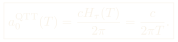
This is the declared coasting source-clock relation on book page 1210, where H-tau equals one over the source time T. A measured laboratory Hubble rate is a different clock readout and cannot be substituted without the book's time-access map. The numerical proximity of an acceleration scale to cH is not exclusive to QTT. The source-clock construction and its linked predictions are what must carry the physical claim, including a test of redshift evolution. No new numerical pass is asserted here.
QTT therefore accepts the demand this essay makes of dark matter: derive the source response, freeze its coefficients and observation map, and let the resulting motion and lensing face the data together. Its ontology gives a different reason for the equations. Whether that reason describes nature is settled by the distinctive tests, not by the language used to introduce it.
The Universe That Humans Invented · Essay 12The same-model contract
A useful next comparison would publish five commitments before opening the validation data. This is a proposed test design, not a report of an experiment completed in this essay.
| Commitment | What must stay fixed | What tests it |
|---|---|---|
| Gravitational response | The halo or alternative source law inferred from declared construction data | Held-out motions and lensing with the same object |
| Mutual dynamics | The inner density, orbital distribution, and allowed history | Bar pattern speed and angular-momentum exchange |
| Baryonic regularity | Formation prescriptions or the alternative acceleration law | Normalization, scatter, and structured departures on new galaxies |
| Energy accounting | Independently constrained stellar history and transfer mechanism | Whether the required halo transformation is dynamically affordable |
| Physical identity | A named candidate and its permitted interactions, or a defined non-particle source | Detection limits, repeatable new signals, and cross-scale consequences |
Distances, inclinations, stellar masses, instrument effects, and model uncertainties must be propagated on both sides. Count target-fitted coefficients, selected histories, nuisance normalizations, and branch choices. A measured input is not an illicit knob; an adjustment made using the very datum being judged is not an independent prediction.
Failure must be allowed to stick. If one frozen dark-matter model fails, do not claim that every dark component has been disproved. If a QTT source map fails, do not rescue it by making its boundary term a private fitting function. Revise openly and test the revision on data it has not already consumed.
The Universe That Humans Invented · Essay 12What the title means
The logical inconsistency is protecting the force law while announcing that the discrepancy uniquely proves a substance. It is invoking a halo's pull while neglecting its dynamical response, calling a flexible reconstruction an independent prediction, or allowing a mechanism to spend energy it does not possess.
These are concrete failures of reasoning when they occur. They are not allegations that researchers have never studied the problems; the cited work shows that many have studied them carefully. The issue is whether the complete physical account passes its obligations simultaneously.
Dark matter may turn out to be a real constituent. Gravity may require a deeper source description. Both possibilities remain answerable to observations. What should end is the exemption that lets one part of the inference decide, in advance, which other part of the universe is allowed to be wrong.
The Universe That Humans Invented · Essay 12Maps and source papers
- Two Universes explains the source-ontology distinction used here.
- Lexicon: endurance current and Renewal Dust define the QTT terms.
- Vacuum-capacity source map, Newton's constant, A2 field dynamics, and Renewal Dust are the relevant QTT concept families.
- Derivation Atlas, Observatory, and Blog Map separate derivations, empirical tests, and explanatory essays.
Book anchors
Quantum Traction Theory: Main Book v10.01: p. 199, endurance count and acceleration; p. 219, A2 source law; p. 535, acceleration-scale and renewal-dust statements; p. 1210, source-clock acceleration relation. These links locate the cited edition; the concept DOI identifies the book family.