FIELD NOTES / FIELDS AND FOUNDATIONS / 24 OCTOBER 2026 / ALI ATTAR
Right Equations, Wrong Picture? The Story of the “Field”
A successful equation can describe what we observe without settling what produces it. Turn the picture over.
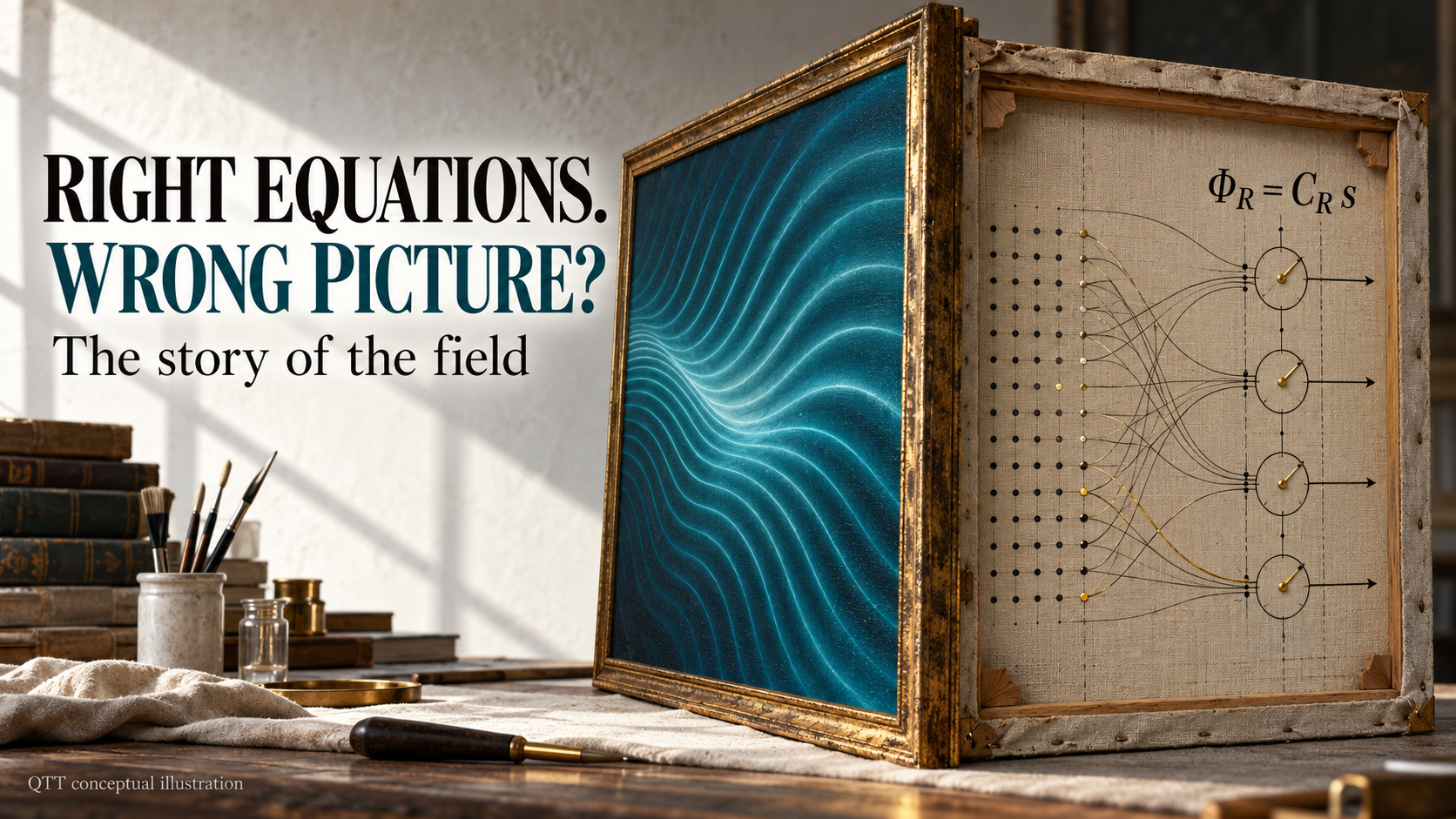
I had an interesting exchange with Michael R., specifically about "fields", and I promised to write about it. Here we go.
You can correctly predict what a detector will record and still misunderstand what produces the result.
That possibility matters enormously in physics. An equation can tell us what happens next without settling what exists underneath it. When we confuse those two achievements, a successful description can quietly become a picture of reality that we stop questioning.
This is where QTT draws a heretical picture and gets the known result.
Start by Flipping the Picture. That's Where the Real Story Is.
In art, experts sometimes turn a painting over. The back can reveal its history, the artist and details hidden from the person looking only at the front.
Quantum Traction Theory takes physical source addresses as a starting point, along with internal phase, finite capacity and rules for how they change. Phase means how an internal cycle is lined up, like the hands of a clock. A receiver interacts with the source, and completed outcomes become records.
The construction runs in this direction:
The field we use to describe the experiment can then be constructed from that source. It does not have to be installed at the beginning as a separate, fundamental ingredient.
To see why that distinction makes sense, start with something familiar.
Sound Is Real. Is Sound a Substance?
When someone speaks, a pressure disturbance travels through the air. We can describe its speed, frequency and interference with wave equations. Underneath that description, air molecules move and interact. The smooth pressure wave describes their collective behaviour; it is not an extra material poured between them. The Feynman Lectures.
Knowing the wave equation would not, by itself, tell you the molecular structure of air.
That example does not mean light is sound, or that light needs air. It shows something more general: a measurable wave can be produced by a deeper mechanism. Being real and being fundamental are different claims.
What Exactly Is a Field?
At a basic level, a field assigns a quantity to each position and time. A temperature field tells you how hot each place is. An electric field tells you about the force a test charge would experience.
The next question is much deeper: is that field a basic ingredient of nature, or does it describe something underneath?
Successful predictions do not automatically answer that question. Physics already contains both fundamental-field proposals and effective fields describing collective behaviour. QTT develops a particular alternative source construction.
The QTT Change
In the QTT field paper, the relationship is written simply:
Read it as: "The field image available to receiver R is obtained from the source state s through that receiver's access map."
The source is the physical configuration. The access map specifies which part reaches the receiver. The resulting field image is a description of that available part. It is an amplitude description, not yet the final count of detector clicks.
This is a mathematical construction with declared conditions on source evolution and receiver contacts. The receiver map must be constructed or independently qualified, rather than adjusted until the desired answer appears.
For a specified two-path arrangement, the construction produces bright and dark output ports from transported internal phases. It also constructs wave behaviour and, in the stated long-wavelength limit, a smooth wave equation. Within those reconstructed sectors, a primitive smooth wave is no longer a required starting object.
QTT Construction, Written Out
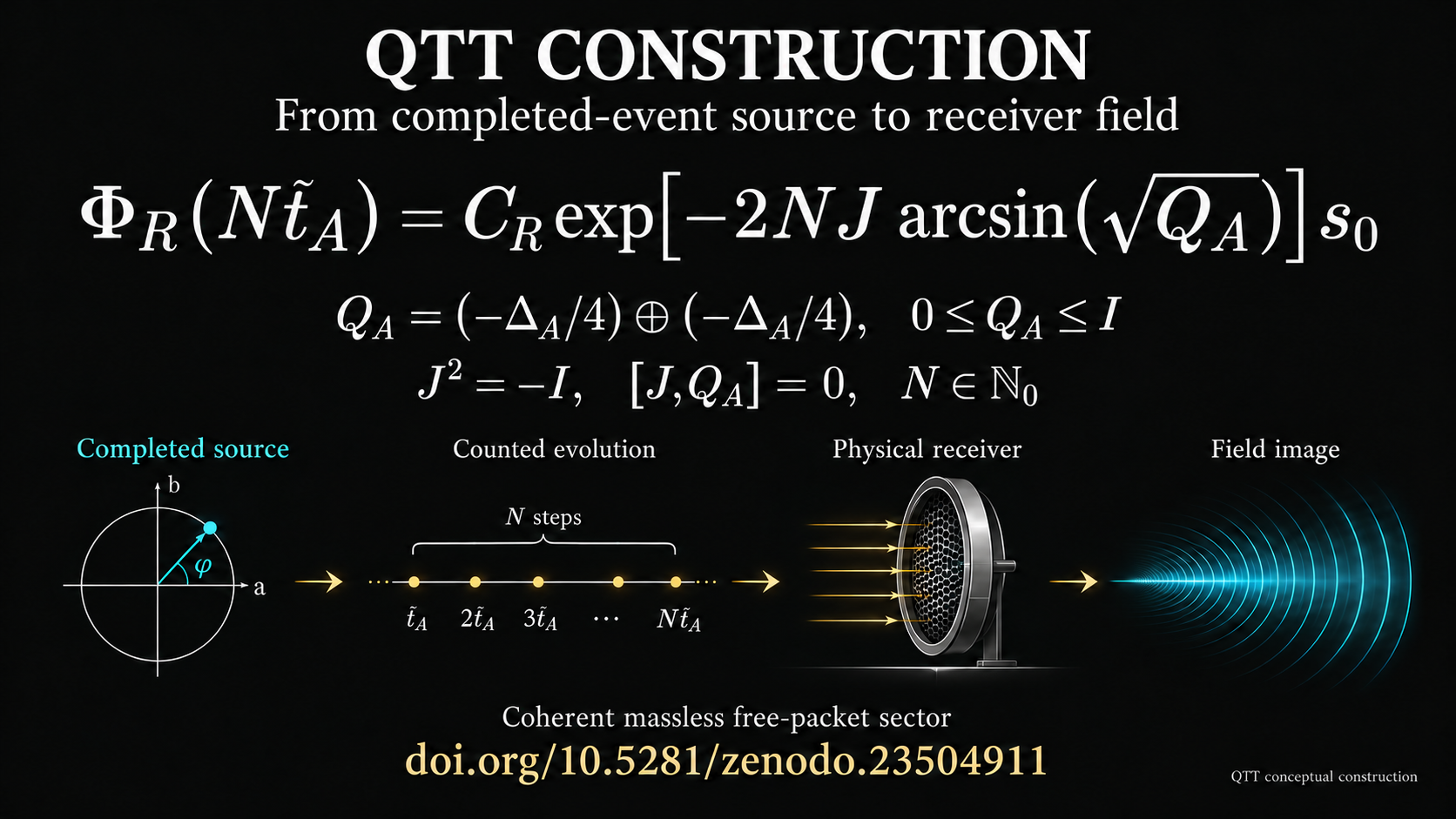
The short equation above tells us the relationship. This expanded expression supplies the source evolution inside it. Start with the completed-event source, advance its internal phases through N source ticks, then calculate the part available to the receiver. The paper proves that this exponential is exactly the inherited finite propagator, including both ends of its admitted spectral range. Its real phase dial has two real components, a and b; the receiver map is still independently specified, not adjusted to fit the resulting image.
Version 1.2 makes the receiver question concrete. For a specified local two-tick phase-history receiver, a qualified preparation change cannot affect its complete output probabilities before enough source contacts have elapsed. The paper derives that readout map and gives an exact one-rail example. It also calculates the cost of imperfect localization and proves why strict compact preparation is obstructed on the infinite multidimensional scalar lattice. The result applies to its declared source and receiver class, not every possible detector or interacting field.
Version 1.3 supplies an explicit three-dimensional preparation and receiver contact. On its fixed 7-by-7-by-7 source, two preparations start with the same field image. One source tick later, the same specified receiver has click probabilities of 2.47% and 59.69%. The exchange contact, missed outcomes and spatial preparation tails are included in that calculation, with no outcome fitting. These are constructed predictions, not new experimental data. The paper also gives admitted-source error certificates and identifies the precise matching task between its directional source pole and the separately protected radiative sector; it does not claim that the full interacting matching is already complete.
The Information a Picture Can Miss
Version 1.4 carries the fixed source correction into a complete detector calculation under stated physical conditions. It proves why an unknown emission history can imitate a timing shift, and identifies which directional harmonics an orthogonal receiver comparison retains or cancels. A reproducible audit of the published LHAASO burst records finds a maximal advance of about 6.6 femtoseconds at the highest central reconstructed KM2A energy under the stated Planck-sized readout. That is below the archive's timing reach. This sharpens the next experiment without changing the source law or calling an underpowered null a failure.
The paper gives a particularly clear example. Two source configurations give a receiver the same present field image. But a phase difference is hidden in the part that receiver does not retain.
When the two channels are mixed, one configuration sends all the ideal output to one port. The other sends it to the opposite port. Same present image. Opposite future outputs.
This is an exact constructed example, not a newly observed anomaly. Ordinary quantum mechanics, when it retains both channels and their relative phase, predicts those outputs too. The lesson concerns the incomplete image: information you discard can matter later.
The paper proves the precise condition under which that discarded information cannot return and change the future image. That tells us when the field image is enough to predict its own evolution, and when we must retain more of the source.
What Would Settle the Upstream Question?
Where two constructions predict the same records, those records alone cannot select between their underlying pictures. In the ideal two-path example, neither QTT nor the matched ordinary quantum calculation needs to fit the output probabilities.
QTT's achievement here is an explicit source-to-observation construction. Experimental selection requires a further step: fix a detector prediction where the source accounts differ, establish the apparatus conditions independently, and test it without retuning the answer. A qualified contradiction must count against the claim it actually tests.
The possibility is substantial enough without pretending that experiment has already settled it. We may keep a successful downstream equation while changing our account of what produces it.
A field can remain useful, measurable and physically real while losing its place as the first ingredient of the universe.
Further reading: Fields and Waves from Completed Events: A QTT Source-to-Observation Reconstruction.
Continue Reading
The Reality Dimension: A Spine You Cannot Walk Along
Internal phase and the real rotation structure behind the source description.
What If the Physics Textbooks Disappeared?
Reconstructing observations from declared source rules instead of inheriting an interpretation.
The Part We See, the Whole That Exists
Why a receiver's available information and a complete source description have different jobs.
Maps for this note: Blog Map / All Field Notes / Lexicon / Two Universes / Corpus Tree / Derivation Atlas.
Source Papers
- Fields and Waves from Completed Events: A QTT Source-to-Observation Reconstruction, v1.4. The explicit source law, local-history theorem, three-dimensional contact and all earlier results are retained. The new detector-transfer, emission-identifiability and receiver harmonic theorems connect the fixed residual to measurable records. An official LHAASO archive audit calculates the conditional timing envelope and sensitivity gap; it does not claim an observed QTT signal.
- Completed-Event Transport and Quantum Coherence and Wave Dynamics. Mathematical source dependencies, not independent experimental confirmations.